
How to Track and Regulate Your Personal Performance
Building Sustainable Performance Through Biology, Psychology, and Self-Awareness

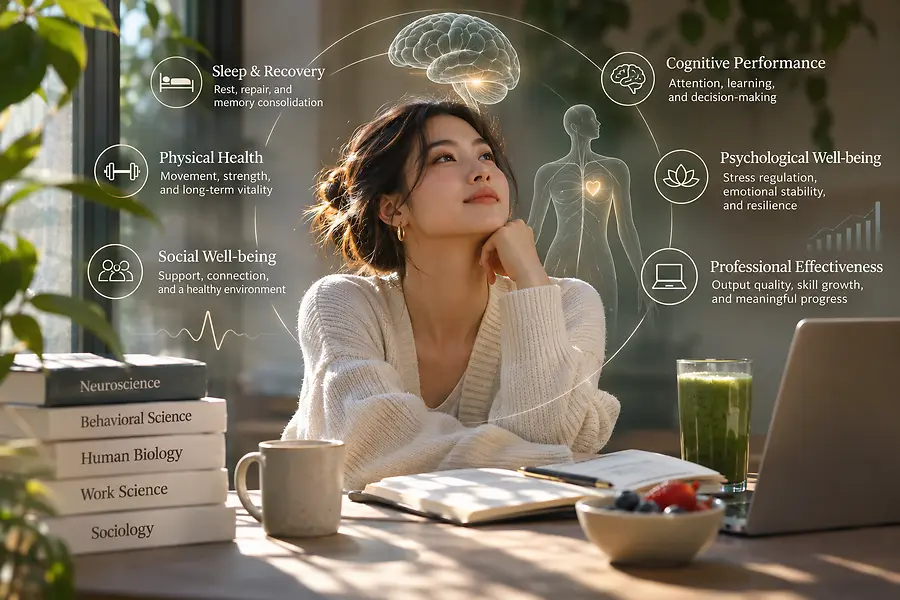
Human performance is not simply a product of motivation or discipline. It emerges from interactions among biological health, cognitive functioning, emotional regulation, working conditions, and social environments.
Understanding these factors allows us to shift from maximizing short-term productivity toward developing sustainable, long-term capabilities.
1. The Science Behind Human Performance
Four disciplines offer valuable perspectives on how human performance functions.
Biology: Physical Capacity and Recovery
Sleep, nutrition, exercise, and physiological recovery directly influence our ability to function.
The Centers for Disease Control and Prevention (CDC) recommends that adults aged 18–60 obtain at least seven hours of sleep per night.
The World Health Organization recommends 150–300 minutes of moderate aerobic activity weekly, alongside muscle-strengthening activities at least twice a week.
These behaviors support physical health and provide an important foundation for cognitive performance.
Neuroscience: Attention and Cognitive Efficiency
The prefrontal cortex supports executive functions such as planning, attention, working memory, and decision-making.
Research indicates that excessive stress can impair prefrontal cortical functioning, making complex reasoning and emotional regulation more difficult.
This suggests that working longer does not necessarily mean working better. Cognitive performance depends on the quality of attention and opportunities for recovery, not merely the hours invested.
Occupational Psychology: Sustainable Productivity
The Job Demands-Resources model explains how high demands, insufficient resources, and limited recovery opportunities can contribute to exhaustion.
Sustainable performance requires balancing responsibilities with adequate resources, autonomy, feedback, and recovery.
Sociology: Environmental Influences
Performance does not occur in isolation. Workplace culture, economic circumstances, social expectations, and access to support influence individual outcomes.
Improving performance may therefore require changing our environment, not simply increasing personal discipline.
2. What Should We Actually Track?
A useful personal performance system should measure both achievements and the resources required to produce them.
I suggest monitoring five dimensions:
Dimension
Trackable indicators
Suggested tools
Physical health
Sleep duration, exercise frequency, resting heart rate, energy
Apple Health, Oura, Fitbit
Cognitive performance
Focused work hours, task completion time, errors, learning progress
Toggl Track, RescueTime
Psychological well-being
Stress, mood, mental fatigue, emotional recovery
Daylio, journal
Professional effectiveness
Work quality, deadlines, skill development, feedback
Notion, Excel
Social well-being
Social support, relationship satisfaction, personal boundaries
Weekly self-assessment
Not every variable needs to be measured continuously. A small set of meaningful indicators is often more useful than an overwhelming amount of data.
Wearable measurements, including heart rate variability and sleep-stage estimates, should be interpreted cautiously. They provide potentially useful trends but are not definitive assessments of health or recovery.
3. How to Build a Personal Performance Monitoring System
The most effective system is one that is simple enough to maintain.
Step 1: Establish a Baseline
For the first two weeks, observe your normal routines without attempting major changes.
Record a few indicators each day:
- Sleep: Total hours and perceived restfulness.
- Physical activity: Exercise type and duration.
- Cognitive performance: Focused work time and meaningful tasks completed.
- Psychological state: Stress and energy, rated from 1–5.
- Recovery: Whether you feel sufficiently refreshed to function the following day.
This initial period provides a reference point for evaluating future changes.
Step 2: Evaluate Performance Weekly
Spend 15 minutes reviewing your data.
Ask yourself:
- Effectiveness: Am I producing meaningful, high-quality results?
- Efficiency: Am I completing comparable tasks in less time or with fewer errors?
- Sustainability: Can I maintain this performance without sacrificing physical or psychological health?
- Growth: Am I developing skills and capabilities that increase my future potential?
A productive week accompanied by severe exhaustion may indicate high short-term output but poor sustainability.
Conversely, improved concentration, better recovery, and steady skill development may represent meaningful progress even when total working hours decrease.
Step 3: Adjust One Variable at a Time
Use your observations to identify opportunities for improvement.
For example:
Problem: Concentration consistently declines in the afternoon.
Possible explanations: Insufficient sleep, prolonged cognitive effort, environmental distractions, or inadequate breaks.
Intervention: Schedule demanding intellectual tasks earlier, introduce structured breaks, and protect sleep consistency.
Evaluation: Compare concentration, completed work quality, and fatigue over the following two to four weeks.
Changing one major factor at a time makes it easier to understand which adjustments may be beneficial, although everyday observations cannot establish causation with certainty.
4. How Do We Know We Are Improving?
Human performance naturally fluctuates. A single unproductive day does not demonstrate declining capability, just as one exceptionally productive day does not establish lasting improvement.
Instead, evaluate trends over several weeks or months.
Meaningful improvement may include:
- Completing increasingly complex work with greater accuracy.
- Learning new skills and retaining information more effectively.
- Maintaining stable energy and concentration throughout demanding periods.
- Recovering more effectively from physical and psychological stress.
- Achieving meaningful results without continuously increasing working hours.
True improvement occurs when our capabilities expand without consistently compromising our ability to recover and function well.
An increase in productivity accompanied by deteriorating sleep, chronic stress, or persistent exhaustion should prompt closer examination rather than automatic celebration.
5. The Long-Term Goal: Preserving Human Capacity
Ultimately, personal performance management should not become another source of pressure.
The goal is not to optimize every hour, eliminate every weakness, or transform ourselves into perfectly efficient individuals.
It is to develop enough self-awareness to recognize when to challenge ourselves, when to change strategies, and when to prioritize recovery.
Our bodies and minds are the foundations of everything we hope to accomplish. Protecting them is not separate from ambition; it is essential to sustaining it.
The most meaningful measure of performance is not how much we can accomplish today, but how effectively we preserve, renew, and expand our capacity to achieve throughout our lives.

Debbie Shen is a risk analytics professional pursuing a Master of Engineering at Duke University with a BS in Actuarial Science and three years of risk management experience. She previously worked as a Credit Risk Analyst analyzing 200,000+ loan applications and building automated reporting systems. Her expertise spans financial mathematics, credit risk, AI systems, and quantitative analytics. As a student leader…





