
Human Judgment in the Age of Automated Decisions: Where AI Safety Begins
How Leaders Can Keep AI Accountable and Protect Against Automation Bias

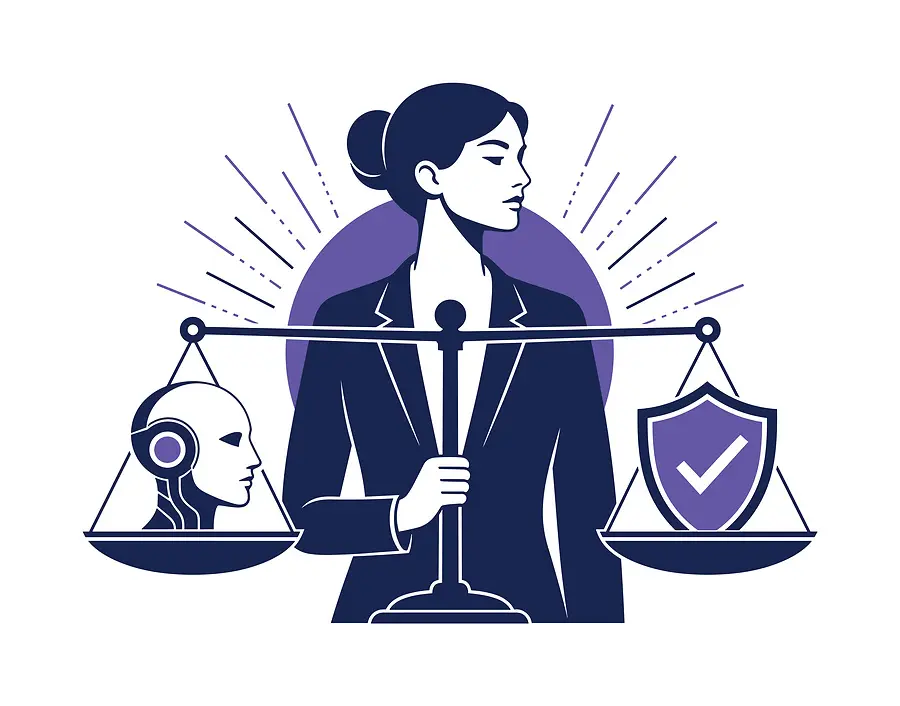
AI has moved from administrative novelty to the center of how many organizations make decisions. Its speed and scale are easy to admire, and they make it easy to forget that algorithms don't understand context or consequences.
Automated systems now make or shape decisions that affect people's potential, their well-being, and their access to opportunity. As leaders, we need to recognize that AI safety depends less on how sophisticated the code is than on the strength of human judgment and on whether leaders are willing to exercise real oversight.
The High Stakes of Automated Decisions
When AI tools run without meaningful human oversight, small failures compound fast and often go unnoticed. AI models learn from historical patterns, so they inherit our past flaws along with our past achievements. Left unchecked, they can lock in structural inequities or break down when the world shifts in ways their training data didn't anticipate.
In practice, this tends to happen in a few ways. A model can anchor on irrelevant details instead of the important signals, and if people defer to its output without examining the case themselves, those errors can slip through. Systems trained on legacy data often penalize anyone whose path doesn't fit the historical pattern, filtering out diverse, high-value people before a human ever reviews them. Models can also lean on proxy variables that reflect historic disparities, discriminating against historically underrepresented groups while the bias hides behind an appearance of mathematical objectivity.
Without active human intervention, these systems end up repeating past mistakes at scale.
Overcoming Automation Bias
Often, the biggest vulnerability in adopting AI is human passivity.
Behavioral scientists use the term automation bias for our tendency to favor machine-generated suggestions over our own observations or professional instincts. Once a team starts treating automated outputs as objective truth, critical thinking gives way to compliance.
To counter automation bias in your organization, consider three operational shifts:
- Treat AI as a second opinion. Position AI recommendations as a draft or a starting point. Build a culture where questioning an algorithm's output is seen as rigorous governance rather than inefficiency.
- Ask for reasoned agreement on high-stakes decisions. When someone accepts an AI recommendation on a critical decision, ask them to note briefly why the output holds up against outside evidence. A light-touch policy is enough.
- Track "default pass" rates. Monitor how often your teams accept automated recommendations without changes. An approval rate near 100% rarely means the algorithm is perfect. More often, it means automation bias has taken root.
Three Practical Strategies for Auditing AI Outputs
Before deploying automated tools for high-stakes decisions, leaders need a structured way to check whether the outputs are accurate, fair, and safe.
- Equity audits. Test the model on edge cases and measure error rates for each demographic group separately, so no group is held to a lower standard than another.
- Contextual sanity checks. Regularly review a random sample of rejected or flagged cases and ask whether each decision still makes sense once you know the real-world context the numbers leave out.
- Adversarial stress testing. Feed the model unusual or non-standard scenarios to see where it breaks, and write down what you find. That tells your team where human review matters most.
Leading With Human Wisdom in an AI-Driven World
Keeping people responsible for automated decisions doesn't have to slow technical progress. As organizations deploy more complex tools, the most influential leaders will be the ones who keep questioning those tools and take responsibility for what they decide, whether or not they were first to automate.
Once decisions are automated, critical thinking becomes a safety protocol, and it may be the most important one we have.

Kriti Faujdar is a technology expert with 12+ years of AI and machine learning expertise across space, security, and consumer applications. She developed autonomy systems at ISRO, earned her master's in computer science from UMass Amherst, advanced AI/ML platforms at Microsoft, and currently builds agentic systems at Yelp. Active in ACM and Force Technology Council, she mentors AI startups and conducts AI safety…





