I Froze Under the Table: Why I Am Finally Speaking About September 11, 2024
A Black woman's journey from silence to voice: processing workplace trauma, family love, and the courage to speak her truth.

There are experiences a woman can recount chronologically, and then there are experiences her body remembers before she ever develops the language to explain them.
September 11, 2024, is one of those dates for me.
I am writing this from a place of greater clarity. I am okay. I am continuing my life, career, education, businesses, creativity, and faith. Being okay today, however, does not require me to pretend that something did not hurt me yesterday.
For a long time, I bottled this experience inside myself.
Now I need to express it.
September 11, 2024
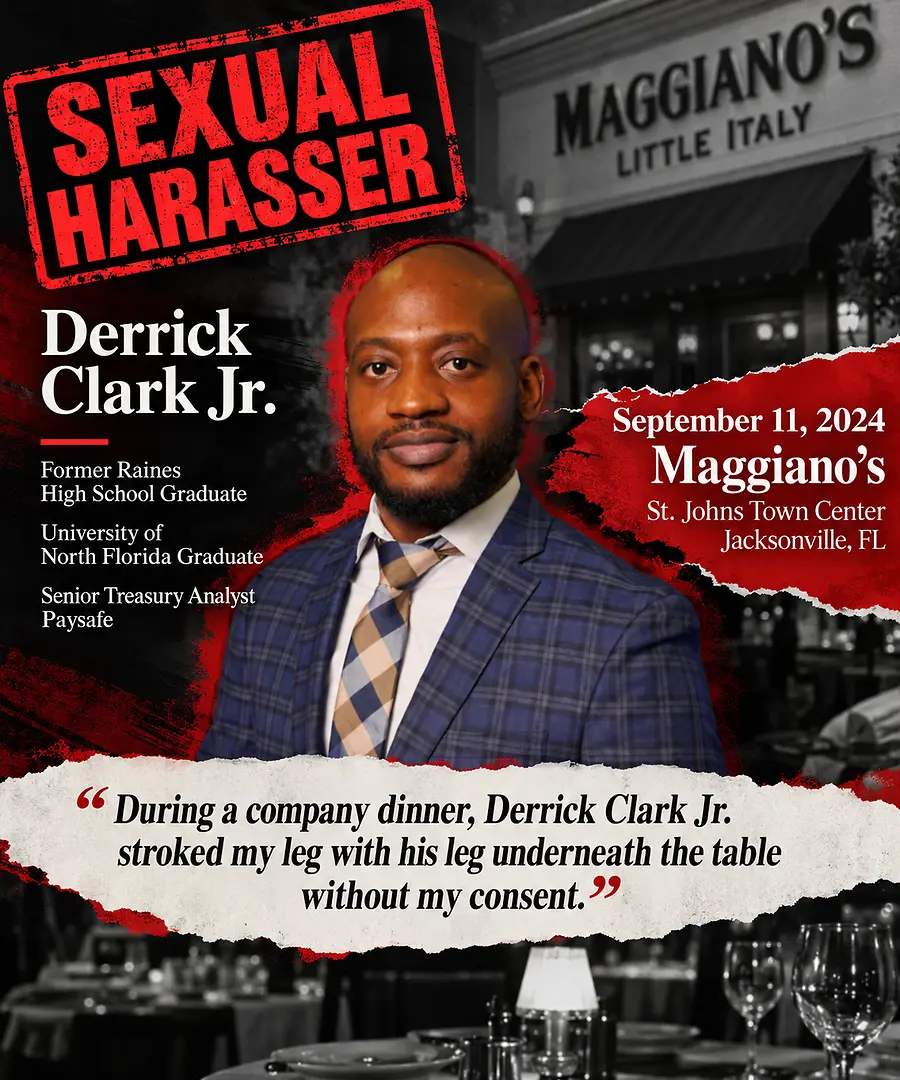
On September 11, 2024, I attended a company dinner at Maggiano's in St. Johns Town Center in Jacksonville, Florida.
During that dinner, I allege that my then-colleague, Derrick Clark Jr., stroked my leg with his leg underneath the table without my consent.
I remember freezing.
I remember the anger arriving almost simultaneously with the shock.
"I remember freezing up and wanting to stab him in front of all the white women. But I knew I would have been in jail."
That sentence is uncomfortable because the emotion was uncomfortable.
It describes an intrusive reaction of anger that flashed through my mind—not an action I took, attempted, planned, or advocated. I did not physically retaliate. Instead, I sat with the collision of shock, humiliation, anger, and an immediate awareness that if I reacted violently, my reaction could become the story instead of what I say had just happened to me.
So I froze.
That matters because people sometimes imagine that someone experiencing unwanted physical contact will immediately scream, push the person away, confront everyone in the room, or report it.
That was not my response.
I froze.
And afterward, I carried it.
"I Suffocated Speaking Out"
My silence did not exist in a vacuum.
At the time, I already felt scrutinized within my professional environment. I perceived my manager, Ellen Torres, as treating Derrick more favorably than me. That perception intensified my fear that speaking about what I say happened would expose me to additional professional scrutiny rather than protection.
"I suffocated speaking out."
That is perhaps the simplest way I can explain it.
I was a Black woman trying to navigate Corporate America while questioning whether the environment around me would see my humanity before seeing stereotypes attached to my race, gender, ambition, or personality.
I experienced Derrick as professionally competitive. From my perspective, he was less interested in helping me than competing with me, particularly around advancement toward a Senior Treasury Analyst position.
I cannot independently establish what another person thought or intended. I can only explain what the professional relationship and subsequent encounter felt like from where I stood.
At the time, I expressed my pain this way:
"He wanted Senior Treasury Analyst that bad to tear me down, sexually harass me and cause me a lot of hurt, emotional damage and distress and hurt my view of Black men because of his actions."
That quotation captures what I believed and felt while processing the experience. It should not be confused with an independently established conclusion about Derrick's motives.
What I can say with certainty is that the experience hurt me.
Education Did Not Make the Experience Easier to Understand
I knew Derrick as an educated Black professional. He attended the University of North Florida and Raines High School.
That context made what I experienced more difficult for me to reconcile.
I expected professionalism.
I expected boundaries.
I expected that another Black professional navigating Corporate America would understand how difficult these environments can already become without making another Black colleague feel unsafe or uncomfortable.
Instead, I was left trying to understand an encounter that shocked me.
Derrick's alleged conduct hurt me to my core.
Being a Black Woman in the Room
Race became inseparable from how I processed everything that followed.
At my angriest, I summarized my feelings bluntly:
"They favor our Black men over us."
That sentence describes how I experienced my environment. It is not a declaration about every white woman, Hispanic woman, or workplace.
There are women across racial and ethnic backgrounds who support Black women. There are Black men who respect, protect, mentor, and advocate for Black women every day.
But in that particular professional environment, I felt differently.
I felt as though a Black male colleague received a degree of professional acceptance and grace that I did not believe was being extended to me as a Black woman.
That perception left me wrestling with a larger question:
Who protects the Black woman when she believes speaking will make everyone examine her behavior before examining what happened to her?
I do not have a universal answer.
But I know silence was not healing me.
My Work Was Mine
I was proud of my treasury work.
I created Power BI dashboards for treasury.
"I created Power BI dashboards for treasury. I was the one."
That sentence represents pride.
I wanted to build things. I wanted to improve processes. I wanted to analyze information and demonstrate what I could contribute professionally.
Following the deterioration of my employment relationship, I experienced disputes and interactions involving company information and documents that I perceived as intimidating. I believed that a Power BI presentation sent to my personal email was being treated far more seriously than circumstances warranted.
I also recall interactions involving Canadian personnel, document scanning, and signatures that I personally experienced as pressure during an already difficult period.
Those statements describe my recollections and interpretations. They are not presented as findings that the company committed criminal misconduct or definitively acted for a particular retaliatory purpose.
What I know is what those circumstances did to me emotionally:
They made me afraid that speaking could cost me more than remaining silent.
Watching the Professional World Continue
One difficult part of processing workplace trauma is discovering that the professional world does not necessarily stop because you are hurting.
I understand Derrick to have remained employed with Paysafe and subsequently advanced to a Senior Treasury Analyst position.
Watching someone's career continue while privately carrying my experience forced me to understand something:
Professional advancement cannot resolve a personal allegation.
A title cannot tell me what happened underneath a restaurant table.
A promotion cannot determine what I experienced inside my own body.
And someone else's career trajectory does not require me to erase my memory.
Why I Finally Began Speaking in 2025: My Father
Something changed in me during 2025.
My father experienced cancer.
And I was scared.
My dad has always been there for me. When I began contemplating his mortality, I started thinking differently about men, protection, love, and the standard by which I understood manhood.
"My dad has always been there for me. Never abused me. Never touched me. Ever."
Those words are deeply important to me.
My father protected me.
He provided for me.
He gave me an example of masculine love in which a daughter could feel safe around the first man she ever knew.
"Knowing he was going through cancer scared me so bad, to be honest, because he's the only man that has ever protected and provided for me as a father and showed me what a real man is."
Cancer suddenly made the strength I had always associated with my father feel vulnerable.
And that frightened me.
But it also forced me to look backward.
I began thinking about what I had accepted in silence from other men.
I thought about Derrick and the unwanted physical contact I allege occurred underneath that restaurant table.
I thought about the anger.
The freezing.
The humiliation.
The questions.
And then I thought about another man who had occupied a very different place in my life.
Rique: What I Was Actually Looking For
During this period, I reached out to Rique Bentley, a man with whom I had previously shared intimacy.
This portion of my story is not written to blame Rique for what Derrick allegedly did.
It is not written to make Rique responsible for healing me.
And it is important for me to state something plainly:
"He never touched me without my consent."
My experience with Rique was fundamentally different.
What I was looking for from him was emotional.
At the time, he presented an energy that felt warm enough for me to believe I could be vulnerable.
"Rique Bentley presented a warm energy at first that made me lean on being honest with him because I felt that he was real with how he presents himself as a man."
After something had happened that left me questioning my safety and my perception of men, I wanted to turn toward someone familiar.
I wanted comfort.
I wanted prayer.
I wanted presence.
I wanted someone to tell me, even momentarily, that I did not have to process everything alone.
"I believed that he would care to simply stop and pray, come see me to comfort me."
Looking back, I recognize something important:
What I hoped Rique would provide and what he was actually obligated to provide were not necessarily the same thing.
He was not responsible for repairing an injury another person caused.
He was not responsible for becoming my therapist.
And he was not responsible for carrying trauma that belonged to my experience.
What hurt was realizing that I had emotionally assigned him a place in my life that he may never have understood himself to occupy.
That realization was painful.
But it was also instructive.
Sometimes Disappointment Is Not Blame
There is a difference between saying someone hurt your feelings and saying that person is responsible for your trauma.
I understand that difference more clearly now.
Rique did not create what happened at that company dinner.
He was not underneath that table.
He did not cause my workplace fears.
And I do not hold him responsible for another man's alleged actions.
My disappointment came from what I hoped our connection represented.
I had believed that vulnerability would be met with tenderness.
When the response did not resemble what I hoped for, I felt rejected at an extraordinarily vulnerable moment.
And because I was already processing complicated emotions surrounding race and Black masculinity, that disappointment became tangled with larger questions about whether I would receive the same tenderness that I perceived Black men sometimes extending toward women who did not look like me.
That was my emotional interpretation.
It does not establish Rique's motives.
It does not tell me what was inside his heart.
And with distance, I can acknowledge that another person's emotional limitations or choices do not automatically constitute an attack against me.
Sometimes two people simply understand a relationship differently.
That realization can hurt without requiring either person to become a villain.
What My Father's Love Made Me Understand
This is where my father's example became incredibly important.
When I compared my experiences with other men against the relationship I had experienced with my father, I realized why certain interactions affected me so profoundly.
I once expressed that realization this way:
"Derrick Clark nor Rique portray this type of man."
But even that sentence deserves context because I was comparing two entirely different relationships against the safest masculine relationship I had known.
My father was my father.
Neither Derrick nor Rique could reasonably be expected to occupy that position.
What my father gave me was something more valuable:
a reference point.
My father's example taught me that masculinity does not require making a woman smaller.
Protection does not require possession.
Strength does not require intimidation.
And being a man does not entitle someone to a woman's body, vulnerability, affection, or silence.
"Black Women Are Not Respected Unless Their Dad Respects Them"
At one of my lowest emotional points, I expressed another painful thought:
"No matter what, Black women are not respected unless their dad respects them."
Today, I understand that sentence differently.
It describes something I felt, not a universal rule governing Black womanhood.
There are Black women raised without fathers who are deeply loved, respected, protected, and extraordinary. A woman's dignity does not originate from male validation.
But my father's presence gave me something important.
Because I knew what respectful masculine love looked like inside my home, I eventually became unwilling to redefine disrespect as affection outside of it.
Because I knew what protection felt like, I could recognize when I did not feel protected.
Because I knew what it meant for a man to care about my well-being without sexualizing, diminishing, or competing with me, I had a reference point for evaluating my relationships with men.
What I was really discovering was this:
"My father's respect taught me that I was supposed to expect respect from men even when he was not standing beside me."
Cancer frightened me because suddenly I had to contemplate a world in which the man who modeled that standard for me might not always physically be there.
That realization hurt.
But it strengthened my voice.
To the Woman Who Froze
This is for the woman who responded exactly as I did.
- You froze.
- You finished dinner.
- You went home.
- You went back to work.
- Maybe you convinced yourself that what happened "wasn't serious enough."
- Maybe you feared HR.
- Maybe you feared losing your career.
- Maybe you were already considered difficult.
- Maybe you were the only Black woman in the room.
- Maybe you feared that your anger would become more important to everyone than the boundary you believe someone crossed.
Your voice does not have to arrive on the same day as your pain.
- Speaking later is still speaking.
- Writing is still acknowledging.
- Telling someone trustworthy is still breaking silence.
- Seeking therapeutic, advocacy, or legal support does not make you weak.
- And freezing does not mean you consented.
Black Women Are Allowed to Speak
I am speaking because I became tired of believing strength meant swallowing everything.
It does not.
At one point, my anger sounded like this:
"I'm speaking out because I am tired of Black women being targeted, hurt, and abused mentally because of Black men hating their own mother and race."
Time has allowed me to examine those words more carefully.
I cannot know that racial self-hatred motivated another person's behavior. And the actions of individual men cannot define Black men collectively.
There are extraordinary Black men.
There are extraordinary Black women.
And loving Black culture should never require a Black woman to remain silent about something she says a Black man did to her.
We should be capable of doing both:
loving our community and holding individuals accountable within it.
I Am Okay
I want readers to understand this clearly.
I am okay.
Writing this does not mean I am still sitting underneath that table in September 2024.
It means I finally have enough distance from that woman to speak for her.
- She froze.
- She became angry.
- She questioned herself.
- She questioned Corporate America.
- She questioned race.
- She questioned men.
- She questioned whether anybody would believe her.
- And then she kept living.
- My career continued.
- My creativity continued.
- My education continued.
- My businesses continued.
- My faith continued.
- My relationship with my family continued.
- My voice continued.
Perhaps that is the most important thing I can give another woman through this story:
What somebody does to you does not receive ownership over everything you become afterward.
- You are permitted to speak.
- You are permitted to heal.
- You are permitted to be angry without allowing anger to become your identity.
- You are permitted to love Black men while holding an individual Black man accountable for conduct you experienced.
- You are permitted to be disappointed by someone without turning that person into an enemy.
- And you are permitted to recognize the men who showed you genuine love.
For me, one of those men has always been my father.
His cancer frightened me enough to remind me that life is too fragile to spend it suffocating beneath things I desperately needed to say.
My father gave me protection as a child.
As a woman, I am learning how to give myself a voice.
I bottled mine long enough.
Now I have spoken.
Editorial & Legal Notice
This article is a first-person personal narrative reflecting the author's recollections, allegations, perceptions, emotions, and interpretations of events. Allegations concerning identifiable individuals or organizations are presented as the author's account and are not represented as judicial findings, criminal convictions, admissions, or independently established determinations of liability.
Statements concerning perceived favoritism, workplace competition, retaliation, discrimination, interpersonal motives, or emotional conduct describe the author's personal interpretation unless an independent determination is specifically identified. Individuals and organizations referenced may dispute the author's account or characterization of events.
The discussion concerning Rique Bentley is expressly presented as the author's reflection on her own expectations, vulnerability, and emotional disappointment. The author does not allege that Bentley sexually assaulted her or touched her without consent and does not attribute responsibility to him for the alleged conduct of another individual.
The article is intended to document personal experience and encourage thoughtful discussion surrounding consent, workplace boundaries, Black womanhood, fatherhood, emotional support, corporate culture, and women's ability to speak about unwanted conduct.