I Was Doing Fine Until I Opened LinkedIn
Why comparing your career to others' LinkedIn highlights is a game you can't win.

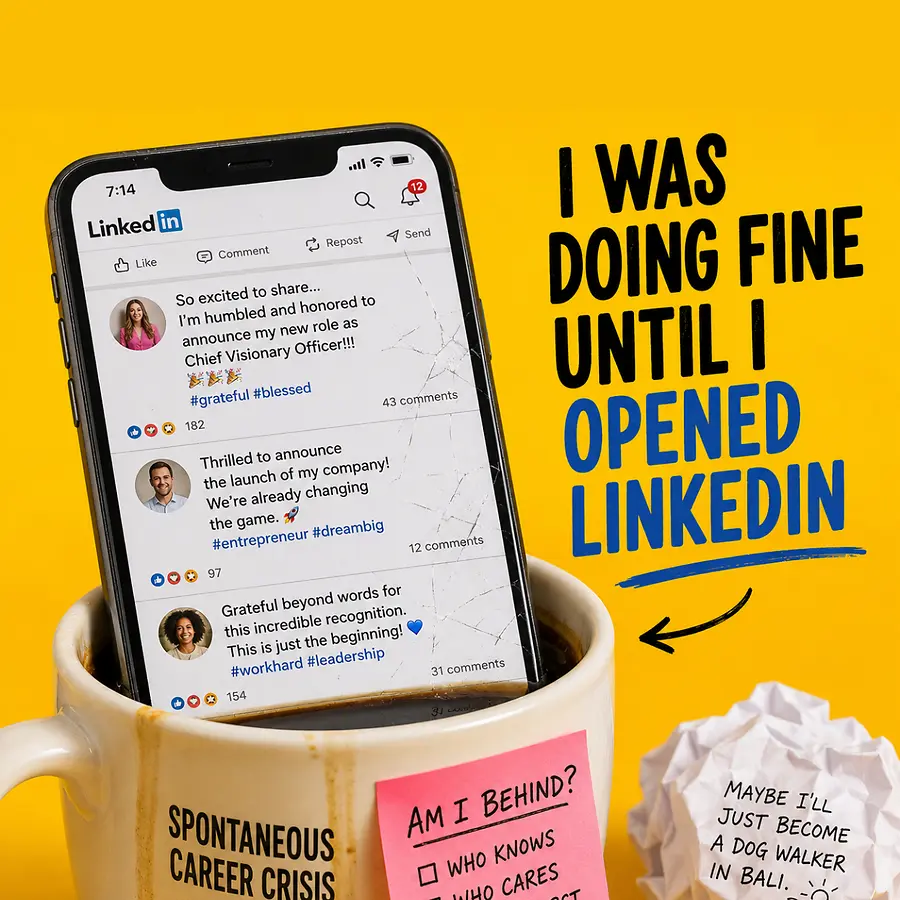
LinkedIn Is Not a Career Report Card
Nothing will make you question your entire career faster than LinkedIn at 7:14 on a Tuesday morning.
You were fine. Actually, you were having a pretty good morning. Coffee was hot. Your inbox wasn't completely on fire. You had a productive day planned.
Then you opened LinkedIn.
Someone you vaguely remember from somewhere just became a Chief Something Officer at 34.
Fantastic.
Another person launched a company.
Good for them.
Someone else is "humbled and honored" to announce something they are very clearly neither humbled nor quiet about.
And suddenly you're staring at your coffee thinking:
Am I behind?
Behind whom? Doing what? According to what governing body?
No idea.
But for approximately seven minutes, you're convinced you've made several catastrophic life choices.
Nothing about your career changed between 7:13 and 7:14.
You just opened LinkedIn.
Apparently, There Was a Schedule
At some point, we collectively decided life was supposed to go something like this:
- Get the degree.
- Get the job.
- Get the better job.
- Become a manager.
- Become a director.
- Become a VP.
- Become an executive.
- Post about how "humbled" you are.
- Start giving unsolicited leadership advice on LinkedIn.
Congratulations. You have arrived.
Except actual careers don't work like that.
People get laid off. Companies get sold. Bosses leave. Industries change. You take a job that looks perfect and discover three weeks later that you've made a terrible mistake.
You take another job you weren't sure about, and it changes your entire career.
Sometimes you get promoted. Sometimes you get reorganized. Sometimes you spend six months wondering whether "organizational restructuring" is corporate language for we have absolutely no idea what we're doing.
There is no schedule.
We just really like pretending there is one.
Comparison Has Terrible Data
This is especially ridiculous because we compare ourselves using almost no actual information.
We see:
NEW JOB ANNOUNCEMENT! 🎉
We don't see:
Applied to 73 jobs, got ghosted by 51, cried in a Target parking lot once, and seriously considered opening a bakery despite having no idea how to bake bread.
We see:
- The promotion, not the ten years before it.
- The successful company, not the first idea that bombed.
- The award, not the rejection.
- The professional headshot, not the person eating shredded cheese over the sink at 9:30 p.m., wondering what they're doing with their life.
We're comparing our entire existence to somebody else's press release.
That seems like a flawed methodology.
And yet we do it constantly.
Someone else's good news becomes evidence that we're somehow doing badly.
Which is ridiculous when you think about it.
Their career changed.
Yours didn't.
And Then There Are the Ages
This one gets us every time.
She made VP at 32.
He started his company at 28.
She became CEO at 39.
Wonderful.
Colonel Sanders didn't franchise Kentucky Fried Chicken until his 60s, and I'm pretty sure nobody was standing outside the restaurant saying, "Great chicken, Harland, but frankly, this feels a little late."
We have somehow convinced ourselves that achievement becomes less impressive if it doesn't happen early enough.
Why?
There is no bonus prize for becoming successful before your frontal lobe finishes developing.
And there is definitely no committee somewhere reviewing your file and saying:
"Promising candidate. Unfortunately, she didn't have everything figured out by 35."
Success doesn't have an expiration date.
And it definitely doesn't have an age requirement.
Maybe Changing Your Mind Is Actually the Point
The person you were at 25 shouldn't necessarily be making all the decisions for the person you are at 40.
Twenty-five-year-old you didn't know anything.
Twenty-five-year-old me thought I knew everything.
Which is significantly worse.
We're supposed to change.
We're supposed to learn things, meet people, screw things up, discover we're good at things we never planned to do, and occasionally realize the thing we spent years chasing isn't actually what we want anymore.
Changing direction doesn't mean you failed.
Sometimes it just means you received additional information.
That's called making an informed decision.
Very professional. Put it on the résumé.
Nobody Is Keeping Score
This might be my favorite realization of getting older:
There is no final report card.
Nobody is going to call you at 50 and say:
"Hi, we're reviewing your records and noticed you became a director three years later than Jennifer. Unfortunately, we're going to have to deduct points."
Jennifer is not your problem.
Jennifer is probably comparing herself to Melissa.
Melissa is comparing herself to somebody she follows on Instagram.
And that woman is currently sitting in her car, avoiding going into the grocery store because she needs five minutes when nobody asks her for anything.
We're all doing it.
The person whose career you think is perfect is probably wondering why someone else's career looks better.
Which means we've somehow created an enormous professional comparison loop where nobody wins and everyone is mildly annoyed.
Excellent system.
The Time Is Still Going to Pass Anyway
In my last article, I wrote about something I've come to believe more and more:
The time is going to pass anyway.
Apply for the job.
Take the class.
Start the business.
Change careers.
Do the thing you've been talking yourself out of doing because you think you should have done it five years ago.
But I've realized there's another part of that idea.
Time will pass whether you spend it building the life you want or worrying that somebody else built theirs faster.
Their promotion didn't take yours away.
Their success isn't evidence of your failure.
Someone younger accomplishing something impressive doesn't mean you missed your window.
It means they accomplished something impressive.
That's it.
No existential crisis required.
So the next time you open LinkedIn and discover that a 31-year-old has been named Global Executive Supreme Vice President of Something Important, congratulate them.
Maybe even like the post.
Then close the app.
Drink your coffee.
Get back to whatever you were doing before LinkedIn convinced you there was suddenly a problem.
Because five minutes ago, you were doing just fine.


