IMMAD Impairment Measurement Marijuana and Driving
Examining the intersection of cannabis legalization, impaired driving risks, and innovative detection technology for public safety.

The Politics of Cannabis
The politics of cannabis have been dynamic and variable throughout this and the previous century. Cannabis was outright banned by the federal government in 1937. Before that cannabis was used as a recreational product for fun as well as the plant being valuable as a fiber. The culture for cannabis as a legal alternative to alcohol to obtain a buzz, or other buzz inducing products were reflected in popular culture of the 1930s and in music such as Cab Callaway's 1931 popular song "The Reefer Man". The lyrics were written by Andy Razaf and J. Russell Robinson. The song was reflective even then of a known cognitive and sensory dysfunction related to cannabis. With contemporary legal adult use cannabis, then as now, the impact and impairment from cannabis was obvious.
Cab Callaway sang "Man, what's the matter with that cat there? Must be full of reefer...Get away from here. Man, is that the reefer man?...That's the reefer man, I believe he's losing his mind, I think he's lost his mind..." the song concludes, "Have you ever met that funny reefer man? (Reefer man!) Have you ever met that funny reefer man? (Reefer man!) If he takes a sudden mania, wants to give you Pennsylvania. Then you know you're talking to the reefer man."
Cannabis Impaired Driving
Tragically the increased legalization of cannabis has resulted in an increased use of cannabis accompanied by the expansion of the negative impact on cognition and neuroprocessing. The products now available for recreational use are much more powerful and impairing than those of Callaway's era. The growing rate of a driver "losing his mind" has resulted in a doubling of death on the roads from cannabis impaired driving.
A tragic example is sixteen year old Bjorn Hartzell. While under the influence of cannabis he was traveling 112 mph in a 40 mph zone and crashed into a minivan. Two adults and three children, occupants of the van, died. One occupant of the van survived a child. Hartzell survived and is now twenty. He was recently convicted of five counts of second-degree murder and one count of endangerment in connection with the crash. Not all families receive this nature of justice with marijuana impairment driving crashes. Often families receive no justice due to no evidence of actual impairment.
IMMAD - Impairment Measurement Marijuana and Driving
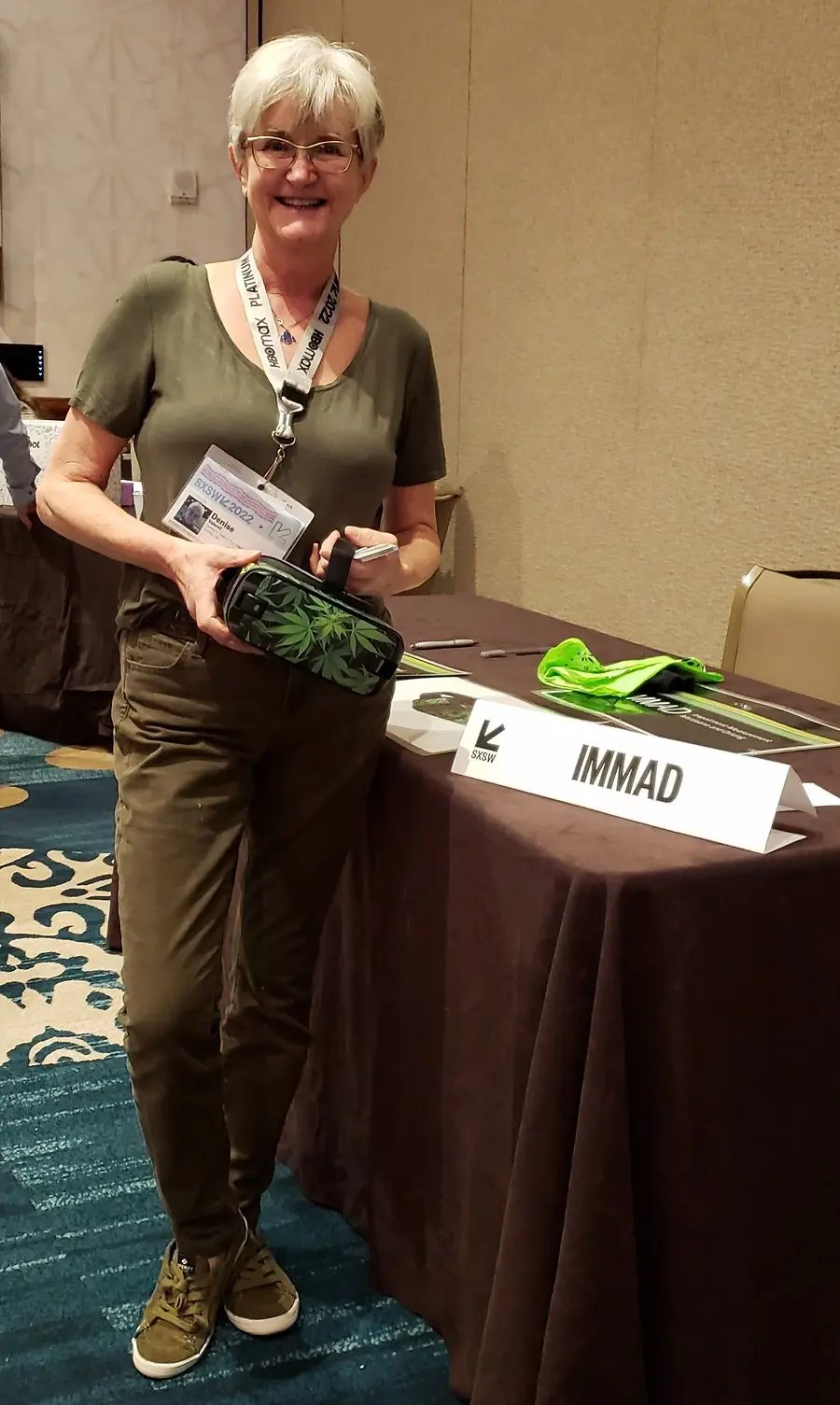
There are benefits and harm from cannabis. IMMAD-Impairment Measurement Marijuana and Driving is a company that specializes in education and technology for the responsible use of marijuana. IMMAD focuses on technology for roadside use by law enforcement to determine functional impairment to drive with marijuana use. The technology also has applications in the workplace.
IMMAD forensics technology is a simple virtual reality goggle test with Bluetooth response that takes four minutes to administer and provides objective evidence of impairment to drive with marijuana consumption. Unlike other products under development to detect cannabis impairment, IMMAD is free of racial bias. IMMAD science is complex, but the test itself is simple.
IMMAD forensics technology has ten-degree square targets with alternating stripes that flash anywhere within the central forty degrees of visual field. Some targets are high contrast and others are lower contrast. With the use of marijuana, a person cannot see the lower contrast sets of stripes in the squares. IMMAD has identified significant dysfunction in the superior/upper visual field, the area of vision needed to detect traffic signals, pedestrians in a crosswalk and other objects. If a driver cannot see accurately, they cannot drive safely.
The IMMAD technology studies were funded by funded by National Institute of Justice: Marijuana Intoxication: Roadside Tool for Law Enforcement to Measure Impaired Peripheral Vision,15PNIJ-22-GG-04417-RESS and National Institutes of Health: Digital Marker of Marijuana Intoxication: Measure of Dysfunctional Retinal Ganglion Cell Response SBIR Phase I contract NIDA -SBIR N43DA-18-1221.
IMMAD's Research
IMMAD's research is important. Alcohol functional impairment is linearly related to biologic measures in the matrices of blood, breath or salvia [1, 2]. This is not the case for cannabis. The most common means to measure presence of cannabis remains blood. If a driver refuses it can take up to four hours to obtain a subpoena for the blood draw. Only a handful of states are using oral/saliva samples to determine what drug is present. Blood and saliva (to date breath has not been shown to measure edible use) can measure what drugs, but these biologics cannot determine impairment.
The retinal biomarker used in IMMAD has already been shown to objectively document acute impairment in visual processing and the retinal biomarker of stripes in IMMAD identifies impairment of functions critical for safe performance [1] particularly driving [2]. Multiple studies found that the risk of being involved in a crash significantly increases after marijuana consumption [3]. A study of 811 marijuana users in the US identified that 6.9% actually use marijuana while driving, another 5.7% drive within thirty minutes of having used marijuana and an additional 13.4% drive within one hour of having used marijuana [4]. A recent data study reported that 41% of drivers involved in a fatal crash had used cannabis [5].
The functional impairments documented by IMMAD, loss of detection of targets in peripheral vision, are already considered related to the ability to safely drive. Thirty-four states in the US already have laws related to driving and the peripheral vision dysfunctions that IMMAD measures [6]. Canada however does require intact vision in the superior visual field of at least 15 degrees in all provinces [7].
The Reefer Man
Cab Callaway in song describes aspects of cannabis that are funny, entertaining and harmless,
"Have you ever met this funny reefer man? (Reefer man!) If he trades you dimes for nickles and calls watermelons pickles. Then you know you're talkin' to that reefer man (Reefer man!)"
and the majority of cannabis users are not going to undertake activities that will harm themselves or others. And we all have encountered cannabis users who need to be monitored so as to not harm themselves as described;
"Have you ever met that funny reefer man (Reefer man!) If he said he walks the ocean, any time he takes the notion. Then you know you're talkin' to reefer man (Reefer man!)"
But there is no amount of cannabis use that results in "that Reefer Man" which is safe for driving. Sadly many cannabis users still take the position that they are safe behind the wheel. The results are deaths and harm to families. IMMAD is committed to preventing such drivers from getting behind the wheel.
References
- Valenti DA and Halsor C, Acute Cannabis Use: Retinal Function. Invest Ophthal Vis Sci 2018. 59 (5292).
- Wood, J.M., Vision Impairment and On-Road Driving. Annu Rev Vis Sci, 2022. 8: p. 195-216.
- Elvik, R., Risk of road accident associated with the use of drugs: a systematic review and meta-analysis of evidence from epidemiological studies. Accid Anal Prev, 2013. 60: p. 254-67.
- Zebra. Study: Marijuana Use and Driving. 2017 [cited 2022 8 29 2022]; Insurance Research].
- Ekeh A, et al., Cannabis Prevalence in Drivers Involved in Motor Vehicle Crash Fatalities over a 6-Year Period, in ACS Clinical Congress 2025. 2025, American College of Surgeons.
- Blindness, P. State Vision Screening and Standards for License to Drive. 2020 [cited 2022 8 9 2022].
- Canada. Medical Review Standards. http://www.mto.gov.on.ca/english/dandv/driver/medical-review/standards.shtml [cited 2022 8 29 2022].


