In the Age of AI, Leadership Is Becoming a Judgment Game
Why AI-Powered Leaders Still Need Sound Judgment More Than Ever

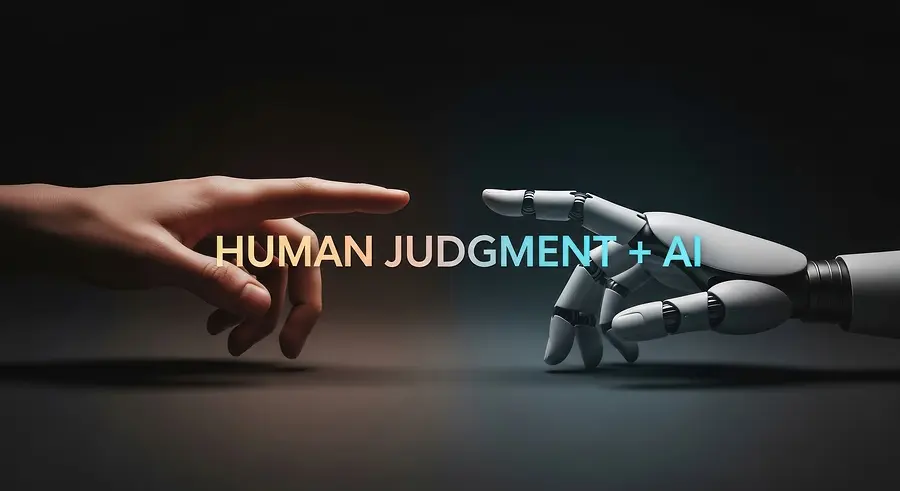
Leaders have more information than ever before.
More data. More tools. More perspectives. And now, more AI-generated answers delivered in seconds—with confidence.
And yet, decision-making feels harder, not easier.
Because the challenge is no longer access to information. It’s knowing what to trust. And more than that, it’s knowing when to trust yourself.
AI didn’t make leadership easier. It made poor judgment more expensive.
From Clarity to Judgment
Over the past few years, much of the leadership conversation has centered on clarity—and for good reason. Leaders operating in volatile, fast-moving environments needed ways to cut through noise and focus on what actually mattered: clarity frameworks, strategic filters, communication models. All valuable.
But clarity alone isn’t enough.
Because even when you can see the situation clearly, the decision still carries risk. And that is where many leaders hesitate—not because they don’t understand the situation, but because they don’t fully trust the decision itself, or themselves in making it.
Clarity helps you see. Judgment determines what you do next.
Those are not the same skill. And conflating them is one of the more expensive mistakes a leader can make.
The False Promise of More Input
For years, the operating assumption was straightforward: more information leads to better decisions. So organizations invested accordingly—in data, dashboards, reporting infrastructure, and now AI—tools designed to accelerate insight, reduce uncertainty, and improve outcomes.
In many ways, they’ve delivered on that promise.
Leaders can now generate options faster than ever. They can model scenarios in seconds. They can access diverse perspectives that once took days or weeks to gather. The analytical horsepower available to a mid-level manager today would have been unthinkable a decade ago.
But more input hasn’t simplified decision-making. In many cases, it has made it more complex.
Because information doesn’t just create clarity—it also creates noise. Conflicting recommendations and polished outputs can sound authoritative but often reflect averages, not the specifics of your situation.
Leaders today aren’t struggling because they lack answers. They are surrounded by them. What they lack is the ability to discern between them.
AI is very good at generating options. It is not responsible for what happens next.
That accountability still sits with the leader—entirely.
Why Judgment Feels Harder Right Now
Most leaders aren’t struggling because they lack capability. They’re struggling because the environment itself makes good judgment harder to access.
They’re being asked to:
- Move quickly
- Get it right
- Navigate constant change
- Support their teams through uncertainty
- Adjust strategy in real time
All while absorbing more inputs than at any previous point in their careers.
That combination leaves very little room for reflection—and reflection is where judgment actually develops.
So instead, many leaders compensate in ways that feel productive but rarely are.
They gather more input.
They revisit decisions they’ve already made.
They delay action—not because they’re unclear about the situation, but because they’re trying to eliminate a risk that cannot be eliminated.
More information doesn’t make uncertainty disappear. It makes uncertainty harder to interpret.
And over time, that accumulation starts to feel heavy—not because leaders can’t decide, but because every decision feels like it carries more weight than it should.
AI Is Not Replacing Leadership. It’s Exposing It.
There’s a growing narrative that AI will simplify leadership by making better answers more accessible. In practice, it is doing something more revealing than that.
It is exposing where judgment is strong—and where it isn’t.
AI can draft, summarize, recommend, and accelerate analysis. It can compress weeks of research into an afternoon. These are real capabilities with real value.
But it cannot fully understand organizational context. It cannot read the emotional dynamics of a team under pressure. It cannot weigh competing human consequences or navigate the unspoken dynamics that determine whether a decision lands well or poorly. And it does not carry accountability for the outcome.
So when leaders rely too heavily on speed, surface-level confidence, or well-packaged AI outputs, weak judgment becomes visible faster than ever—and at scale.
A poor instinct acted on quickly, dressed up in a polished recommendation, still leads to a poor outcome. It just gets there faster.
Because when answers are easy to generate, the real differentiator is not who has access to them. It is who can work with them well.
Which answers you trust.
Which ones you challenge.
Which ones you set aside entirely—and why.
That is judgment.
What Strong Judgment Looks Like Now
Judgment has always mattered in leadership. But in this environment, it becomes the defining capability—not because leaders need to know more, but because the work requires knowing what to do with what they already know.
Strong judgment doesn’t look like speed. It looks like discernment. And it shows up in moments that are small but consequential:
- Pausing before acting on the fastest answer
- Testing whether something is actually true, not just persuasive
- Recognizing the difference between gathering more data and avoiding a decision
- Holding productive tension long enough to make a better call
- Moving forward with clarity even when certainty isn’t available
- Thinking through second-order consequences before committing
None of this is about slowing everything down. The best leaders are still decisive. But they are intentional about when speed helps and when it hurts—because those are not the same situation.
The Leadership Advantage That Remains
The next era of leadership will not be defined by who has access to the most information. That advantage has largely been commoditized. It will be defined by who can think most clearly and act most wisely with the information they have.
Because information is no longer the scarce resource.
Discernment is.
Judgment is.
And in an environment where decisions are made faster, seen more broadly, and felt more quickly across organizations and markets, the cost of poor judgment keeps rising—not just for the individual leader, but for the team, the culture, and the business they are responsible for.
The leaders who will navigate this moment well are not the ones who move the fastest or generate the most options. They are the ones who can see what matters, think beyond the obvious, and make sound decisions under real pressure—without the false comfort of certainty and without the paralysis that comes from waiting for it.
In the age of AI, judgment may be the leadership skill that matters most.
Because it is the one thing the technology cannot replicate.