Integrating Mathematics into Early Childhood Classroom Activities & Learning Environments
Creating Meaningful Mathematical Experiences Through Exploration, Environment, and Responsive Teaching in Early Childhood Classrooms

Integrating Mathematics into Early Childhood Education: Building Foundations for Lifelong Learning
The integration of mathematics into early childhood education represents a foundational component of children's cognitive and academic development. Mathematical learning in the early years extends beyond the acquisition of numerical knowledge to encompass broader competencies, including critical thinking, logical reasoning, problem-solving, spatial awareness, pattern recognition, and decision-making.
When mathematics is embedded within meaningful, developmentally appropriate classroom experiences, children have opportunities to construct mathematical knowledge through active exploration rather than relying exclusively on formal or worksheet-based instruction. Activities involving counting, sorting, measuring, classifying, comparing quantities, recognizing patterns and geometric forms, constructing with blocks, and participating in games allow children to encounter mathematical concepts within authentic contexts.
The National Association for the Education of Young Children (NAEYC) and the National Council of Teachers of Mathematics (NCTM, 2002) emphasize that effective early mathematics education should build upon children's existing knowledge, experiences, cultural contexts, and individual interests while progressively extending their mathematical understanding.
The Classroom as a Mathematical Learning Environment
From a constructivist perspective, young children develop mathematical knowledge through interactions with materials, peers, educators, and their surrounding environment. Consequently, the physical and pedagogical design of the classroom functions as an important component of mathematical instruction.
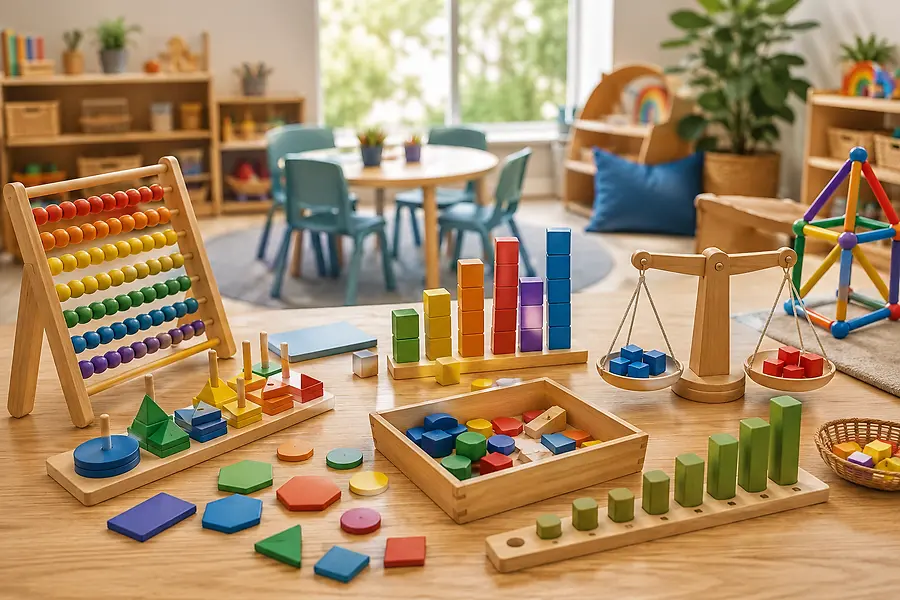
An intentionally designed learning environment should provide frequent opportunities for children to independently and collaboratively investigate mathematical relationships using accessible and developmentally appropriate materials. Manipulatives, counting objects, puzzles, building blocks, measuring instruments, geometric materials, natural objects, and visual representations of numbers can encourage children to explore concepts related to quantity, classification, measurement, geometry, spatial reasoning, and mathematical relationships.
According to the National Research Council (2009), early mathematical competence establishes a crucial foundation for subsequent academic success. The council highlights the importance of providing well-structured, engaging experiences that cultivate a deep understanding of mathematics among young learners.
Rather than serving as a physical backdrop for instruction, the classroom environment should function as a dynamic educational tool that promotes problem-solving, exploration, and curiosity.
Interdisciplinary Experiences
Mathematical learning can be further strengthened through interdisciplinary experiences that demonstrate the interconnected nature of knowledge. One classroom activity that I particularly value involves using a microscope to examine slides and materials associated with the natural environment.
Although microscopy is traditionally conceptualized as a scientific activity, it also provides meaningful opportunities to integrate mathematical thinking. For example, children can:
- Count observable features.
- Compare the relative sizes of specimens.
- Identify geometric forms and repeating patterns.
- Classify objects according to shared characteristics.
- Organize observations into categories.
Educators may further extend the activity by encouraging children to record quantities, create simple representations of their observations, or compare findings across different specimens.
Through this approach, mathematical concepts become embedded within scientific inquiry, enabling children to recognize that mathematics functions as a practical tool for interpreting, organizing, and understanding the natural world.
The Educator's Role
The educator's role within such an environment is equally significant. Effective mathematics instruction requires teachers to move beyond the transmission of predetermined answers and instead facilitate children's mathematical reasoning through intentional questioning, modeling, observation, and responsive scaffolding.
Open-ended questions, such as asking how children arrived at a particular solution, whether a problem could be approached differently, or what patterns they notice, encourage children to articulate and evaluate their thinking.
Introducing precise mathematical vocabulary within authentic experiences can also strengthen conceptual understanding and mathematical communication.
Clements and Sarama (2014) argue that effective early mathematics education should reflect developmental learning trajectories that recognize how children's mathematical understanding becomes increasingly sophisticated over time. Educators must therefore carefully observe children's emerging competencies and provide appropriate levels of challenge and support that extend learning without undermining children's autonomy or willingness to experiment.
A Culture of Intellectual Risk-Taking
Equally important is the establishment of a classroom culture in which intellectual risk-taking is encouraged and mistakes are viewed as productive components of the learning process.
Children who feel psychologically safe to experiment, revise their thinking, and explore alternative solutions may be more willing to engage with challenging mathematical concepts.
Within such an environment, the educator's responsibility is not simply to evaluate whether an answer is correct but to examine and support the reasoning processes children use to reach conclusions.
This pedagogical orientation shifts mathematics from a performance-oriented activity toward a process of inquiry in which curiosity, persistence, flexibility, and reasoning are valued alongside accuracy.
Intentional Alignment Across Curriculum and Environment
Ultimately, effective integration of mathematics into early childhood education requires intentional alignment among curriculum, classroom environment, interdisciplinary exploration, and responsive educator-child interactions.
Mathematical development is strengthened when children encounter mathematical concepts repeatedly through authentic activities. Children are encouraged to investigate those concepts through hands-on experiences, collaborative dialogue, and independent discovery.
Activities that connect mathematics with children's interests and other curricular domains, including scientific exploration through microscopy, demonstrate how educators can create meaningful learning experiences that transcend traditional disciplinary boundaries.
By designing environments that encourage experimentation, inquiry, problem-solving, and multiple approaches to learning, educators can support not only children's mathematical competence but also their confidence and intellectual curiosity.
Establishing these foundations during early childhood may contribute to children's long-term ability to approach mathematics as an accessible, meaningful, and valuable tool for understanding and engaging with the world.


