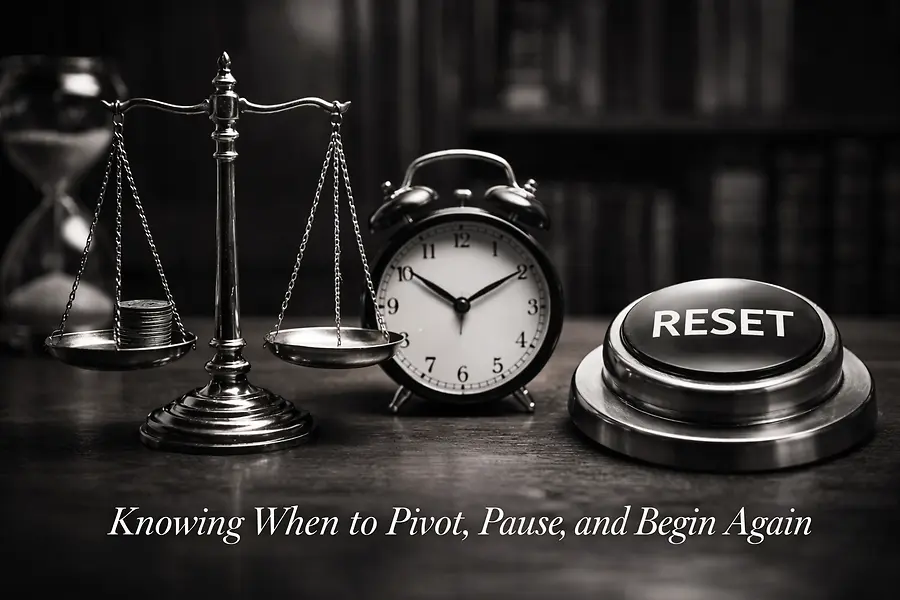
Knowing When to Pivot, Pause, and Begin Again
In a culture that celebrates relentless forward motion, the strongest leaders understand that progress is not always about acceleration — it is about judgment.

Success is visible. It is measured, documented, and rewarded. Expansion earns attention. Momentum becomes identity.
But some of the most defining moments — in companies, careers, creative work, and personal ventures — do not happen during expansion. They happen in interruption.
Not because something collapsed, but because something no longer fit.
In high-performing environments — corporate, entrepreneurial, or creative — forward motion is often treated as the only acceptable outcome. Yet there are seasons when continuing in the same direction quietly costs more than adjusting course.
The difference between endurance and wisdom is knowing when to keep pushing — and when to shift.
When Momentum Stops Being the Right Metric
High achievers are exceptionally skilled at making things work. They build, execute, stabilize, and carry responsibility without visible strain. They launch initiatives, scale ideas, refine products, support teams, and push projects across the finish line.
Adaptability becomes second nature. Endurance becomes proof of competence.
Momentum reinforces this capacity.
But momentum is not the same as accuracy.
Sometimes it confirms tolerance. Sometimes it confirms overextension. Sometimes it confirms that something unsustainable can, in fact, be sustained for longer than it should be.
There comes a point when progress and alignment diverge. Recognizing that gap requires more strength than pushing through it. It requires discernment.
The Pivot: Strategic Course Correction
A pivot is not always planned. Sometimes it is a reaction to the unexpected — a shift you did not anticipate, a loss, a market turn, or a decision that changes the terrain without your consent.
Not every pivot begins with strategy. Some begin with disruption.
What distinguishes experienced leaders is not their ability to avoid the unexpected, but their ability to metabolize it.
Interruption exposes assumptions. It reveals where capacity was stretched and surfaces where direction relied on conditions that no longer exist.
If ego drives the response, the pivot becomes reactive. If judgment drives the response, the pivot becomes clarifying.
Evaluation sharpens positioning. Capacity becomes more accurately defined. Opportunity becomes more precisely chosen.
Markets shift. Audiences evolve. Vision sharpens. Capacity changes.
Course correction is not abandonment. It is refinement.
It requires the clarity to say:
- This approach needs adjustment.
- This model has reached its limit.
- This path no longer reflects where I am headed.
Handled with discipline, what began as disruption becomes an inflection point — one that creates room for stronger alignment and, often, more significant opportunity than uninterrupted momentum would have allowed.
The Pause: The Discipline of Restraint
In fast-moving environments, speed is often mistaken for strength. Yet the most disciplined response to disruption is sometimes restraint.
The pause creates space to assess before acting.
It allows you to evaluate:
- What changed?
- What was overlooked?
- What assumptions need revisiting?
- What no longer belongs to this season?
Without pause, people risk rebuilding the same structure with minor variations. With pause, they return with sharper judgment.
Restraint is not weakness. It is control.
The Return: Building Without Ego
Beginning again after interruption looks different.
It is not fueled by urgency or the need to prove resilience. It is guided by clarity. Boundaries are defined. Pace is deliberate. Expectations are measured against capacity.
This is not comeback energy. It is disciplined rebuilding.
Those who return with intention create systems that reflect sustainability, not ego. They measure strength not by speed, but by stability.
Whether leading a team, launching a venture, or shaping creative work, the principle is the same: build what you can sustain.
A More Accurate Definition of Strength
Strength is not uninterrupted forward motion.
It is the ability to change direction without defensiveness, to hold still without anxiety, and to begin again without ego.
Applause reinforces expansion. Interruption reveals maturity.
In a culture that rewards acceleration, those who endure — executives, founders, creatives, and independent builders alike — understand that knowing when to pivot, when to pause, and when to begin again is not a deviation from success.
It is what sustains it.