LCCs are a Failing Concept in the US
Why Low-Cost Carriers Struggle to Compete in the United States Compared to Europe and Asia

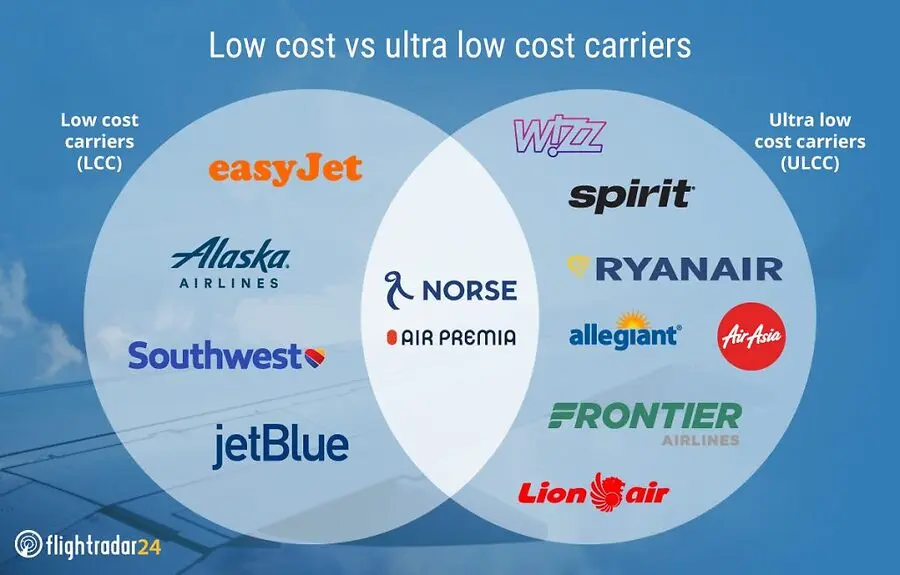
(First, before we begin, a note on the display picture above: Alaska Airlines is most certainly not a low-cost carrier, especially after its acquisition of Hawaiian Airlines. Other than that, LCCs are highlighted quite well. Now then, let’s begin.)
The United States has tried for decades to make the LCC (low-cost carrier) model work and thrive from coast to coast. From Spirit, JetBlue, Breeze Airways, and Frontier Airlines, to Southwest, Sun Country, Allegiant, and Avelo, to name only the most prominent LCCs, most have either struggled significantly or are operating on razor-thin margins. The reasons are fairly clear once you understand how the model operates.
Low-cost airlines (LCCs) and ultra-low-cost carriers (ULCCs) work by operating on a series of thin margins of economic viability, while in turn choosing to pass many services and fees onto the consumer.
In this piece, I will illustrate five points of operational pressure and structural challenge within the LCC model in the United States.
ULCCs work by maintaining minimal operational cost structures, including restrictive fuel strategies per flight, buy-on-board service models, and a “nickel-and-diming” approach to ancillary fees for services that are typically included in legacy carrier fares. They also operate with lean baggage policies and tightly controlled overhead costs.
Primary vs. Secondary Airports
A notable challenge for low-cost carriers in the United States has been the decision to operate heavily out of primary airports instead of secondary ones. This is less of an issue in Europe (and to some extent Asia), where secondary or even tertiary airports—often former or lightly used military airfields—are more common and more cost-efficient. Many of these airports also have at least minimal customs facilities, enabling relatively seamless intra-regional international travel under agreements such as those within the European Union.
By contrast, few secondary airports in the United States have customs facilities. Chicago Midway operates alongside O’Hare as a secondary option. In New York, LaGuardia serves as a secondary airport to JFK. Los Angeles has several alternatives, notably Hollywood Burbank Airport and John Wayne Airport in Santa Ana, both often seen as feeder airports to LAX. In the Bay Area, Oakland San Francisco Bay Airport and San Jose International Airport serve secondary and tertiary roles relative to San Francisco International Airport.
However, many of these secondary airports lack full customs infrastructure, limiting their ability to support international LCC expansion. As a result, international low-cost operations in the U.S. often depend on larger gateway airports or preclearance arrangements.
Labor and Operational Costs
Labor costs are another critical factor. Customs and border protection officers in the United States operate under the Department of Homeland Security (DHS) and are not easily scaled across smaller airports. The staffing and infrastructure required to support international operations are expensive, making them feasible primarily at larger airports.
These costs are partially offset through airport fees, gate leasing, and airline partnerships, but they remain a significant barrier to widespread low-cost international expansion.
Passenger Density
Passenger density is another important consideration. Europe and parts of Asia generally have much higher population densities than comparable regions in the United States. Cities such as London, Paris, Frankfurt, Berlin, Lisbon, Madrid, Tokyo, Beijing, and Hong Kong operate within far denser travel corridors than most U.S. metropolitan regions.
Population density does not directly equal passenger volume, but it strongly influences market size and route efficiency over time.
For example, in 2025, Europe’s largest low-cost carrier, Ryanair, transported over 200 million passengers. The United States has a population of approximately 347 million people, with a significant portion of travel demand concentrated among adults. Passport ownership rates remain comparatively lower than in Europe, which also impacts international travel demand distribution.
Ryanair’s model is transparent: extremely low base fares with extensive ancillary fees. A ticket may cost as little as €15–€20, but services such as baggage, seat selection, and onboard purchases are additional. This structure is clearly disclosed in advance and embedded in the contract of carriage.
The Shift Toward Premium Travel
In the post-COVID era, American travelers have increasingly shown a willingness to pay for premium travel experiences, particularly on domestic and international routes. Many passengers now choose first-class or premium economy cabins on legacy carriers over basic economy fares on ultra-low-cost carriers.
At the same time, passport applications and international travel interest have increased significantly in recent years, with a notable portion of travelers opting for higher-comfort accommodations when flying abroad.
The “Sword of Damocles”: Fuel Prices and Global Instability
Finally, the metaphorical “Sword of Damocles” over the airline industry is fuel price volatility, which disproportionately affects ultra-low-cost carriers due to their thin margins.
Geopolitical instability in key energy-producing regions can significantly impact global oil prices. When oil prices rise sharply, operating costs increase across the aviation sector. Legacy carriers are generally better positioned to absorb these shocks due to diversified revenue streams, while ULCCs face greater financial strain.
These pressures have led some carriers, including Southwest and Frontier, to adjust elements of their business models toward more traditional legacy-carrier structures, including expanded fare bundles and reduced reliance on ultra-optional pricing structures.
I hope this provides clarity on why the LCC model has struggled to achieve consistent success in the United States compared to counterparts in Europe and Asia. See and learn more at Brooke in the Air Travel.