Leading from the Inside Out: How Adult Learning Theory Shaped My Approach to Leadership
How adult learning theory transforms leadership across boardrooms, classrooms, and beyond.

I have spent over two decades in rooms where decisions are made: boardrooms, school offices, franchise war rooms, construction trailers, and now, open fields where I calibrate a drone before a commercial flight. Through every chapter, one question has followed me: How do you lead experienced professionals in a way that truly brings out their best?
It sounds simple. It is not. Most leadership frameworks are built on the assumption that the leader possesses knowledge and distributes it downward. But real organizations are filled with experienced professionals who bring their own expertise, instincts, and deeply held ideas about how work should be done. The question is not whether they can learn. The question is whether you, as a leader, can create the conditions for them to grow.
That question became the foundation of my doctoral research at Mercer University, where I investigated how professionals perceive andragogy (adult learning theory) in relation to professional development. What I discovered in that research did not remain in the academic world—it fundamentally changed the way I lead.
The Lesson That Changed Everything
Malcolm Knowles, the father of adult learning theory, proposed something that seems obvious but is radical in practice: adults learn best when they understand why something matters, when they can draw on their own experience, and when they have ownership over the process. They are not empty vessels waiting to be filled. They are individuals with histories, motivations, and agency.
Early in my career as an educator, I saw this principle play out in classrooms. Students thrived when they felt respected as thinkers, not just recipients of information. But the real revelation came later, when I stepped into executive leadership—first as the head of a nonprofit educational organization, and then as a senior operations executive overseeing a multimillion-dollar, multistate portfolio. I realized the same principle applied at a much larger scale.
Managers across multiple regions were experienced operators with deep knowledge of their markets and teams. What they needed was not someone directing from above. They needed a leader who could build systems that supported their growth, remove operational bottlenecks, and translate organizational strategy into something they could execute with confidence.
Systems Over Commands
My approach to leadership has always been rooted in infrastructure—not the physical kind (though I have managed my share of construction projects and new facility launches), but the organizational kind. When I stepped into my executive operations role, the company was in a startup growth phase. There was no centralized HR system, no standardized performance framework, and no scalable way to onboard or develop talent across locations.
I built those systems from the ground up. Implementing an HRIS platform was not just a technology decision; it was a leadership philosophy in action. It communicated to our teams: we see you, we are tracking what matters, and we are investing in the infrastructure that makes your work sustainable.
The result was not just operational efficiency—it was trust. And trust is the currency of adult learning.
When people trust the system, they engage with it. When they engage, they grow. When they grow, the organization grows. That cycle drove significant revenue growth across our locations and sustained employee retention above 90%.
Data-Driven, People-Centered
One of the tensions I navigate constantly is the balance between data and humanity. I am a data-driven decision-maker. I synthesize operational and financial metrics into clear leadership updates. I build dashboards and reports that give senior leadership visibility into performance, risk, and progress. But I have never believed that numbers tell the whole story.
Behind every KPI is a team. Behind every retention metric is a manager who either invested in their people—or did not. My doctoral research reinforced what I had observed for years: professionals do not just want training. They want development that respects their experience and connects to their real work. Organizations that understand this distinction are the ones that retain their best people.
That is why the leadership development programs I designed were never one-size-fits-all. They were built on the principle that a site manager with five years of experience requires a fundamentally different growth path than a new hire. I developed structured programs focused on cultivating emerging and current leaders through skills training, coaching, and values-based leadership practices. Andragogy taught me that approach. Experience confirmed it.
From the Boardroom to the Flight Line
Today, I am the founder of a commercial drone services company. People sometimes ask how an educator and executive ends up flying drones. The answer is simple: the leadership principles are the same.
Building a company from the ground up requires the same commitment to systems, the same respect for expertise (including my own continued learning), and the same ability to operate with clarity in ambiguous environments. Earning my FAA Part 107 certification was not a departure from my career—it was an extension of the mindset that has always driven me: identify what needs to happen, build the capability to do it, and execute with precision.
As I evaluate advanced technologies and develop service capabilities for commercial clients, I bring the same strategic lens I used to manage a multimillion-dollar portfolio. What does the data tell us? What does the client need? How do we deliver with consistency and excellence?
What I Want Other Leaders to Know
If my career has taught me one thing, it is this: the best leaders are the best learners. Not in the superficial sense of attending conferences and collecting certificates (though continuous education matters), but in the deeper sense of remaining curious—about people, what motivates them, what they already know, and what they need from you that they may never directly ask for.
Andragogy gave me language for something I had always sensed: the most powerful thing a leader can do is not command a room, but create the conditions in which talented people do their best work. Whether you are running a school, a franchise operation, or a technology company, that principle does not change.
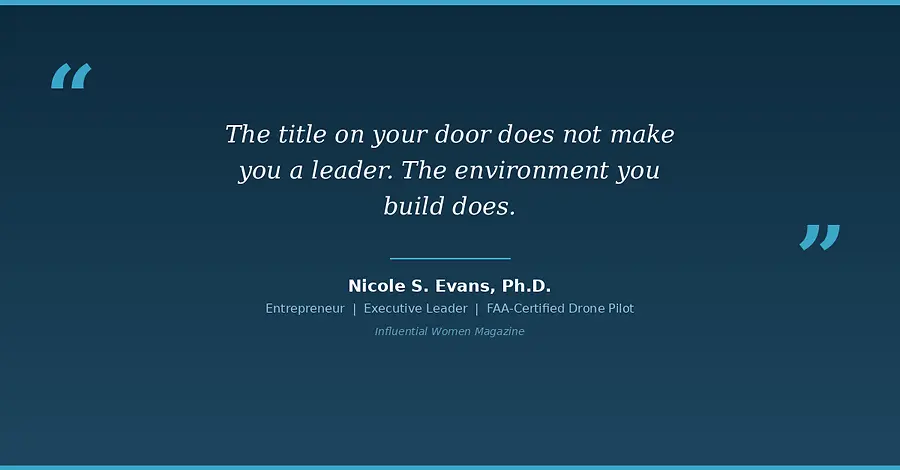
The title on your door does not make you a leader. The environment you build does.
~ ~ ~
Nicole S. Evans, Ph.D., is an entrepreneur, executive leader, and FAA-certified drone pilot. She holds a Doctor of Philosophy in Curriculum & Instruction from Mercer University, where her research focused on adult learning theory and professional development strategy. With over two decades of experience spanning education, nonprofit leadership, and multistate executive operations, she is passionate about building organizations where people—and performance—thrive.


