
Leading with Purpose: Women, AI, and the Future of Product Portfolio Management
Turning Domain Expertise Into Technology Influence Across the AI Value Lifecycle

BETTER, FASTER, CHEAPER, SMARTER
Women Shaping AI Through Product Portfolio Management
A practical perspective on how women can bring domain expertise into the AI value lifecycle, influence investment choices, and help enterprises convert AI ambition into measurable, responsible value.
By Lisa Bennett
Publication Description
AI is changing how enterprises set priorities, allocate capital, build products, and define success. Drawing on my path from Accounting and Information Systems Audit to Product Portfolio Management, I examine a question every leadership team should be asking: Is AI making the enterprise better, faster, cheaper, and smarter? I also explore why women have a timely opportunity to shape the investment decisions behind that transformation.
From Strategy to Business Value
I did not begin my career expecting to work at the intersection of artificial intelligence and Product Portfolio Management. I began in accounting, where the discipline is simple but demanding: understand the numbers, test the assumptions, and explain what they mean.
From there, my career moved through Information Systems Audit, Project Management, Program Delivery, and ultimately Product Portfolio Management. Each role added a different perspective on how enterprises turn strategy into results.
Accounting taught me to understand value. Information Systems Audit taught me to examine technology, risk, governance, and controls. Project Management taught me how to translate strategy into execution—and that delivery depends as much on relationships and shared accountability as it does on plans.
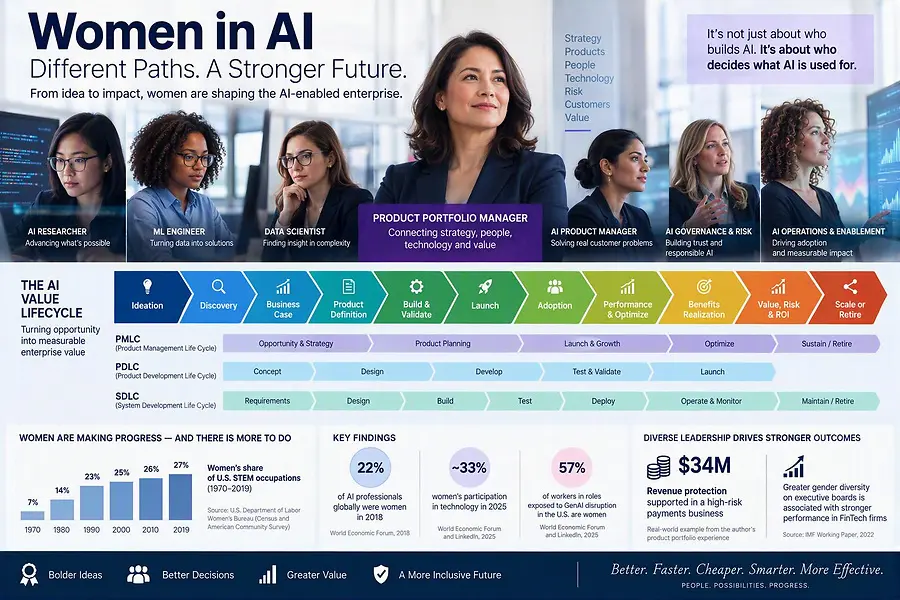
Product Portfolio Management brought those lessons together. It taught me to evaluate not only whether work can be delivered but also whether it deserves investment and creates measurable business value. In my own career, that has included leading strategic initiatives supporting approximately $34M in revenue protection within a high-risk payments business.
Business value is broader than new revenue. It can mean protecting existing revenue, reducing exposure, improving efficiency, strengthening customer relationships, or building capabilities that enable future growth.
That experience sharpened the question I now bring to every portfolio conversation:
Are we investing in the right opportunities, and can we prove those investments are creating value?
That question matters even more as enterprises invest in AI. AI can make organizations better, faster, cheaper, and smarter—but potential is not performance. Deployment is not adoption, and adoption is not value.
How much measurable value is AI creating, for whom, at what cost and risk, and what evidence supports our next investment decision?
Why Women Matter in the AI Economy
The case for women in AI should not rest on stereotypes about how women think or lead. It is a business issue: talent, economic opportunity, workforce transition, and who has a voice in consequential decisions.
In 2018, the World Economic Forum reported that women represented 22% of AI professionals globally. By 2025, the World Economic Forum and LinkedIn reported significant expansion in female AI talent and a narrowing of the AI talent gap in 74 of 75 economies studied. The same 2025 analysis reported that women were more represented in occupations exposed to GenAI disruption and less represented in roles positioned for GenAI augmentation.
Historical U.S. workforce trends make the point that progress is not automatic. Women’s representation in STEM occupations rose from 7% in 1970 to 27% in 2019, while their representation in computer occupations rose to 34% in 1990 and later declined to 26% by 2019.
The opportunity is not simply to increase the number of women who use AI. It is to increase the number of women who help decide what AI is used for.
Women across Finance, Audit, Risk, Operations, Product, Compliance, Customer Experience, Project Management, and Portfolio Management already hold expertise the AI-enabled enterprise needs. The opportunity is to convert that expertise into influence over what gets funded, built, measured, and scaled.
AI Is an Investment, Not Just a Technology
Product Portfolio Management connects strategy, customer need, capital, product, technology, delivery capacity, financial performance, risk, adoption, and benefits. Before funding AI, leaders should be able to answer six questions: What problem are we solving? Why is AI the right intervention? What should improve? What will the capability truly cost? What risk are we prepared to accept? What evidence will prove the benefit?
My experience supporting approximately $34M in revenue protection reinforced a critical distinction: not all value is the same. Protecting existing revenue differs from creating new revenue. Releasing employee capacity differs from reducing cash expenses. Leaders need those distinctions before they can make sound investment decisions.
The goal is not to build the largest AI portfolio. It is to build the most valuable, responsible, and sustainable one.
The AI Value Lifecycle
AI measurement should not begin after launch. It should begin at ideation. I connect Product Management, Product Development, Systems Development, benefits realization, and Portfolio Management through one investment lifecycle:
Ideation → Discovery → Business Case → Product Definition → Build & Validate → Launch → Adoption → Performance → Benefits Realization → Value, Risk & ROI → Scale or Retire
PMLC, PDLC, and SDLC Working Together
PMLC follows the product. PDLC develops the product. SDLC governs technology. Benefits Realization proves the value. Product Portfolio Management decides whether the enterprise should keep investing.
Measuring AI Across the Product Lifecycle
Start With the Problem, Not AI
The wrong question at ideation is, “Where can we use AI?” The stronger question is, “What meaningful problem are we trying to solve, who experiences it, and is AI the most appropriate and economical intervention?”
Sometimes deciding not to use AI is the strongest AI decision. That is not resistance to innovation. That is disciplined leadership.
Better, Faster, Cheaper, Smarter
Once an opportunity advances, I use a straightforward measurement lens that keeps the conversation focused on enterprise outcomes—not technology activity.
Core Measures
Cycle-Time Improvement = (Baseline Time − Current Time) ÷ Baseline Time × 100
Adoption Rate = Active Users ÷ Intended Users × 100
Benefit Realization = Realized Benefit ÷ Planned Benefit × 100
AI ROI = (Validated Financial Benefit − Total AI Investment) ÷ Total AI Investment × 100
- Hours saved do not automatically equal dollars saved. Productivity, capacity creation, cost avoidance, and cash savings should not be reported interchangeably.
From Delivery to Value
My Project Management background shapes how I measure AI. The current PMBOK Guide, Eighth Edition, emphasizes organizational value and strategic alignment. PMI’s Benefits Realization Management framework similarly focuses on identifying expected benefits, managing their realization, and sustaining results. Both reinforce a point leaders cannot afford to miss: successful delivery does not automatically create value.
Successful delivery and successful value realization are not the same thing.
For AI investments, I use the following evidence chain:
Baseline → Investment → Delivery → Adoption → Outcome → Benefit → Risk → ROI → Decision
Traditional project measures tell us whether implementation is on track. Product and benefits measures tell us whether the intended outcome occurred. Product Portfolio Management brings the evidence together and determines whether continued investment is justified.
Benefits Traceability
An AI investment should remain traceable to the original business need throughout its lifecycle. When that connection is lost, technology activity can easily be mistaken for enterprise value.
Idea → Problem → AI Capability → Product Outcome → Enterprise Benefit → Portfolio Evidence
Traceability keeps the measurement honest. Usage is not automatically value. Speed is not automatically value. Hours saved are not automatically savings.
It also creates an essential inclusion check: Did the product create value for the people whose needs justified the investment—and did it unintentionally disadvantage others?
Illustrative Example: AI-Enabled Merchant Onboarding
Consider a hypothetical AI capability supporting merchant onboarding. The figures below are illustrative and show how the framework converts operational results into an investment decision.
In this example, cycle time improves by 35%, rework falls by 41.7%, unit cost declines by 18%, adoption reaches 85%, benefit realization reaches 90%, and illustrative ROI is 50%. The numbers are useful—but the gaps between them are where leadership judgment begins.
Why did several operational measures exceed target while financial benefit realization reached only 90%?
Several explanations are possible: lower-than-expected volume, timing differences, released capacity that did not convert into financial savings, or operating costs that differed from the business case. These are hypotheses to test, not conclusions to declare.
The illustrative portfolio decision is Scale with Monitoring. The combined evidence supports further investment, while the benefit gap remains visible, owned, and subject to analysis.
AI Can Help Measure AI
AI can also strengthen the discipline used to measure AI. An appropriately configured measurement agent could collect authorized information, apply approved calculations, compare results with baselines and targets, and surface exceptions for human review.
Agent Collects → Calculates → Compares → Flags → People Validate → Governance Decides
The agent should not own the investment decision; accountable leaders should. The agent must also prove its own value. If a hypothetical agent reduced monthly portfolio-reporting effort from 120 hours to 50 hours, effort would decline by 58.3%. If it generated $90K in validated annual financial benefit against $72K in total annual cost, illustrative ROI would be 25%. That evidence might support a decision to Continue and Optimize rather than immediately Scale.
For portfolio decisions, agent economics should be evaluated through Total Cost of Ownership—not model tokens or credits alone:
Agent TCO = Build + Integration + Data + Platform + Model/Agent Usage + Security + Governance + Support + Change
The Women + AI Opportunity Is Upstream
The most important opportunity for women in AI is not at the edge of the conversation. It is upstream, where problems are selected, business cases are shaped, measures are defined, and capital decisions are made.
Women should be present when the problem is selected, the business case is constructed, the product outcome is defined, risk is evaluated, success measures are established, benefits are validated, and leadership decides where capital goes next.
The AI Value Lifecycle creates entry points for many professional backgrounds. Finance can challenge the economics. Audit can challenge the evidence. Risk and Compliance can challenge exposure. Operations can challenge practicality. Customer Experience can challenge whether users benefit. Product Management can keep the problem ahead of the technology. Portfolio Management can connect those signals to the investment decision.
Enterprise decision-making improves when the expertise needed to understand an AI investment’s full impact is represented at the moment consequential choices are made.
For women, that is the opportunity: turn existing domain expertise into technology influence.
Continuous Learning Turns Expertise Into Influence
As AI becomes more relevant to Product Portfolio Management, I have deliberately expanded my knowledge through Microsoft AI Product Management, Generative AI for Product Managers, and learning involving Microsoft Copilot, Planner, and AI-enabled ways of working.
I am not learning AI to become an AI engineer. I am learning enough to become a stronger Product Portfolio Manager in an AI-enabled enterprise—to ask better questions, challenge assumptions, and make more informed investment decisions.
Learn enough about AI to participate confidently. Then bring the expertise you already have.
Finance, Audit, Risk, Product, Operations, Compliance, Customer Experience, and Project Management do not become less valuable because of AI. Their expertise becomes part of how AI is governed, evaluated, and converted into enterprise value.
Better. Faster. Cheaper. Smarter. More Effective.
I am optimistic about AI. But optimism without discipline becomes expensive. Enterprises need evidence, accountability, and broader participation alongside ambition.
Better, when outcomes demonstrably improve.
Faster, when time-to-value decreases.
Cheaper, when total economics—not isolated activity—improve.
Smarter, when the quality and speed of decisions improve.
More effective, when measurable, responsible, and sustainable enterprise value is realized.
The executive question is simple: How much value is AI creating, for whom, at what cost and risk, and what evidence supports our next investment decision?
For Product Portfolio Managers, the work is to follow value across the full lifecycle: Ideation → Product → Delivery → Adoption → Outcomes → Benefits → Risk → ROI → Decision.
For women, the opportunity is just as clear. We should not only ask how AI will change our careers. We should help decide how AI changes our enterprises: which ideas are funded, whose problems are prioritized, which products are built, what risks are accepted, how success is measured, which investments scale, and which require the courage to stop.
The future should not be measured only by how many women use AI. It should also be measured by how many women help decide what AI is used for.
That is not participation at the edge of AI. It is leadership at the center of enterprise value creation.
References
World Economic Forum and LinkedIn. Gender Parity in the Intelligent Age (2025).
World Economic Forum. Assessing Gender Gaps in Artificial Intelligence (2018).
International Monetary Fund. Women in Fintech: As Leaders and Users (2022).
U.S. Department of Labor, Women’s Bureau. Percentage of Women Workers in STEM.
Project Management Institute. PMBOK® Guide, Eighth Edition (2025).
Project Management Institute. Benefits Realization Management Framework.
- National Institute of Standards and Technology. System Development Life Cycle guidance.

Lisa Bennett is a Portfolio Manager for SMB & Enterprise Merchants at Paysafe with more than 25 years of experience spanning Accounting, Information Systems Audit, Project Management, Program Delivery, and Product Portfolio Management. She specializes in fintech and payments, bringing together financial, technology, risk, governance, and delivery expertise to lead complex, highly regulated initiatives. Throughout…





