Loganair & the Shortest Flight Ever (AvHistory #27)
Discover Scotland's Regional Airline and the World's Shortest Commercial Flight

Welcome back, dearest travelers! Have you been to the Scottish islands? The Hebrides, the Orkney Islands, Shetland, or the Westrays?
Did you know that Scotland is home to one of the most unique transit flights in the world? Let's take a look at Scotland's unique regional flag carrier, Loganair, and its island flights.
About Loganair
Loganair is, simply put, Scotland's premier regional airline. It is headquartered at Glasgow Airport in Paisley, Renfrewshire, Scotland (northern UK). Primarily operating domestic flights throughout the United Kingdom, the airline is the largest regional airline in the UK.
A Brief History
In addition to its main base at Glasgow, Loganair has hubs at Aberdeen, Edinburgh, and Inverness. It holds a United Kingdom Civil Aviation Authority (UKCAA) Type A Operating License, permitting it to carry passengers, cargo, and mail on aircraft with 20 or more seats. This enables it to operate small jet services and medium-sized turboprop services.
Here's a brief history of Loganair. The airline was established on February 1, 1962, by Willie Logan of Logan Construction Company Ltd., a company with absolutely no aviation experience. Nevertheless, Loganair began operating as the company's air charter arm, with a small Piper PA-23 Aztec based at Edinburgh.
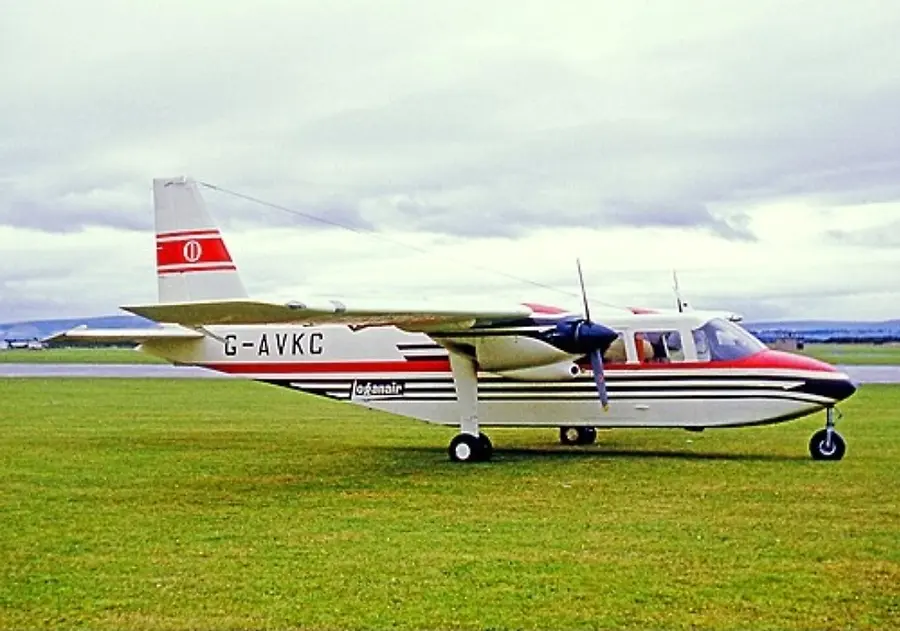
In 1967, Loganair took delivery of three Britten-Norman Islander twin-engine, eight-seat, light commuter propeller-driven airliners and began regular flights between the Orkney Islands. It also started operating in Shetland in 1970 as an air ambulance service. This contract was canceled in 2006.
The company brought jet aircraft into its fleet with two British Aerospace 146s (BAe 146s). In December 1983, it became a subsidiary of the Airlines of Britain Group, joining British Midland and British Overseas Airways Corporation. New jet aircraft were soon added to the fleet, including the British Aerospace Jetstream 31 and British Aerospace Jetstream 41. State-of-the-art turbopropeller aircraft, such as the British Aerospace ATP, were added as well.
In the late 1980s, Loganair became the fastest-growing scheduled operator at Manchester Airport. Unlike its British counterparts, Scotland's Loganair had no desire to expand internationally. Its only driving goal was to become the premier regional airline in the United Kingdom.
After a restructuring of British Midland Group in early 1994, Loganair's routes outside Scotland and the aircraft used to operate them were transferred to Manx Airlines. In mid-1994, the airline became a franchisee of British Airways, operating the remaining Shorts 360 and BN-2 Islanders in British Airways livery. This arrangement continued until July 2008, when Loganair became the new franchisee of Flybe.
By this time, founder Willie Logan had long since retired. The airline had been taken over by the Royal Bank of Scotland before being bought out by the Airlines of Britain Group in the early 1980s.
In 1996, Airlines of Britain announced that it would split its regional airlines into a separate group, enabling it to increase its franchise links with British Airways. Meanwhile, British Midland looked to strengthen its ties with Lufthansa, not realizing that British Midland itself would soon merge with British Airways. The newly consolidated airline was renamed the British Regional Airlines Group (BRAL), with the British Airways franchise operations of Manx Airlines and Loganair operating under the British Regional Airlines banner.
Crucially, in 1997, a management buyout occurred, with Loganair becoming independent of BRAL and operating just six aircraft (one de Havilland Canada DHC-6 Twin Otter and five Britten-Norman Islanders, all basic propeller-driven aircraft), with just 44 staff members across the UK. This formed the basis of the Loganair we know today.
In June 2005, Loganair was awarded a contract by the Irish government to operate a daily return service from Knock to Dublin. This public service obligation (PSO) route operated for three years as a British Airways service, effective July 22, 2005. This is the equivalent of the United States' Essential Air Service (EAS) program. The operation ceased in July 2008 after the contract was lost to Aer Arann, a short-lived Irish regional airline operating under the Aer Lingus brand. The airline soon went bankrupt, and its remaining assets were acquired by competitors such as Ryanair.
Loganair also purchased routes from the short-lived and subsequently absorbed Citiexpress regional airline in March 2004.
Until October 2008, Loganair was a British Airways franchisee, operating flights sold through BA using BA flight codes. Loganair's inter-island operations between the Orkney and Shetland Islands, carried out using Britten-Norman Islanders, were removed from the franchise agreement in 2004. Since then, these flights have been marketed under Loganair's own name rather than British Airways'. This was a prelude to things to come.
Loganair soon became a franchise airline of Flybe, operating in the airline's distinctive white-and-red colors.
On November 21, 2016, Flybe and Loganair jointly announced that their franchise agreement would permanently terminate on August 31, 2017, and that Loganair would become an independent airline operator. Despite the headlines, it is unclear who initiated the termination. Loganair later relaunched its website without renewed interline agreements with Flybe or Aer Lingus, a potential partner and Ireland's national flag carrier.
In February 2019, following fellow regional operator Flybmi's cessation of operations, Loganair announced that it would take over Flybmi's routes from Aberdeen to Bristol, Oslo, and Esbjerg (in Norway), from Newcastle to Stavanger and Brussels (Belgium), and from City of Derry Airport to London Stansted Airport.
A tribunal examining Loganair's swift action following Flybmi's closure found that the carrier had acted lawfully, despite having created several contingency plans for the potential demise of UK airlines Eastern Airways and its onetime owner, Flybe.
Speaking of this contingency planning, in March 2020, following Flybe's cessation of operations, Loganair announced that it would take over several Flybe routes from Scotland and Newcastle. What Loganair was doing was entirely legal. Authorities simply didn't like it because it was overly aggressive from a corporate standpoint, hence the tribunal.
In March 2023, Loganair secured a lease from British Airways for a record 30 additional slot pairs at Heathrow Airport, previously leased to Flybe before its demise in January 2023. Loganair also called on the UK government to reform competition remedies to ensure that Heathrow slots remain permanently available for UK regional connectivity.
As of September 2019, Loganair served 44 destinations in the United Kingdom, the Isle of Man, the Republic of Ireland, and continental Europe, with flights reported as far away as Austria. Part of Loganair's operations includes the world's shortest scheduled commercial route between Westray Airport and Papa Westray Airport, a distance of 1.7 miles, as well as flights to Barra Airport, the only airport in the world to use an active beach as a runway.
The Shortest Scheduled Flight in the World!
This is where our short island flight comes in! And I do mean short. This is the Loganair flight from Westray to Papa Westray.
Based in the Orkney Archipelago—a cluster of islands off the north coast of mainland Scotland in the United Kingdom—this island network, and specifically the Westray flights, acts as a flying bus service for locals and a bucket-list adventure for aviation enthusiasts.
The flight distance is a mere 1.7 miles, with a total time in the air and on the ground, including taxiing, of barely four minutes in favorable conditions. Although the flight is officially scheduled for two minutes, with a favorable wind, the actual time in the air is often under 60 seconds (the current world record is 56 seconds).
Nature of the Flight & the Experience
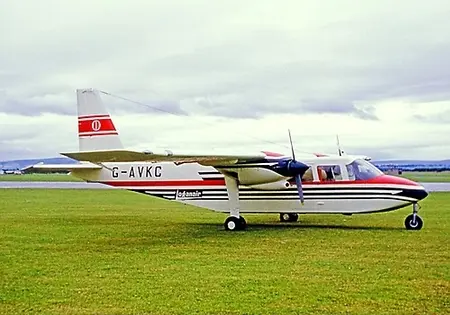
You won't find jet bridges, flight attendants, or even midair service here. The entire operation relies on the Britten-Norman Islander (pictured above), a rugged, twin-engine propeller plane perfectly suited for the harsh Scottish weather and northern UK climate.
You walk out to the aircraft, fly for four minutes, and walk off at the arrival aero-shed. Yes, you read that correctly: an aero-shed. There is no airport terminal, just a small shack, a manual check-in desk, a vending machine for snacks, and two lightly padded benches for passengers.
The view from a seat in the eight-person Islander is nearly unparalleled. Because there is no cockpit door, you can sit right behind the pilot and watch them operate the controls throughout the entire flight, from takeoff to landing.
Make no mistake: this route is a lifeline for the roughly 90 residents of the island of Papa Westray.
This flight is how teachers, doctors, and schoolchildren commute daily, especially when rough conditions in the North Sea make ferry travel unreasonably difficult or hazardous.
We have many more articles to come! Stay tuned, or visit our site at brookeintheairtravel.net for so much more!

Brooke is the founder and chief operator of Brooke In The Air Travel LLC, a company she formed shortly after graduate school in 2022. She holds a Bachelor’s degree in history and sociology, plus a Master’s degree in history, and has since dedicated her life to travel and unraveling the complex mysteries of flights, connections, hotel bookings, etiquette, and in general “how to travel” with the least hassle…