Mass Incarceration as a Public Health Crisis: An Urgent Need for Clinical Diversion and Restorative Justice Alternatives to Incarceration
Examining the intersection of criminal justice, public health, and structural inequality in addressing mass incarceration through evidence-based clinical and restorative alternatives.

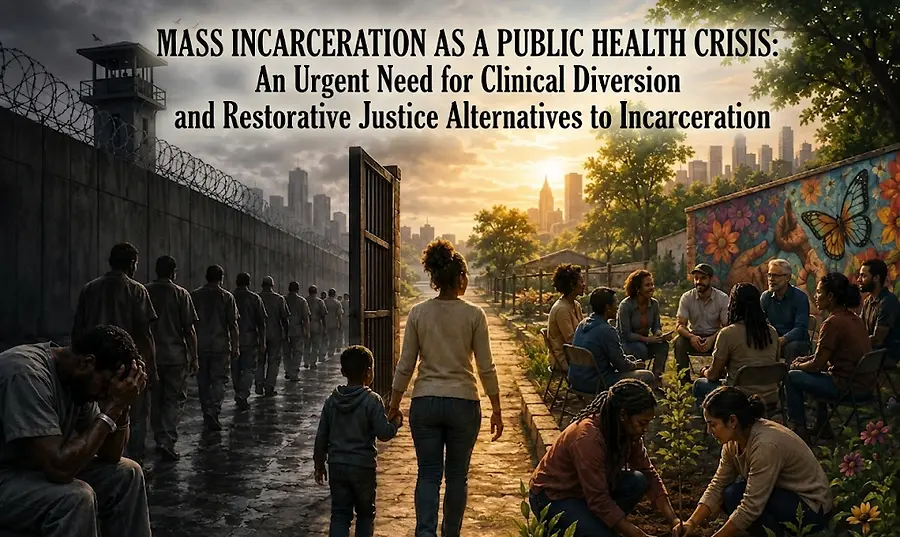
Mass Incarceration as a Public Health Crisis: An Urgent Need for Clinical Diversion and Restorative Justice Alternatives to Incarceration
Mass incarceration is not only a criminal legal issue; it is a public health crisis rooted in structural inequality, untreated mental illness, poverty, and racialized systems of social control. On any given day, approximately 1.9 million people are incarcerated in U.S. jails and prisons, with millions more cycling through probation and parole systems¹. This scale of confinement has not produced proportional improvements in safety or well-being. Instead, it has intensified harm across individuals, families, and entire communities.
The core issue is not simply the existence of incarceration, but its overreliance as a default response to complex social and clinical needs. When systems designed for punishment are used in place of healthcare, housing stability, and trauma-informed interventions, predictable public health consequences follow.
Incarceration as a Public Health Crisis
Correctional settings contain disproportionately high rates of serious mental illness and substance use disorders. Research consistently shows that individuals in jails and prisons experience significantly higher rates of psychiatric conditions than the general population². Many enter the system with pre-existing trauma histories and unmet behavioral health needs, and incarceration often worsens these conditions.
Correctional systems are not designed to provide sustained clinical care. Even when services exist, they are frequently fragmented, under-resourced, or interrupted by transfers, disciplinary segregation, or release. This creates a system that manages symptoms through containment rather than treatment.
From a public health standpoint, incarceration functions as a risk amplifier:
- It increases exposure to trauma and violence.
- It disrupts continuity of psychiatric and medical care.
- It destabilizes housing and employment trajectories.
- It elevates long-term morbidity and mortality risks.
These outcomes are not incidental; they are structurally produced.
Race, Poverty, and Structural Inequality
Mass incarceration is deeply embedded in racial and economic inequality. Black, Indigenous, and low-income communities experience disproportionate surveillance, arrest, and sentencing compared to White and higher-income populations, even when controlling for comparable behavioral patterns³.
Poverty is frequently criminalized through policies that penalize survival-related conditions such as housing instability, unpaid fines, substance use, or limited access to treatment. These mechanisms convert structural deprivation into individualized punishment.
The result is a system that does not distribute justice evenly; rather, it distributes exposure to punishment along predictable lines of race, class, and disability.
Family Systems and Intergenerational Harm
Incarceration extends far beyond the individual. Families experience emotional disruption, financial instability, and prolonged relational trauma when a caregiver is removed from the household. Children with incarcerated parents are at increased risk for behavioral health challenges, academic disruption, and future justice system involvement⁴.
The United States has one of the highest rates of parental incarceration globally, meaning that justice system involvement is not an isolated event in many communities; it is a repeated and normalized developmental experience.
These patterns contribute to intergenerational cycles of trauma that are often misinterpreted as individual pathology rather than system-generated harm.
Limitations of Punitive, Fear-Based Models
Punitive systems assume that deterrence and exclusion are sufficient to reduce harm. However, criminological research has repeatedly demonstrated that incarceration alone has limited deterrent effects, particularly for offenses driven by trauma, substance use disorders, or untreated mental illness.
In many cases, incarceration destabilizes the very conditions needed for behavioral stabilization: housing, healthcare continuity, employment, and social support. The result is a cycle of release and reentry that reflects systemic failure rather than individual failure.
Punitive models do not resolve root causes; they relocate them into institutional settings.
Clinical Diversion and Restorative Justice as Public Health Strategies
Clinical diversion and restorative justice models represent evidence-informed alternatives that align with public health and social work principles.
Clinical diversion prioritizes:
- Early identification of mental health and substance use needs.
- Community-based treatment rather than incarceration.
- Stabilization through supportive services.
- Reduction in repeat system involvement.
Restorative justice prioritizes:
- Accountability through structured dialogue and repair.
- Centering harm, survivor needs, and accountability processes.
- Community-based resolution rather than exclusion.
- Reintegration rather than permanent labeling.
Meta-analytic research has found that restorative justice programs are associated with reduced recidivism and higher victim satisfaction compared to traditional court processing in many contexts⁵. While outcomes depend on implementation quality, the broader evidence supports restorative approaches as viable alternatives to adversarial systems.
Clinical diversion models similarly align with evidence demonstrating that treatment-based interventions for mental illness and substance use disorders are more effective at reducing criminal legal system involvement than incarceration alone.
Theoretical Frameworks for System Transformation
Effective reform requires grounding in frameworks that directly address structural harm.
Anti-oppressive frameworks highlight how power, race, disability, and class shape exposure to criminalization. Without this lens, systems may reproduce inequality while appearing neutral.
Strengths-based frameworks emphasize resilience, capacity, and recovery rather than deficit-oriented labeling.
Liberation psychology situates psychological distress within contexts of structural violence, arguing that healing requires social transformation rather than solely individual intervention⁶.
Together, these frameworks reject the assumption that harm can be resolved primarily through isolation and punishment.
System Incentives and Structural Failure
One of the central contradictions of mass incarceration is that it is justified as a mechanism for public safety while simultaneously producing conditions that undermine safety. By concentrating trauma, mental illness, and poverty within correctional settings, systems perpetuate the very conditions they claim to reduce.
Policy and funding structures often reinforce this cycle. Investments in correctional infrastructure routinely outpace investments in housing, mental healthcare, and community-based prevention. This creates institutional incentives that prioritize containment over resolution.
Conclusion: Toward a Public Health Approach to Justice
Mass incarceration functions as a social determinant of health. It shapes physical health outcomes, mental health trajectories, family stability, and community well-being on a large scale.
There is no sustainable path to public safety that relies primarily on punishment and exclusion. A different approach requires investment in clinical diversion systems, restorative justice practices, and community-based care infrastructures that address harm at its roots.
This is not a peripheral reform effort; it is a structural necessity grounded in empirical evidence and public health ethics.
A society that seeks safety must decide whether it will continue reproducing harm through confinement or invest in systems that make repair possible. What is required is not rhetorical agreement, but sustained policy transformation, funding realignment, and institutional courage.


