Most Product Goals Are Wrong. Here's a Fix.
Why vague product goals kill execution—and how to write ones that actually work.

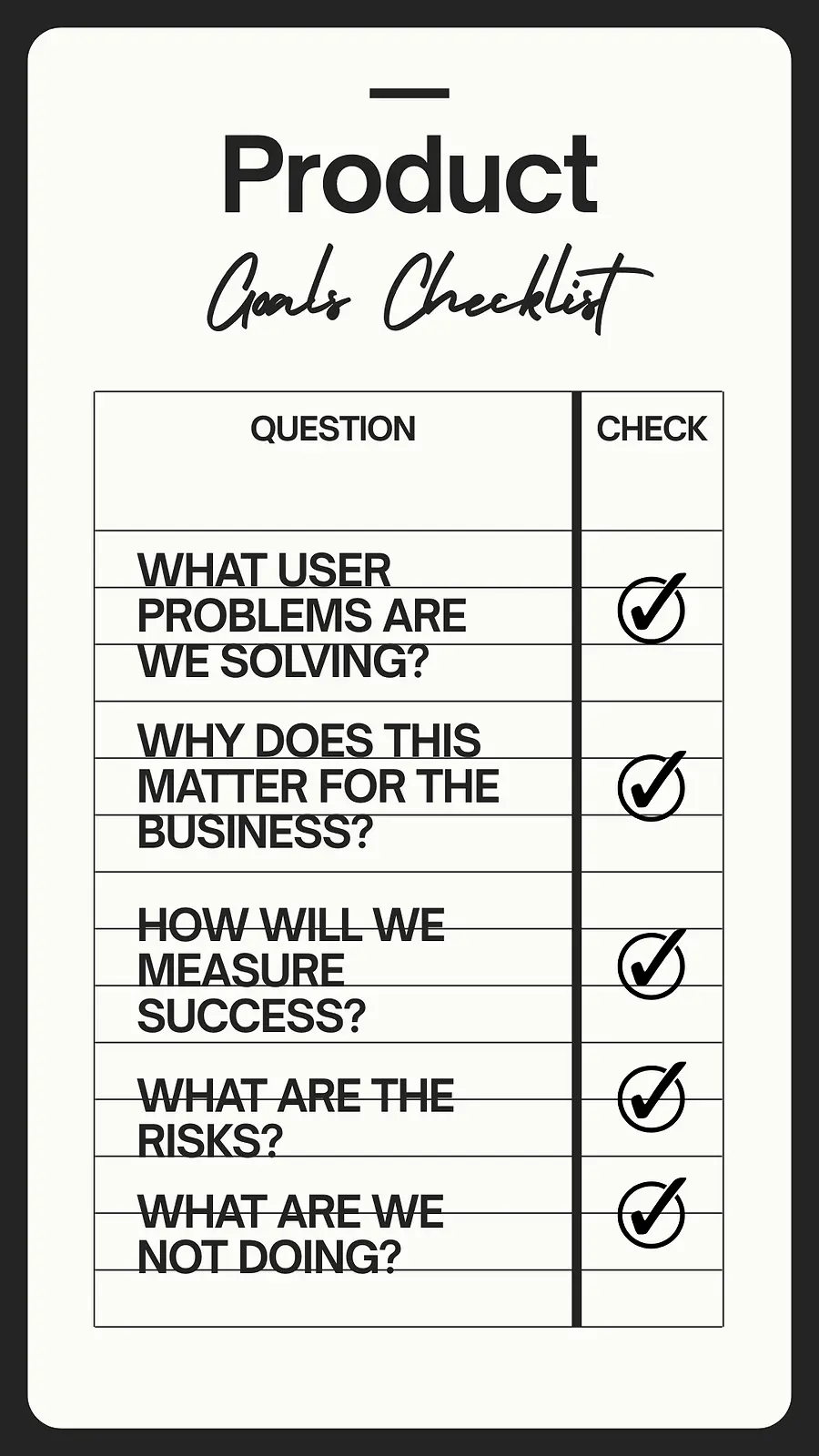
Most product goals sound impressive.
- "Increase engagement."
- "Grow revenue."
- "Improve retention."
But here's the problem:
They don't tell teams what to actually build.
And that's why execution breaks down.
The Real Job of a Product Goal
A product goal isn't a metric. It's a decision-making tool. It should help teams answer:
- What do we prioritize?
- What do we ignore?
- What does success actually look like?
Instead, use the following structure:
Start with the User Problem
Weak: Increase DAU by 20%.
Strong: Help new users experience value during their first session.
☛ Metrics follow value—not the other way around.
Connect to Business Outcomes
☛ User Problem → Product Goal → Business Impact
- Problem: Users can't discover relevant content.
- Goal: Improve personalization.
- Outcome: Higher retention and increased revenue.
Measure the Right Things
Measure outcomes that reflect real value:
- Engagement (CTR)
- Depth (time spent)
- Satisfaction (return visits and retention)
☛ Prevent shallow wins.
Define Success and Failure
Ask yourself:
- What does success look like?
- What are the guardrails?
- What would failure look like?
☛ Not all growth is good growth.
Ruthlessly Prioritize
☛ Don't set 10 goals. Focus on 1–3 real priorities.
☛ Eliminate the noise.
Final Thought
Most teams don't fail because they lack talent. They fail because:
☛ Their goals don't create clarity.
Fix your goals, and you'll fix your product.
Originally posted at https://www.nikita-patil.com/


