Motor City’s Mega Airport (airport analysis #12)
Detroit Metropolitan Wayne County Airport: Michigan's Premier International Aviation Hub

Welcome back, dearest value travelers! We're nearing the end of our airport analysis series, but one mega airport we absolutely need to cover is Detroit's Metropolitan Wayne County Airport (IATA code: DTW).
Don't let the simple, municipal-sounding name fool you. DTW is Michigan's premier international airport and actually one of the largest international airports in the United States. DTW is operated by the Wayne County Airport Authority. It is located approximately 18 miles southwest of Detroit's city center, in Romulus, an outer suburb of Detroit. It is by far Michigan's busiest airport, eight times busier than Michigan's next-busiest airport, Gerald R. Ford International Airport in Grand Rapids, Michigan.
To continue the overview, the airport is the second-largest hub for Delta Air Lines (Delta's main base and hub in Atlanta being by far the largest). In fact, Delta is the only airline to establish a hub at Detroit. The airport has service to 30 international destinations and to 43 states across the United States. In terms of operations, the airport has six runways, two terminals, and 129 in-service gates.
Metro Airport serves the metropolitan Detroit area; the Toledo, Ohio, area, about 40 miles south; the Ann Arbor area to the west; Windsor, Ontario; and Southwestern Ontario in Canada (connecting to airspace served by Toronto-Pearson International Airport). The airport now serves over 140 total destinations and was named the best large Category III U.S. airport in customer satisfaction by J.D. Power & Associates in 2010, 2019, and 2022. Category III airports are those with service for 33 million passengers per annum (PPA) or more.
A Brief History
Now for the history of Motor City's mega-airport. The beginnings of the goliath start in the Roaring Twenties. Wayne County began to plan an airport in the western townships of the county as early as 1927. They built it, having no idea how big it would become. The following year, the county board of commissioners issued a $2 million bond to fund the purchase of one square mile of land at the corner of Middlebelt and Wick roads, the northeastern boundary of today's airport.
Construction was completed in 1929, and the first landing was on February 22, 1930. Wayne County Airport was dedicated on September 4, 1930. That year, Thompson Aeronautical Corporation, a forerunner of American Airlines, began service from the airport. From 1931 until 1945, the airport hosted Michigan Air National Guard (Michigan ANG) operations gained by the United States Army Air Forces, especially immediately after the war in late 1945. It was named Romulus Field during the war, from December 8, 1941, to May 8, 1945; it was then all east of Merriman Road and north of Goddard Road. This boundary road can still be seen in satellite imagery today.
Wayne County expanded the airport to become Detroit's primary airport. It was officially renamed Detroit-Wayne Major Airport in 1947, and in the next three years, it expanded threefold as three more runways were built. In 1949, the airport added runways 3L/21R and 9L/27R, followed by runway 4R/22L in 1950.
In 1946-47, most airline traffic officially moved from the cramped Detroit City Airport (now Coleman A. Young International Airport) northeast of downtown Detroit to Willow Run Airport, over 20 miles west of the city and 10 miles (16 km) west of Wayne County Airport.
A quick note on Coleman A. Young International Airport: This airport, while within the city limits of Detroit, is strictly a business jet airport and cargo terminal now, as the only commercial aircraft landing here are dedicated cargo jets such as the 747-400F. If cleared by their flight plan, this airport also serves general aviation aircraft.
Pan American Airways (in 1954) and British Overseas Airways Corporation (in 1956) were the very first passenger airlines at the early Detroit-Wayne. In 1958, the Civil Aviation Administration-now the Federal Aviation Administration (FAA)-announced the inclusion of Detroit-Wayne in the first group of American airports to receive new long-range radar equipment, enabling the airport to become the first inland airport in the United States certified for jet airliners. Also, later that year, airport management completed the Leroy C. Smith Terminal, or simply the South Terminal.
American Airlines moved from Willow Run to Detroit-Wayne in October 1958, followed by Northwest, the short-lived Allegheny Airlines, and Delta in the next few months; the other airlines stayed at Willow Run until 1966.
Willow Run, now a dedicated general aviation airfield, was a secretive bomber construction facility and test production site during the war. Thousands of B-24 Liberator and B-17 Flying Fortress bombers were constructed at a rapid pace that was truly mind-boggling. Truly, it deserves its own historical article.
Northwest's flights to Minneapolis were DTW's only nonstops west beyond Chicago and Milwaukee until 1966. The first scheduled jets were Delta DC-8s to Miami in late 1959. The North Terminal (later renamed the James M. Davey Terminal) opened in 1966. A third terminal, the Michael Berry International Terminal, opened in 1974. These are described in brief below.
The last of its original three parallel runways (3R/21L) was completed in 1976; a new parallel crosswind runway (9R/27L) opened in 1993.
Republic Airlines began official hub operations in 1984, and its merger with Northwest Airlines in 1986 expanded the hub. The Northwest hub operated out of the Davey Terminal throughout the 1980s and 1990s. Transpacific flights began at the airport in 1987, with Northwest providing nonstop service to Tokyo-Narita International Airport.
The last of Detroit Metro's six runways (4L/22R) was completed in December 2001 in preparation for the opening of the state-of-the-art, mile-long, 122-gate, $1.2 billion McNamara Terminal in the airport midfield in 2002. The airport remained a hub for Northwest Airlines until it merged with Delta Air Lines in 2008.
Some brief history is given here on historic terminals before we move on to modern operations. All major named terminals were subsequently demolished, and the two modern terminals, McNamara and Evans, were built in their places and are active today.
Barry Terminal
The Berry Terminal, named for former airport commissioner Michael Berry, opened in 1974 as the sole international terminal at DTW. It was decommissioned on September 17, 2008, and replaced by the Evans Terminal. All international passengers would arrive at this terminal, pass through customs and immigration inspection, and continue on to their connecting flights by bus to adjacent terminals.
Originally containing six gates (two of which were removed in 2003 to allow for construction of an adjacent Northwest Airlines maintenance hangar), the terminal was later used for scheduled and charter flights. There were still several international scheduled flights on low-cost carriers to destinations in the Caribbean and other warm-weather places in the early 2000s, including flights from Champion Air, Ryan International Airlines, and USA3000 Airlines, all of which are no longer in existence. Four charter airlines also used this terminal until 2011.
Following its closure in 2008, the Berry Terminal became a popular space for commercial film and television production. Berry was finally entirely demolished in 2018.
Smith Terminal
The Smith Terminal, named for Detroit-Wayne Major Airport visionary Leroy C. Smith, was built in 1958. Though cited as the oldest of Metro Airport's terminals, that designation belongs to the Executive Terminal building located near Middlebelt Road and Lucas Drive, one-quarter mile east. The Executive Terminal was built in the late 1920s and is still in operation today as home to ASIG, a flight support company.
The Smith Terminal's 32 gates originally housed Northwest Orient Airlines, Allegheny Airlines (forerunner to US Airways), Eastern Air Lines, and Pan Am, among others. A control tower was included in the construction and served its purpose until the late 1980s, when a new control tower was built near the site of the new McNamara Terminal.
In later years, Smith Terminal hosted North American carriers other than Northwest, Continental, and later Delta, which relocated to the McNamara Terminal in 2002 before its merger with Northwest.
State-of-the-art for its time, the Smith Terminal eventually became a victim of airline expansion. The design of the building did not allow for physical expansion of the ticketing area. To accommodate additional airlines, ticketing counters were constructed on the sides of the lobby in areas that previously held lounges and retail. In contrast, the North Terminal was constructed with future expansion in mind.
Spirit Airlines, prior to its dissolution, operated out of many of the gates once used by Northwest and made few (if any) upgrades to the gate areas in those parts of the terminal. The Northwest Airlines display boards near check-in counters at each gate remained in place, with the Northwest logos removed, and a Spirit information board simply affixed over the old signage. Numerous passengers referred to this "fix" as tacky and ill-conceived. Regardless, it certainly did Spirit no favors.
The Davey Terminal
The James M. Davey Terminal was built in 1966 and was first known as "Terminal 2" or the "North Terminal." The terminal was said to be the largest post-tensioned building in the world. Tapering cruciform columns around the perimeter and curved beams supported five large concrete roof panels. The lack of columns allowed maximum flexibility in the interior space. The spaces between the roof panels and exterior columns were filled with glass to allow abundant natural light into the building.
It was renamed the "J. M. Davey Terminal" in 1975 in honor of former airport manager James M. Davey. It originally contained three concourses labeled C to E, as well as a Host Hotel, which later was rebranded Marriott. In the early 1980s, a separate ticketing area was constructed to the north of the Davey Terminal, along with Concourses F and G to eventually accommodate Northwest Airlink's (Northwest Airlines' regional subsidiary) regional jet fleet.
Over time, the terminal and added concourse began showing its age due to its layout and poor maintenance, hastened further by increased aircraft traffic, which it was not designed to handle efficiently. Despite this, more gates were added to Concourse C in a short-term expansion project in the early 1990s, making it 26 gates in length.
The Davey Terminal was originally the principal base of operations for Republic Airlines, which, as mentioned, merged with Northwest Orient Airlines to become Northwest Airlines in 1986. Upon relocation of Northwest operations to the McNamara Terminal, the Davey Terminal was mothballed for three years before demolition of the ticketing area and Concourse G began on October 17, 2005, to prepare for the new North Terminal project.
All concourses of the Davey Terminal and the adjoining Marriott hotel, except gates 1 to 11 of Concourse C, were subsequently demolished in 2005-06.
Modern Evolution
In April 2011, Lufthansa itself launched a unique curbside check-in and baggage check service for premium customers from DTW's North Terminal (Evans Terminal) to Frankfurt and beyond. Lufthansa became the only airline allowing international customers departing from DTW to check their bags and receive a boarding pass at the curb, while DTW became Lufthansa's first North American gateway with this service.
Detroit's economy plunged in the Great Recession of 2008-2009. This event caused airlines such as British Airways to drop flights to London-Heathrow and other airlines such as KLM and Virgin Atlantic to use codeshare flights through Delta Air Lines. The city has lost population, but Detroit Metropolitan Airport has since regrown, and airlines are looking to expand or resume service. JetBlue began flights to Boston in February 2014.
Royal Jordanian Airways was the first airline to schedule the then-new Boeing 787 Dreamliner into Detroit, on December 1, 2014. A genuine first for the airport.
Ground services are provided for all types of travelers at both terminals.
Beginning in January 2018, SMART (Suburban Mobility Authority for Regional Transit)-the primary transit service servicing the Detroit suburbs-began providing a direct connection from the airport to the Rosa Parks Metro Transit Center in downtown Detroit via Route 261, with dedicated stations at both the McNamara and Evans terminals at the airport. The Michigan Flyer intercity bus service offers transportation from both terminals to Ann Arbor and East Lansing. At least four other bus services are offered from the airport; all a passenger has to do is use the service's app or go to one of the airport's information booths.
The airport is accessible from I-94 via Merriman Road (Exit 198), which is the nearest entrance to the Evans Terminal, and from I-275 via Eureka Road (Exit 15), which is closer to the McNamara Terminal. Both entrances and the terminals are connected by John D. Dingell Drive, an expressway completed in 1999 and named after the longtime congressman, Sen. Dingell. Cell phone parking lots are located near both entrances.
Free shuttle buses are available between the two terminals and also connect to the Green parking lots. Rental car companies provide their own shuttles (Avis, Enterprise, and Budget), as do private off-site parking lots and most hotels in the airport's vicinity (within three miles).
Short-Lived Low-Cost Services
In 2017, WOW Air announced service to Reykjavík on the Airbus A321. This marked the first-ever entrance of a modern European low-cost carrier to DTW. In the summer of 2018, Reykjavík went from the 55th most-traveled destination to the fifth due to this flight's popularity. Passengers could connect onward in Reykjavík, boosting travel to European destinations.
In March 2019, the airline ceased operations entirely and filed for bankruptcy, leaving Metro Airport with no low-cost nonstop service to Europe. The airport looked for potential replacement service to begin in 2020, but due to the COVID-19 pandemic, that effort ceased until 2022, when Icelandair and Delta announced seasonal flights to Reykjavík, Iceland's capital, starting in 2023.
Spirit Airlines had access to all terminals and 28 overall gates until the airline's collapse in May 2026.
We'll now briefly discuss the current operations of the airport.
DTW currently has two active passenger terminals, with a grand total of 151 gates.
McNamara Terminal
The Edward H. McNamara Terminal is the larger of the two terminals, containing 122 gates between its three concourses, lettered A, B, and C. As of 2026, the McNamara Terminal is served exclusively by Delta Air Lines, other members of the SkyTeam airline alliance, and WestJet.
The McNamara Terminal is an airport wonder in itself. The longest single terminal in the world, surpassed only by Osaka's Kansai Airport Terminal 1 in Japan (see my article on the Most Kawaii Airport in the World for more information on Kansai).
The McNamara Terminal opened on February 24, 2002, as the first major airport terminal in the U.S. to open after the September 11 attacks. It replaced the Davey Terminal as the primary base of Northwest Airlines in Detroit. Known during planning as the Midfield Terminal, the facility was named in honor of Edward H. McNamara, then the sitting county executive of Wayne County.
It was developed in collaboration with Northwest to serve as its primary hub for international flights and was prominently branded by the airline as the Northwest WorldGateway upon its opening. It would remain so until Northwest's merger with Delta Air Lines in 2008.
As mentioned, McNamara Terminal's linear Concourse A houses 64 gates and is roughly one and a quarter miles in length. The terminal uses an integrated, airside, ceiling-mounted AirTrain people mover to alleviate walking from one end to the other, quickly transporting passengers between three elevated stations within the concourses. Moving walkways also line the entire length of Concourse A as an alternative option.
Concourse A includes a post-security variety of restaurants and retail stores, and four Delta Sky Club lounges (one used to be a Northwest lounge before the merger). At the midpoint of the concourse is a large, laminar-flow water feature, similar in design concept to Singapore's Changi Airport's waterfalls.
The smaller concourses of Terminal 1, Concourses B and C, containing 17 and 41 gates, respectively, run parallel to Concourse A and combined are roughly 0.5 miles (0.80 km) long. They are primarily used for smaller aircraft and feature jet bridges at all gates. They were expanded between 2004 and 2006. Concourses B and C also contain retail stores, restaurants, and a Delta Sky Club lounge.
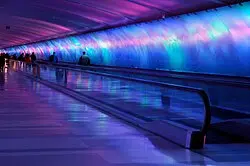
Concourses B and C are connected to the main terminal and Concourse A by the underground pedestrian Light Tunnel, which runs under the airport ramp (pictured above). The tunnel features an elaborate, multicolored light show behind sculpted glass panels, synchronized with an original musical score composed by Victor Alexeeff. This is a similar design to Chicago O'Hare's own tunnel of light, officially titled "The Sky's The Limit," which connects its concourses B and C underground in Terminal 1.
McNamara Terminal prominently features signage in Japanese, as it serves a large number of international travelers from Japan.
The terminal houses ten international gates that are capable of dual jet bridge loading and unloading. The gates contain two exit configurations depending on the arriving flight. Domestic arrivals follow an upper path directly into the terminal, while international arrivals proceed downstairs to customs and immigration screening.
The Customs and Border Protection processing center located in the terminal's lower level is designed to accommodate as many as 3,200 passengers per hour. International arriving passengers connecting to another flight are screened by TSA at a dedicated screening checkpoint within the international arrivals facility. Those passengers then exit directly back into the center of Concourse A. Passengers arriving from international destinations who end their trip in Detroit (or connecting to a neighboring domestic flight via the Evans Terminal) exit directly into a dedicated International Arrivals Hall on the lower level of the terminal.
Evans Terminal
Speaking of the Evans Terminal, this is Detroit's second and final terminal. The Warren Cleage Evans Terminal is the smaller of the two terminals. The Evans Terminal was originally known as the North Terminal and was renamed in April 2022 after Warren Evans, who is the current county executive of Wayne County as of 2026 (re-elected in 2024 for a six-year term, ending in 2030).
This terminal is coextensive with Concourse D, which is 0.5 miles (0.80 km) long and contains 29 gates, which, as of 2026, serve all flights operated by airlines that are not members of SkyTeam or partners of Delta Air Lines.
The Evans Terminal opened on September 17, 2008, replacing both the Berry and Smith terminals.
The Evans Terminal, known unofficially by Star Alliance members within the airline industry as the Star Alliance Terminal, houses two six-lane security checkpoints and eight gates equipped to serve international flights, which feed to the U.S. Customs & Border Protection inspection facilities located on the lower level and the corresponding arrivals hall. It is also home to a Lufthansa Business and Senator Lounge (two lounges combined by one entrance; passengers, after checking in for the lounge at the desk, turn left for Business and right for the Senator lounge. This is a standard Lufthansa custom.) These lounges are available to passengers flying in Lufthansa premium cabins, as well as select Lufthansa and Star Alliance elite members. This lounge also grants access to Priority Pass members outside of peak hours.
Low-cost airlines (those that still exist) are spread throughout the McNamara Terminal, often right next to full-service carriers.
DTW does not possess any dedicated cargo facilities or carriers, allowing major airlines to build and orchestrate their own freight and logistics. Michigan's Wayne County allows, and indeed prefers, the cross-city Coleman A. Young International Airport to handle all local and regional freight traffic as a dedicated freight airport.
There is one actual hotel inside the McNamara Terminal and the only hotel on airport property. That is the attached and integrated 404-room-and-suite Westin Hotel, which provides direct access to private security screening before emptying passengers into the terminal itself. The Westin took over from the demolished Marriott hotel. Rates per night are fairly decent and commensurate with the neighboring airlines, at up to $580-$600 USD per night depending on room type and season (peak season or offseason).
Thank you for coming on this epic journey with us and exploring the Motor City Mega Airport! Remember to book your travel consultation to explore Detroit yourself at Brooke In The Air Travel!