Move for your mind.
How Movement Rewires Your Brain for Clarity, Confidence, and Emotional Resilience

"I know it works…but how?"
You've felt it before: that openness and clarity of focus in whatever you jump into after a great workout. There's an ease about the ideas that come up and a flow in your attention that may otherwise be pretty rare. Ideally, you notice it and thank your lucky stars for it—but did you know it actually arose from your workout?
Redefine "Workout"
Let's start with a simple idea: exercise can be almost any movement. Working out in a gym, throwing heavy weights around—that's great and undeniably exercise. But gardening can also be a workout. So can chasing a toddler, having your own dance-off, paddling your way across a lake, or giving your dog a great run. It's important to redefine exercise as movement that feels good for you, and it's okay for that to look different from what feels good for someone else.
Old News and New News
You're probably here because you understand very clearly that exercise is good for our bodies—that's the super-simple old news. From functional strength to bone density to metabolism, moving our bodies has multiple physical benefits.
What might be new to you is that movement helps our minds in a number of ways, too. The cognitive and emotional benefits of movement span all ages, all types of minds, all kinds of bodies, and every walk of life. Certain brains (like those with ADHD or those in midlife and beyond) stand to gain even more than average benefits—you'll see why in just a moment.
What Sorcery Is This?
One of the first observable changes that occurs in the mind is openness to change. When the body starts moving vigorously enough to raise the heart rate (aerobically), neuromodulators like dopamine and norepinephrine are released. In turn, these raise levels of brain-derived neurotrophic factor ("BDNF"), which we can think of as fertilizer for the brain. Improved BDNF levels help us with working memory and cognitive flexibility—two points that are important for everyone and critical for some.
There's also the notion that repetition builds connection. You may have heard the expression "what fires together wires together," and we've seen that demonstrated time and again in the research. Synapses—brain connections—actually get stronger the more they work together in a process called Hebbian plasticity (named for the researcher Donald Hebb, who proposed this in 1949). This is why practice works—not just for muscles but for brains, too! It's so simple and so complex at the same time, and we all know instinctively that it's true: repetition builds skill in movement as well as memory.
Experience proves new things to the brain all the time, and the brain responds to that by changing. Prediction error is science's name for the idea that when we expect one thing and experience another, learning happens. Here's a simple example: Jane believes 20 pounds is too heavy for her to deadlift. Her trainer sets her up with a great warmup, proper form and skill, encouragement, and a 20-pound kettlebell. Jane gives it a lift, with all this preparation, and discovers she can do it—and it even felt easier than she predicted. That's Jane's prediction error, and she just trained her body and her brain to understand a new belief. Her brain now has new evidence that 20 pounds is within range for her, and it updates its belief "software" accordingly.
Now here's where it gets interesting: the effort Jane exerted in warming up, learning skills, and actually lifting the weight helped that new belief set in more deeply. When evidence is updated during effort, networks in the brain that handle notions of identity become stronger. Not only will Jane now know she can deadlift 20 pounds, she will begin to think of herself as A Person Who Can Lift Heavy Stuff. Experience + effort = identity shift.
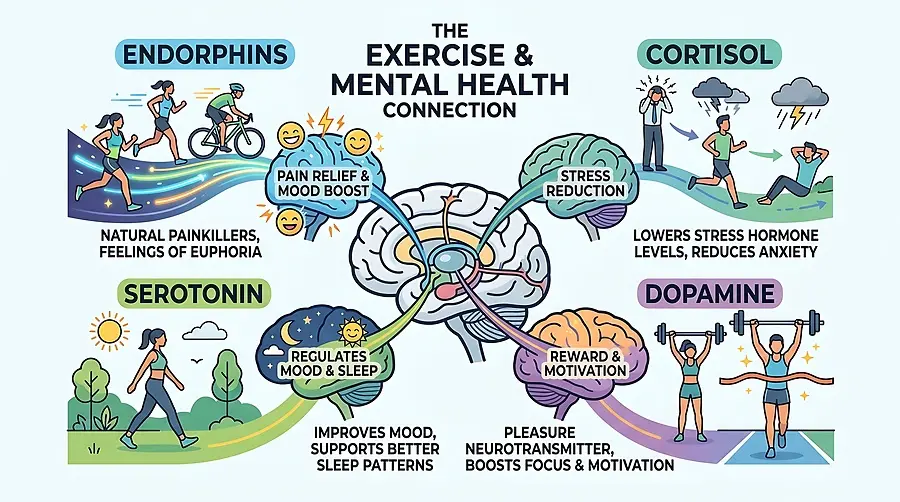
Emotion moves as the body moves. Movement can help the body process and metabolize emotion instead of storing it and reprocessing it, which can be a cognitive drain. Our bodies can be our own therapists, in a way! Exercise modulates important brain chemicals like cortisol, serotonin, and dopamine in order to support emotional regulation and memory reconsolidation. And it's important to note modulation here—it's not just a matter of increasing across the board, but of finding healthy balances in these chemicals. Some move up, others down. Movement allows us a way to release emotions without collapsing under them, building resilience and lightening our mental load.
Along with moving those feelings right through us, movement keeps our brains so busy that there's scarcely space left for overthinking or self-criticism. It's such a big job to coordinate all of our limbs in space, time, and effort that the brain has to sharply focus its attention on that job to the exclusion of non-necessary things like rumination. Once again, it's simple and complex simultaneously: big movement gives our brains enough "jobs" to do that there's just nothing left over for beating ourselves up about mistakes.
And finally, continuing to show up for your exercise—whatever that looks like for you—is a way of reinforcing self-trust. When we come back to repeat the same tough task we did last week and the one before, we're teaching our minds that we are the kind of people who can do hard things. Repetition, especially in a routine or ritualized way, builds a kind of coherence between the cognitive, emotional, and physical systems that helps us form a stronger sense of self. Every rep helps us feel more aligned, steady, and purposeful.
What's Next?
That part is up to you, but scheduling your next movement session would be a great start!
What if you:
- were to brainstorm a list of all the different ways you like to move your body, so you can begin building more of them into your week?
- put away the screen you're reading this on, put on your favorite music, and just move for 2 minutes?
- investigate a whole new way to move that you've never tried before?
- invite someone else to join you in the brain-building, body-friendly movement you'll do next?
Whatever you choose, you can do it knowing that movement is about far more than just looking good or even feeling strong—it's about building new and stronger connections in your brain. Those connections keep you healthy in ways that go beyond any program or price tag—they make you happier, smarter, more regulated, and ready for whatever comes next in your life.