Negativity Bias: The Reason You Can List Your Failures Faster Than Your Wins (And Why It Holds You Back)
Why Your Brain Forgets Your Wins—and How to Remember Them

Try this. In ten seconds, list three ways you've fallen short this year.
Now list three things that went right in the past month.
It took longer the second time, didn't it?
That delay has nothing to do with a personality defect. It's simply how your mind is built. And whenever you're trying to reshape a habit or become someone a little different from who you were, that built-in tendency can quietly trip you up.
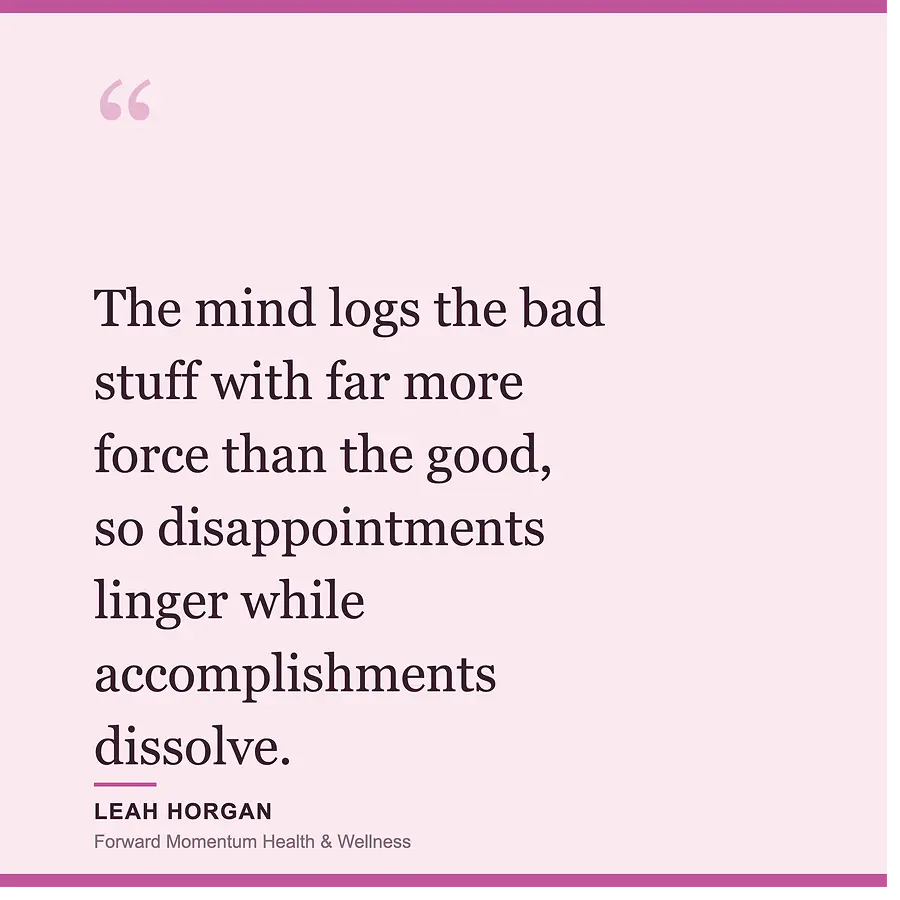
Put plainly, the mind logs the bad stuff with far more force than the good, so disappointments linger while accomplishments dissolve. But if you make a habit of intentionally noticing your strengths and small victories, you begin to counter that pull. Research suggests that this habit can help people stick with the changes they're genuinely trying to make.
1. Your setbacks stay sharp while your successes go fuzzy
There's a famous paper titled Bad Is Stronger Than Good. Its authors reviewed years of research and kept arriving at the same conclusion: whether it's everyday experiences, major life events, close relationships, or learning, negative experiences simply carry more psychological weight than positive ones. A single harsh comment cuts deeper than a compliment lifts us, and we work much harder to avoid thinking of ourselves as "bad" than we do to earn the label "good" (Baumeister et al., 2001).
So there's nothing wrong with you if you remember the plan you abandoned in the spring more clearly than the four steady months you spent cooking at home. But when you're trying to change your work, your health, or the direction of your life, a mind that catalogs every misstep while dismissing every success leaves you looking at a distorted picture of how far you've actually come.
Miss a couple of workouts, and your inner narrator doesn't say, "I skipped two sessions." It says, "I can't stick with anything," or even, "I'm just a person who gives up."
A minor setback becomes an identity.
The solution isn't to grit your teeth harder. It's to change what you're paying attention to.
2. A thought is only a thought, and you can choose to reframe it
Reframing means intentionally retelling a situation so you experience it differently. Instead of saying, "I always give up," you replace it with something kinder that is still true.
"I always give up" becomes, "I worked out two days this week," or, "I haven't found an approach that works for me yet."
Notice how that changes the emotional weight?
This isn't about pretending everything is fine. Cognitive reappraisal—reframing the meaning of a situation—is one of the most extensively researched emotion-regulation strategies in psychology and consistently ranks among the most effective for improving emotional well-being. Likewise, a large review involving nearly 30,000 participants found that greater self-compassion is associated with healthier behaviors (Phillips & Hine, 2021).
The takeaway is simple: when you offer yourself the same kindness you'd offer someone you care about, you're more likely to keep going.
3. Trade "should" for what genuinely matters to you
Pay attention to how often the word should drives your inner dialogue.
- I should eat healthier.
- I should exercise more.
- I should be more disciplined.
The problem is that should is borrowed motivation. It burns out quickly.
Psychologists distinguish between motivation that comes from external pressure and motivation that grows from personal values. One review that analyzed 184 datasets found that lasting behavior change is much more likely when people act from their own values rather than guilt or obligation (Ng et al., 2012).
So instead of saying:
"I should eat better."
Try asking yourself why it actually matters.
Maybe it's because you want the energy to play with your grandchildren someday.
Maybe it's because you want to hike mountains, travel the world, or simply feel better every morning.
"I want to take care of my body because I value my health and my future."
That motivation lasts much longer than I should.
Q&A with the Coach
Doesn't celebrating my wins just mean I'm making excuses?
Quite the opposite. Your brain already keeps a running tally of your failures. Acknowledging your wins simply balances the picture so you can identify what's working and build on it.
What if I honestly can't think of a single win?
Lower the bar until something qualifies.
Maybe you paused before giving in to a craving.
Maybe you went to bed twenty minutes earlier.
Maybe you drank an extra glass of water.
Small wins count because they reinforce the identity you're trying to build.
How is reframing different from lying to myself?
A reframe still has to be true.
"I've completely got this" when you don't believe it isn't helpful.
"I showed up twice this week, and I'm still figuring out what works" is both honest and actionable.
Do I need to work on all three at once?
Not at all.
Start by writing down your wins. Most people notice the shift there first. Then choose one small action you'll actually follow through on this week instead of creating the perfect plan you'll abandon by the weekend.
You aren't unmotivated, and you aren't incapable of change.
You're simply working with a mind that's wired to remember failures in vivid detail while allowing successes to fade into the background.
When you intentionally change what you notice, you begin to change how you think.
And when your thinking changes, your choices begin to change too.
Once your progress becomes visible to you, a rough week stays just that—a rough week.
It no longer becomes your identity.


