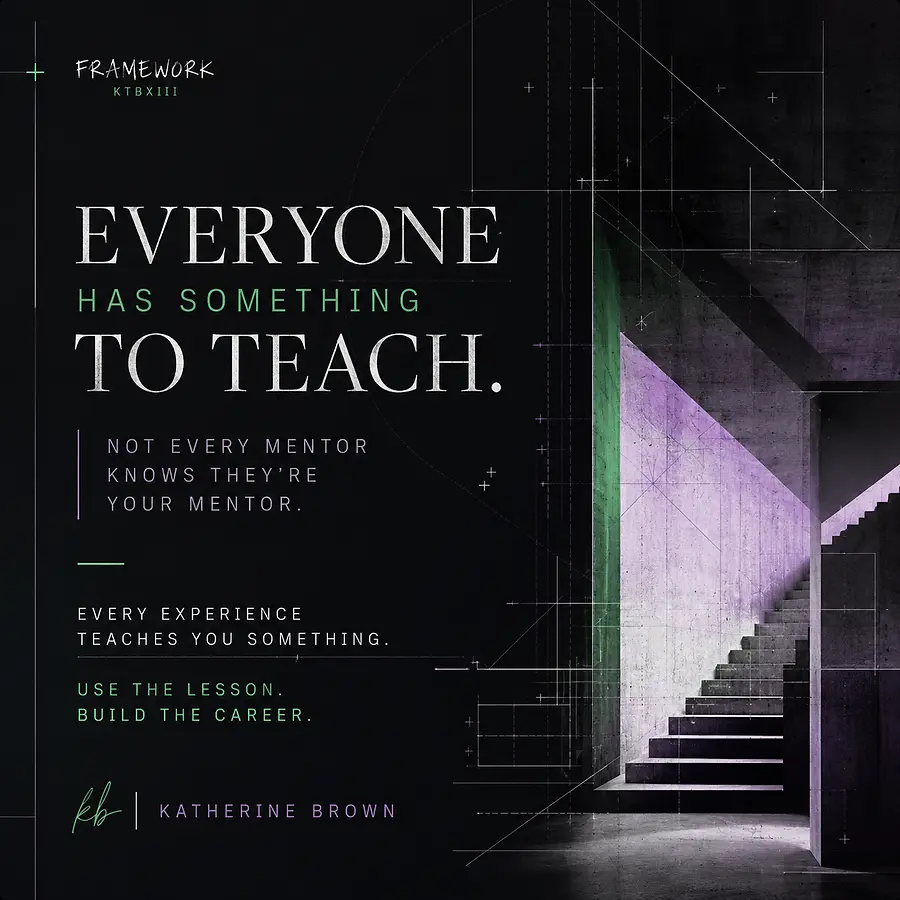
Not Every Mentor Knows They’re Your Mentor
How asking questions and learning from everyone around you can shape a successful career in an unfamiliar industry.

Learning From Everyone: The Unexpected Power of Mentorship
I started a career in construction safety without a traditional background in construction.
I didn’t grow up in the trades. I didn’t enter the industry with years of field experience behind me. There was a great deal I simply did not know.
What I did have was the willingness to ask questions, pay attention, and learn from the people around me.
Looking back, that may have been one of the most important tools I brought with me.
Early in my career, I learned quickly that construction is full of people who know things you cannot learn from a manual alone. Regulations and formal training matter. Certifications matter. Policies and procedures matter. But there is another kind of education that happens when you are standing in the field with someone who has performed the work for twenty years and is willing to explain what actually happens when the plan meets reality.
So I asked questions.
I asked electricians why something was installed a particular way. I asked tradespeople to walk me through their work. I listened when superintendents explained sequencing and logistics. I watched how project owners approached risk and accountability. I paid attention to the people who could walk into a complicated situation, identify what mattered, and communicate it without creating unnecessary chaos.
Over time, I stopped thinking of mentorship as something that had to be formal.
Some of the most influential people in my career have probably never considered themselves my mentors.
They were simply people who took five minutes to explain something.
People who challenged an assumption.
People who showed me a better way to communicate.
People who let me watch how they handled a difficult situation.
People who answered one more question when I was still trying to understand the bigger picture.
Every trade I have worked alongside has taught me something. Every project has taught me something. Project owners, superintendents, safety professionals, engineers, coordinators, and workers in the field have all contributed pieces to how I understand the work today.
And not every lesson came from a positive experience.
Some people teach you what good leadership looks like.
Others teach you exactly what you never want your leadership to become.
Some projects show you the value of strong systems and clear expectations. Others show you what happens when those systems are missing.
Some mistakes teach you more than successes ever could.
Even conflict can be useful if you are willing to examine it carefully enough to ask: What can I take from this? What would I do differently? What should I carry forward, and what should I leave behind?
That does not mean every difficult experience needs to be reframed as something positive. Some experiences are simply difficult. Some decisions are poor decisions. Some environments are unhealthy.
But there can still be information in them.
That distinction has become important to me.
Being grateful for what an experience taught you does not require pretending the experience itself was good.
It means refusing to waste the lesson.
As my career has developed, I have also realized that entering an industry without knowing everything can create an unexpected advantage: you have permission to be curious.
You can ask why.
You can ask someone to show you.
You can admit when you don’t know.
And when you approach those conversations with genuine respect for another person’s expertise, people are often remarkably generous with what they know.
Eventually, those individual lessons begin connecting.
A conversation with an electrician changes how you evaluate an electrical hazard. A superintendent’s explanation of sequencing changes how you think about planning. A worker’s frustration with a procedure makes you reconsider whether a system works as well in practice as it does on paper. Watching a strong leader communicate during an incident changes how you communicate during the next one.
Little pieces of information become a larger understanding of how people, work, risk, and systems interact.
That is how much of my career has been built.
Not through one mentor.
Not through one class.
Not through one project.
Through hundreds of interactions with people who knew something I didn’t.
I still approach the industry that way because there will always be someone on a project who knows something I don’t.
Experience has not made that less true.
It has simply made me better at recognizing it.
If I could offer one piece of advice to someone entering an unfamiliar industry, it would be this:
Do not wait for someone to officially become your mentor before you start learning from them.
Pay attention.
Ask good questions.
Respect expertise wherever you find it.
Learn from the people doing the work.
Learn from good leadership.
Learn from poor leadership.
Learn from the project that goes well and the one that does not.
Keep what makes you better. Leave behind what does not.
Your career will eventually become a collection of those lessons.
Mine certainly has.
And I am grateful to every person—whether they knew it or not—who contributed one.


