
One Page, One Keyword? Rethinking Multi-Keyword Optimization for Web Pages
Stop counting keywords per page—start counting intents, and watch your rankings improve.

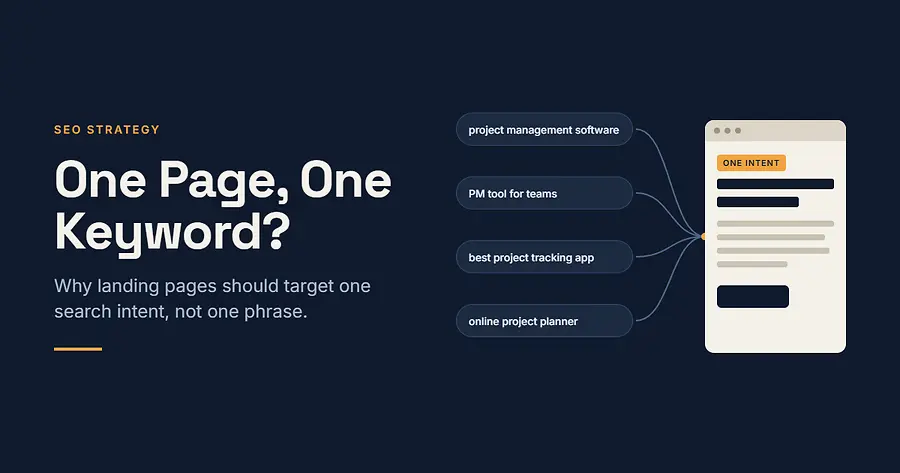
Why the One-Keyword Rule Existed, and What Changed
The one-keyword rule made sense when search engines matched pages to queries by literal text. If you wanted to rank for "cheap flights to Detroit," you needed that exact string in your title, H1, URL, and body. A page trying to rank for five phrases diluted the search engine signals for each one.
As most things in the digital marketing world have shifted, this, too, has changed that math:
- Semantic understanding. Search engines now interpret meaning, not just strings. They know "affordable," "cheap," and "budget" often signal the same need, and that "running shoes for flat feet" and "overpronation sneakers" overlap heavily.
- Pages rank for hundreds of queries. Look at any healthy page in Google Search Console, and you'll typically see it earning impressions for dozens or hundreds of distinct queries, most of which nobody deliberately targeted.
- Passage-level and entity relevance. A well-organized page can rank for a narrower sub-question answered in one of its sections, without that phrase being its headline keyword.
- AI-generated answers. Summaries at the top of results pull from pages that cover a topic thoroughly and clearly. Coverage of related questions now helps visibility rather than diluting it.
The practical result: optimizing a page around a single exact phrase leaves traffic on the table. And spinning up a separate page for every phrase creates problems of its own.
The Real Unit of Optimization: Intent, Not Keywords
The useful question isn't "How many keywords?" It's "How many distinct jobs is the searcher trying to get done?" One job, one page.
A keyword cluster is a group of queries that share the same underlying intent. A page should own one cluster: a primary term that names it, plus the synonyms, variations, long-tail questions, and modifiers that surround it.
For example, consider a project management tool:

The first four phrases are different words for one decision. The last three share vocabulary but describe different people with different goals. Forcing them onto one landing page would mean failing to provide users with what they're looking for.
When to Target Multiple Terms on One Page
Combine keywords on a single landing page when they meet most of these conditions:
- Synonyms and close variants. "Attorney" vs. "lawyer," "sofa" vs. "couch," singular vs. plural. Search engines treat these as near-equivalent; separate pages just split up your authority.
- Same searcher, same stage. Someone typing "payroll software pricing" and "payroll software cost" is at the same point in the buying journey.
- Long-tail questions about the same offer. "Does X integrate with Shopify?" or "Is X HIPAA compliant?" belong as sections or FAQs on the main page, not as standalone pages, unless each has substantial demand and depth.
- The search results look the same. If Google shows largely the same pages for two queries, it already considers them one topic (more on this test below).
- One offer satisfies all of them. If the same product, service, or CTA answers every query, one page is the right home.
The benefits are real: links and engagement accumulate on one URL, you avoid maintaining near-duplicate pages, and the page reads as a complete answer rather than a keyword-stuffed fragment.
When to Split into Separate Pages
Give a term its own page when the intent genuinely differs, even if the words look similar:
- Different audience. "Accounting software for freelancers" and "accounting software for enterprises," for example, need different features, pricing, benefit points, and CTAs.
- Different stage. "What is a heat pump" (learning) and "heat pump installation near me" (ready to buy) should not share a page.
- Different location. A service business in five cities usually needs five location pages, each with real local substance, not one page listing five city names.
- Different product or use case. If a subtopic would need its own pricing, demo, or proof to convert, it needs its own page.
- The search results look different. If Google ranks mostly different pages for two queries, it sees them as different topics.
The Cannibalization Problem
Keyword cannibalization happens when several of your pages target the same intent. Search engines then have to guess which one to rank, and the answer often flips between them. Rankings fluctuate, links and engagement split across URLs, and none of the pages becomes clearly the best.
Signs you have cannibalization include multiple URLs alternating for the same query in Search Console or several pages each ranking on page two for a term none of them wins. The usual fix is to consolidate, merge the content into the strongest URL, 301-redirect the others, and update internal links.
Splitting too aggressively causes cannibalization. Combining too aggressively creates a vague page that ranks for nothing well. Intent is the line between them.
A Practical Framework: The SERP Overlap Test
The most reliable way to decide is to let the search results tell you. Search engines have already grouped queries by intent; you just need to read their grouping.
- List your candidate terms. Pull them from your keyword tool, Search Console, and sales conversations.
- Search each one in a clean (logged-out or incognito) browser, or use an SEO tool's SERP comparison feature.
- Compare the top 10 results for each pair of terms and count the URLs they share.
- Decide by overlap:
- Heavy overlap (roughly five or more shared URLs): same intent. One page.
- Little or no overlap (zero to two shared URLs): different intent. Separate pages.
- In between: look at the type of pages ranking. If one query shows product pages and the other shows guides, split. If both show the same kind of page, lean toward combining.
- Pick a primary term per cluster. Usually, this is the highest-volume, most representative phrase. It anchors the title tag, H1, and URL.
- Map every other term to a page. Each secondary term should have exactly one home. A simple spreadsheet (term, page, role) prevents future cannibalization.
The thresholds aren't sacred. Many SEO tools use similar overlap scoring to build clusters automatically. Treat the numbers as a starting point and use judgment in borderline cases.
How to Structure a Multi-Keyword Landing Page
Targeting several terms doesn't mean cramming them in. It means giving each one a natural, useful place on the page.

A few rules of thumb:
- Write for the reader first. If a variant sounds awkward in a sentence, leave it out. Search engines understand synonyms; readers notice stuffing.
- Cover the sub-questions. The searcher's follow-up questions (price, setup time, integrations, alternatives) are where secondary keywords naturally live.
- Keep one clear CTA. Multiple keywords, one conversion goal. If different terms need different CTAs, that's a sign they need different pages.
- Watch the results. Check Search Console after a few weeks. Queries you didn't plan for will show up; strong ones deserve a section, and off-intent ones may deserve their own page.
A Note on Paid Search and Conversion
For PPC landing pages, the calculus tilts slightly toward focus. Ad platforms reward relevance between keyword, ad, and landing page, and conversion rates generally improve when the page mirrors the exact promise of the ad.
That doesn't mean one page per keyword. It means one page per ad group theme. Group tightly related keywords together, write ads for that theme, and send them to a page built for it. Many teams use dynamic text replacement to swap a headline to match the searcher's term while keeping one underlying page.
Whether organic or paid, the conversion test is the same: Would a person arriving from each targeted query feel they landed in exactly the right place? If yes, the keywords belong together. If someone from one query would feel misdirected, they need a different page.
The Bottom Line
Stop counting keywords and start counting intents. A strong landing page owns one intent completely: it leads with a primary term, weaves in the synonyms and variations searchers actually use, and answers the follow-up questions that come with that need.
Split pages when the audience, stage, location, or offer changes. Combine them when the searcher is the same person asking the same question in different words. When in doubt, check the search results; they'll show you how the search engine has already drawn the line. One page, one purpose. As many keywords as that purpose naturally attracts.
Put It into Practice
Pick your three most important landing pages and run the SERP overlap test. Open Search Console, list the queries each page already ranks for, and check whether any two of your pages are competing for the same intent. You'll likely find quick wins: a variant worth its own section or two pages that should become one.
Want a second set of eyes? Get in touch for a web page keyword audit, and I'll map your keywords to intents, flag cannibalization, and show you exactly which pages to merge, split, or expand.

Kristen is a seasoned marketing leader with 25+ years driving growth for a variety of organizations. As a full-stack marketing professional, she specializes in SEO, SEM, lead generation, and data-driven campaigns managing multimillion-dollar budgets. Currently the Founder + Managing Principal of Digital Hummingbird Marketing., Kristen holds a degree from Florida Atlantic University and a variety of industry…





