People Do Not Live One Identity at a Time: What Disability Justice, Critical Feminism, and DisCrit Teach Us About the Future of Higher Education
Beyond Accommodation: How Disability Justice Can Transform Higher Education's Approach to Inclusion

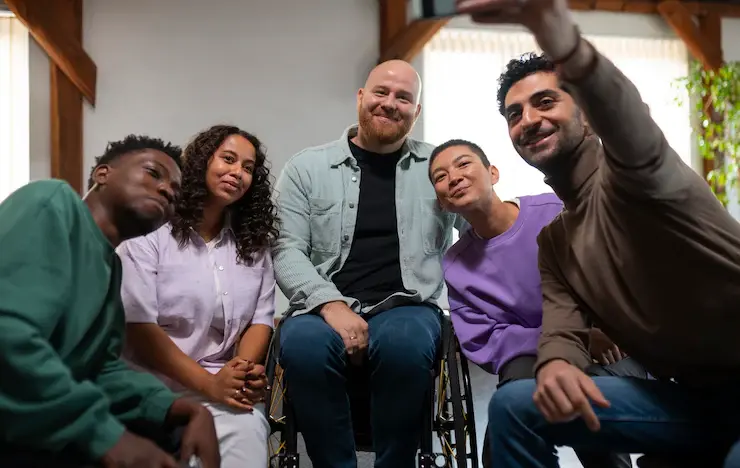
"There is no such thing as a single-issue struggle because we do not live single-issue lives." - Audre Lorde (1984)
Higher education has become increasingly fluent in the language of diversity. We speak confidently about equity. We establish offices for inclusion. We develop accessibility policies. We celebrate diversity through institutional mission statements.
Yet despite these important efforts, many universities continue to approach diversity as though people's identities exist in separate categories. Race belongs to one conversation. Gender belongs to another. Disability is often assigned to accessibility services.
The reality is far more complex. People do not experience their identities one at a time. A disabled woman does not stop being a woman when discussing disability. A Black autistic student does not experience racism separately from ableism. A first-generation student with a learning disability does not navigate higher education through isolated challenges, but through intersecting systems that simultaneously shape opportunity, belonging, and success.
Perhaps this is one of higher education's greatest blind spots. We have become increasingly skilled at organizing diversity. We are still learning how to understand it.
The Limits of the Deficit Model
As a physical therapist, my professional education taught me to identify impairments, improve function, and reduce barriers to participation. Those goals remain essential. However, pursuing graduate studies in Higher Education transformed my understanding of disability. I began to realize that many of the greatest barriers disabled individuals encounter are not created by their diagnoses but by educational systems designed around narrow assumptions of what learning, productivity, intelligence, and success should look like.
This shift mirrors a broader movement within disability scholarship. Rather than asking, "How do we help people fit our systems?" scholars are increasingly asking, "Why were our systems designed this way in the first place?" This question fundamentally changes the conversation.
Disability Justice Is More Than Disability Rights
Many people are familiar with disability rights legislation and accommodations. Far fewer understand disability justice.
Emerging from the work of disabled activists-particularly disabled people of color-disability justice expands beyond legal rights to address the deeper systems of oppression that shape disabled people's lives. Ramirez et al. (2025) describe this movement as a second wave of disability activism grounded in principles such as intersectionality, collective liberation, leadership by those most impacted, love, accountability, and interdependence. Rather than focusing solely on access, disability justice asks how institutions themselves must change to ensure that all people truly belong.
This distinction matters.
Accommodation often responds after barriers exist. Disability justice asks why those barriers were created in the first place.
Why Critical Feminism Belongs in This Conversation
One of the most surprising ideas I encountered was the relationship between disability justice and critical feminism. Traditionally, feminism has challenged systems that privilege certain voices while marginalizing others. Disability justice pursues a remarkably similar goal.
Goulden et al. (2023) argue that both frameworks center the experiences of people historically excluded from dominant systems of knowledge and power. More importantly, both reject the assumption that independence is the ultimate measure of human worth. Instead, they emphasize interdependence, collective care, and mutual aid as essential practices for creating more just communities.
This perspective challenges one of higher education's deepest cultural assumptions. Universities frequently celebrate independence, competition, and individual achievement. Yet education itself has always been relational. Learning happens through communities. Research advances through collaboration. Leadership grows through relationships.
Perhaps interdependence is not the opposite of excellence. Perhaps it is one of its foundations.
DisCrit: Understanding Race and Disability Together
Another framework that profoundly reshaped my thinking is DisCrit, or Disability Critical Race Theory. Developed by Annamma et al. (2013), DisCrit argues that race and disability have historically been constructed together rather than separately. Educational systems have long used assumptions about intelligence, behavior, and ability to justify inequities affecting racialized communities. The framework demonstrates that racism and ableism are not parallel systems operating independently; they frequently reinforce one another through policies, institutional practices, and cultural narratives.
This perspective has important implications for higher education. Students do not arrive on campus carrying separate identities. They bring their whole selves.
Yet universities often organize support through separate offices, separate initiatives, and separate conversations. Mueller and Rajendran (2025) found that students readily recognized racism as a system of oppression but struggled to identify ableism in similar structural terms. Many continued to understand race and disability as separate identity categories rather than interconnected systems shaping educational experiences.
If we teach these issues separately, we risk preparing future educators and leaders to solve only part of the problem.
Beyond Contact: Transforming Systems
Research consistently demonstrates that meaningful engagement with disabled individuals can reduce prejudice. Dole et al. (2025) found that indirect contact-including storytelling, media, education, and authentic narratives-helps challenge stereotypes and foster more positive attitudes toward disability. Likewise, Martiny et al. (2022) argue that engagement should move beyond simple exposure toward experiences that encourage reflection and nuanced understanding.
These interventions are valuable. But disability justice asks us to think further. Prejudice does not disappear simply because people become more familiar with disability. It diminishes when institutions begin redesigning the environments that continue to produce exclusion.
This means examining:
- Curriculum
- Leadership
- Faculty development
- Assessment practices
- Hiring
- Promotion
- Research agendas
- Campus design
Belonging cannot depend solely on changing individual attitudes. It requires transforming institutional cultures.
A Different Vision for Higher Education
Perhaps the greatest lesson disability justice offers higher education is that diversity is not about adding more voices to existing structures. It is about questioning the structures themselves.
It asks difficult questions. Who defines excellence? Whose knowledge is considered legitimate? Who designs our classrooms? Whose ways of learning are rewarded? Whose voices shape institutional decision-making?
These are not disability questions alone. They are leadership questions. Educational questions. Human questions.
As someone whose professional journey bridges healthcare and higher education, I increasingly believe that our responsibility extends beyond helping individuals adapt to existing systems. Our responsibility is also to help redesign those systems. Not because disability is a problem to solve. But because disability reveals possibilities for creating educational environments that are more flexible, equitable, and humane for everyone.
The future of higher education will not be determined by how many accommodations we provide. It will be determined by whether we have the courage to rethink the assumptions upon which our institutions were built.
Because perhaps inclusion is not the destination. Perhaps justice is.
"Disability justice is collective liberation over individual accommodation." - Ramirez et al. (2025)


