People First in the Age of AI: Why Leadership Must Redesign Systems Before Deploying Technology
Why Governance and Resilience Matter More Than Deployment Speed in the Age of Frontier AI

Introduction
Artificial intelligence is advancing faster than most organizations, institutions, and governance systems can fully adapt. Across industries, companies are rapidly deploying AI technologies to improve efficiency, strengthen cybersecurity, accelerate decision-making, and maintain competitive advantage in increasingly volatile global markets. Yet as frontier AI systems become more deeply integrated into enterprise infrastructure and societal systems, leadership is no longer simply about adopting technology quickly.
Stanford Human-Centered AI's 2025 AI Index reported accelerating global AI investment, deployment, and regulatory activity, while McKinsey's State of AI research found that many organizations still struggle to generate sustainable value because governance maturity, workforce readiness, and operational alignment often evolve more slowly than technological capability. Harvard Kennedy School and Microsoft increasingly frame AI transformation as a governance and resilience challenge rather than solely a technology challenge.
The defining question for leadership is therefore no longer whether organizations should adopt AI, but whether their systems, governance structures, and workforce capabilities are prepared to support innovation responsibly. Organizations that succeed in the frontier AI era will likely be those that balance innovation with stewardship, operational speed with resilience, and technological acceleration with human-centered leadership. (Stanford HAI) (McKinsey & Company) (Harvard Kennedy School) (Microsoft)
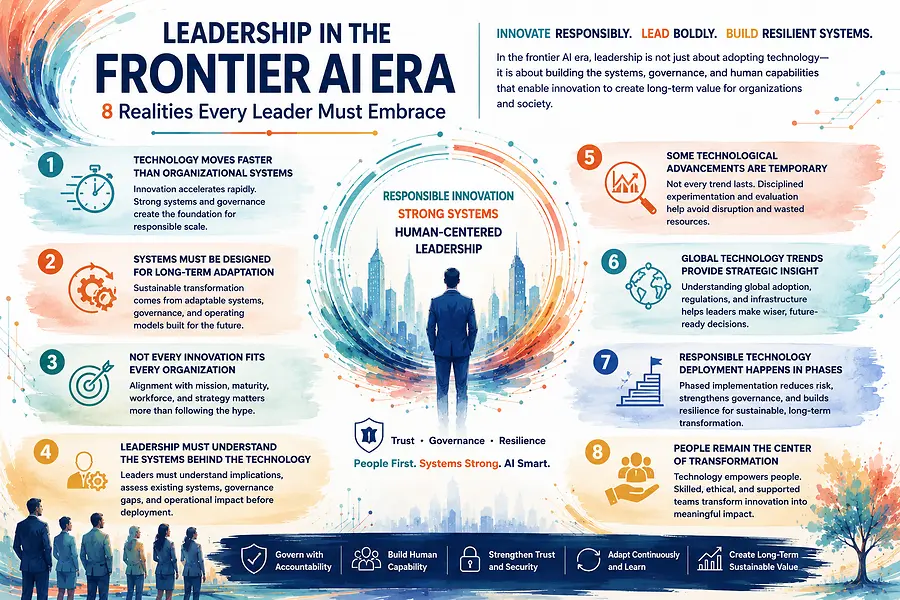
8 Leadership Realities for the Frontier AI Era
1. Technology Moves Faster Than Organizational Systems
Innovation often advances at a pace that governance structures, operational systems, and workforce capabilities struggle to match. Stanford Human-Centered AI reported significant acceleration in enterprise AI deployment and policy activity globally, reinforcing how rapidly technological capability is evolving across industries. Organizations that introduce advanced technologies into systems not designed to support them may unintentionally create operational instability, inefficiency, and systemic risk. Strong systems therefore become the foundation that allows innovation to scale responsibly and sustainably. (Stanford HAI)
2. Systems Must Be Designed for Long-Term Adaptation
Many organizations pursue technology adoption primarily for short-term efficiency gains or immediate financial return. However, McKinsey research increasingly shows that sustainable transformation depends on whether organizations can continuously adapt their systems, governance models, and operational structures alongside evolving technologies. Systems designed only for immediate outcomes often fail under long-term technological acceleration, while resilient systems create the flexibility necessary to support future innovation responsibly. (McKinsey & Company)
3. Not Every Innovation Fits Every Organization
Technological innovation creates pressure to adopt quickly, particularly in highly competitive industries. Yet responsible leadership requires understanding that not every emerging technology aligns with every organization's mission, operational maturity, workforce capability, or strategic direction. Harvard Business School research increasingly emphasizes that organizational alignment and leadership discipline strongly influence transformation success. Effective leaders evaluate both the advantages and limitations of innovation before deployment rather than pursuing technology solely because competitors are doing so. (Harvard Business School)
4. Leadership Must Understand the Systems Behind the Technology
Leaders do not need to be engineers, but they must understand the operational implications of the technologies they deploy. MIT Sloan Management Review emphasized that successful AI implementation depends heavily on leadership alignment, organizational readiness, and management discipline rather than technology capability alone. Responsible leadership requires evaluating what systems already exist, what governance structures are missing, and what operational changes may be necessary before deployment occurs. (MIT Sloan Management Review)
5. Some Technological Advancements Are Temporary
Not every technological trend becomes a lasting transformation. Some innovations emerge rapidly but lose relevance just as quickly. Deloitte's technology and human capital research increasingly highlights the importance of disciplined experimentation, phased testing, and strategic evaluation rather than reactive adoption. Organizations that carefully evaluate emerging technologies before large-scale investment are often better positioned to avoid operational disruption and resource instability. (Deloitte)
6. Global Technology Trends Provide Strategic Insight
Technology evolves within a highly interconnected global ecosystem. Organizations that observe international adoption patterns, regulatory shifts, and infrastructure developments gain stronger insight into how innovations mature over time. Research from Stanford Human-Centered AI and IBM increasingly shows that understanding broader global technology trends helps organizations make more informed decisions about when and how to deploy emerging technologies responsibly. (Stanford HAI) (IBM)
7. Responsible Technology Deployment Happens in Phases
Large-scale technological transformation rarely succeeds through immediate enterprise-wide deployment. PwC and IBM research increasingly emphasize the importance of phased implementation strategies that allow organizations to test systems, identify vulnerabilities, strengthen governance structures, and refine operational processes before broader adoption occurs. This phased approach reduces systemic risk while improving both organizational resilience and long-term transformation outcomes. (PwC) (IBM)
8. Long-Term Success Depends on System Resilience, Not Deployment Speed
Many organizations measure success by how quickly technology is implemented. However, long-term success increasingly depends on how effectively systems function after deployment occurs. IBM Security's Cost of a Data Breach research emphasized that operational resilience, recovery capability, governance maturity, and workforce adaptability are becoming increasingly important as organizations become more dependent on AI-enabled operational systems. Resilient systems allow organizations to manage disruption, recover from setbacks, and continuously adapt as technological acceleration continues. (IBM Security)
3 Real-World Examples
Example 1: Financial Institutions and AI Risk Systems - Governance Determines Technology Success
Major financial institutions are increasingly integrating AI into fraud detection, cybersecurity monitoring, and risk analysis systems. However, organizations that succeed are not simply deploying AI rapidly - they are strengthening governance structures, operational controls, compliance systems, and decision frameworks to ensure that the technology operates responsibly within highly regulated environments. JPMorganChase, Microsoft, and IBM have all emphasized the growing importance of governance maturity and operational resilience as AI becomes more integrated into enterprise risk systems. The lesson is clear: the strength of the system ultimately determines the success of the technology. (IBM) (Microsoft)
Example 2: Healthcare Technology Adoption - Technology Must Operate Within Human-Centered Systems
Healthcare organizations are increasingly deploying digital platforms, AI-assisted diagnostics, and predictive operational systems to improve patient care and efficiency. Yet successful implementation requires rigorous governance, regulatory oversight, phased deployment, and resilient operational systems designed to protect patient safety and institutional trust. Harvard Medical School and leading healthcare systems increasingly emphasize that healthcare technology must operate within systems specifically designed to prioritize human well-being, ethical oversight, and operational accountability. Technology alone cannot compensate for weak systems in environments where human impact is significant. (Harvard Medical School)
Example 3: Phased Digital Transformation in Global Enterprises - Resilience Through Incremental Adaptation
Large global enterprises increasingly deploy new technologies through phased digital transformation strategies rather than immediate large-scale implementation. Organizations often test systems incrementally, evaluate operational performance, strengthen infrastructure, and refine governance structures before expanding adoption enterprise-wide. McKinsey, IBM, and Deloitte research increasingly suggests that phased transformation strategies reduce systemic risk, improve organizational adaptability, and strengthen long-term operational resilience. This approach demonstrates that sustainable innovation is often built through disciplined adaptation rather than accelerated disruption. (McKinsey & Company) (IBM) (Deloitte)
Conclusion
Leadership in the frontier AI era is no longer defined solely by operational efficiency or the speed of technology adoption. It is increasingly defined by stewardship during continuous technological acceleration. Artificial intelligence has extraordinary potential to transform industries, strengthen organizational capability, and create new opportunities across society. Yet technology alone does not determine success-leadership does.
As frontier AI becomes more deeply embedded into enterprise infrastructure and societal systems, leaders must balance innovation with accountability, automation with human-centered governance, and operational speed with long-term resilience. Research from Harvard Kennedy School, Stanford Human-Centered AI, McKinsey, IBM, and Microsoft increasingly frames AI transformation not simply as a technology challenge, but as a governance, workforce, and institutional resilience challenge. Organizations that prepare their people, strengthen governance, modernize operational systems, and build resilience will be better positioned to innovate responsibly while adapting to continuous technological change.
The organizations that thrive in the age of frontier AI will likely not be those that adopt technology the fastest, but those that integrate people, systems, innovation, governance, trust, and sustainability into every stage of transformation. Responsible leadership requires more than deploying AI-it requires building organizations capable of adapting continuously without losing operational integrity, institutional trust, or human purpose.
The future of leadership is therefore not technology alone, but the intelligent integration of people, systems, governance, resilience, and innovation to create sustainable long-term value.
People first. Systems strong. AI smart.