Presenting the Airport Analysis Series! KSAN
Exploring San Diego International Airport: A Military Hub and Aviation Gateway

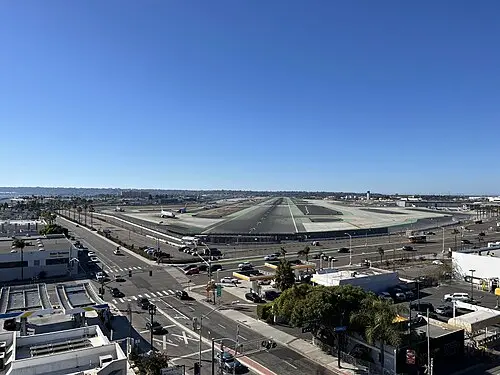
Welcome back, dear readers! We're starting a new series, given the prevalence and fascinating nature of both new and classic airports, as well as the far-reaching effects they have on local communities and geopolitics. I will not be covering every airport, as that would be ridiculous, self-serving, and, at best, serve no purpose for value travelers. Rather, I am focusing on airports with either profound importance to the local economy and populace or airports that are utterly fascinating in a truly unique sense relevant to the experience of travel.
In the past, we've covered KSFO (San Francisco) in California and FRA (Frankfurt) in Germany.
San Diego International Airport (KSAN)
We shall officially start this series with a small airport that is nevertheless critical to regional logistics. I refer, of course, to San Diego International Airport (ICAO code: KSAN). Located just 2.8 miles north-northwest of downtown San Diego, California, and essentially integrated into the city's daily life, much of KSAN's passenger traffic is military in origin.
This makes sense when you consider that San Diego is the headquarters of the U.S. Navy's Pacific Fleet Command (USPACFLT), relocated from Pearl Harbor after World War II. It is also home to Naval Amphibious Base Coronado, the central base of the U.S. Navy's SEAL and Basic Underwater Demolition/SEAL (BUD/S) training programs, as well as Naval Air Station North Island.
Naval Base Coronado and NAS North Island
NAS North Island is part of the larger Naval Base Coronado and serves as the home port for numerous Nimitz- and Ford-class aircraft carriers of the U.S. Navy. NAS North Island itself hosts 23 aviation squadrons and 80 additional transient or tenant commands and activities. One of these, Fleet Readiness Center Southwest, is San Diego's largest aerospace employer.
NAS North Island also administratively operates two other airfields in the Southern California region. One is Naval Auxiliary Landing Facility (NALF) San Clemente Island, located approximately 70 miles (110 km) northwest of San Diego in the Channel Islands. NALF-SC works closely with California State University Channel Islands (CSUCI) on scientific research involving environmental studies, deep-ocean research, and wildlife preservation.
The other is Naval Outlying Landing Field Imperial Beach (NOLF-IB). Formerly an independent naval air station, NOLF Imperial Beach is located in the city of Imperial Beach on the U.S.-Mexico border, 10 miles (16 km) south of NAS North Island.
Without a doubt, Naval Base Coronado is one of the largest installations of the U.S. Navy in the world, with the possible exception of the semi-secretive naval installation on Diego Garcia in the Indian Ocean. Its importance cannot be understated; NAS North Island resembles a small city in both its facilities and daily operations.
It has its own police and fire departments, as well as advanced military security installations. It contains large factory-type buildings that comprise the Naval Aviation Depot, employing approximately 3,300 civilians, along with its own commissary, Navy Exchange facilities employing Department of Defense-authorized civilians, and housing units for deployed personnel. Recreational amenities include officers', chief petty officers', and enlisted clubs, a movie theater, golf course, tennis courts, bowling alley, parks, and beaches.
Keep in mind that NAS North Island and its parent installation, Naval Base Coronado, lie within the greater San Diego metropolitan area.
NAS North Island's central airfield has more than 230 stationed aircraft, and it serves as the permanent home port for three aircraft carriers: USS Abraham Lincoln, USS Carl Vinson, and USS Theodore Roosevelt. Other carriers dock there as needed. Additionally, the base was once home to the Navy's only Deep Submergence Rescue Vehicles, Mystic (DSRV-1) and Avalon (DSRV-2). The support ships for these DSRVs were also homeported there.
I mention all of this not to provide a lecture on military logistics and infrastructure, but to reinforce the point that Naval Base Coronado, together with NAS North Island, contributes significantly to San Diego International Airport's passenger traffic and employment base. With KSAN ranking close behind, military installations employ a substantial portion of the San Diego metropolitan region. As of 2024, approximately 64-67% of the population of San Diego and its surrounding suburbs was employed by the U.S. Navy in some capacity.
The Airport Itself
Now, the airport itself.
San Diego International Airport is owned and operated by the San Diego County Regional Airport Authority. It operates within controlled airspace served by Southern California TRACON (Terminal Radar Approach Control), which is a division of the Federal Aviation Administration (FAA) based in nearby Miramar, California, of Top Gun fame.
Southern California TRACON manages Class B and Class C airspace extending north to San Luis Obispo. Beyond that point, control transitions to NorCal TRACON. Northern California TRACON is based at the former U.S. Air Force installation at Mather, California, which evolved into a civilian community following the Base Realignment and Closure (BRAC) process in 1995.
San Diego International Airport is often regarded as one of the more challenging airports in North America. Its approach path passes close to the skyscrapers of downtown San Diego and can prove demanding for pilots due to the relatively short usable landing area, the steep descent over the crest of Bankers Hill, shifting wind currents immediately before landing, and the limitations associated with operating a major airport with a single runway.
A Brief History
As an abbreviated history, it suffices to say that prior to the airport's development, the area formed part of the San Diego River delta, which discharged into San Diego Bay at the Pacific Ocean. The river was later rerouted to empty directly into the Pacific Ocean west of Mission Bay, creating sufficient land for the airport without dredging the river.
The United States Army Air Corps took control of the municipal airfield in 1942 and expanded it to accommodate heavy bombers manufactured in the region, as well as bomber crew training. Two cantonment areas, Camp Consair and Camp Sahara, were established during World War II to house transient pilots and crews.
Improvements included the construction of an 8,750-foot (2,670-meter) runway capable of accommodating large aircraft before the advent of jet airliners. A May 1952 chart shows an 8,700-foot Runway 9 and a 4,500-foot Runway 13.
The airport is near the site of the Ryan Aeronautical Company factory, where the Spirit of St. Louis was built for Charles Lindbergh's historic 1927 transatlantic flight. Inspired by Lindbergh's achievement and proud to have produced his aircraft, the city of San Diego approved a bond issue in 1928 to construct an airport. Lindbergh encouraged the project and agreed to lend his name to it.
Today, San Diego International Airport continues to bear the name Lindbergh Field, and a replica of the Spirit of St. Louis hangs from the ceiling of Terminal 2.
After the U.S. Coast Guard certified the airport for long-haul operations and San Diego entered the Jet Age, Pacific Southwest Airlines (PSA) established its headquarters there and began service at Lindbergh Field in 1949.
The April 1957 Official Airline Guide listed 42 departures per day: 14 by American Airlines, 13 by United Airlines, 6 by Western Airlines, 6 by Bonanza Air Lines, and 3 by PSA (increasing to 5 PSA departures on Fridays and Sundays).
For at least a decade, SDIA functioned primarily as an intrastate airport. The first scheduled jet services at Lindbergh Field began in September 1960 with American Airlines Boeing 720 flights to Phoenix and United Airlines Boeing 720 flights to San Francisco. Nonstop service to Chicago began in 1962, followed by New York in 1967. By the end of the 1960s, San Diego had firmly entered the global aviation network.
Governance and Relocation Debates
In 2001, the San Diego County Regional Airport Authority (SDCRAA) was created through California State Assembly Bill 93. The SDCRAA assumed jurisdiction over the airport in December 2002, taking over from city and port authorities and ending a nearly century-long game of administrative "hot potato."
The prospect of relocation has haunted the SDCRAA for most of its existence. Beginning in the 1950s, numerous proposals emerged. The city acquired what is now Montgomery-Gibbs Executive Airport and much of the surrounding land through eminent domain in hopes of constructing a replacement airport. However, the Korean War brought a massive expansion of jet traffic to nearby Naval Air Station Miramar, later transferred to the U.S. Marine Corps in 1994 and redesignated as MCAS Miramar. This development rendered a commercial airport in the area impractical.
The Civil Aeronautics Board refused to help fund major enhancements to SDIA during the 1950s, and the city proposed NAS North Island, Mission Bay, and Brown Field near the outer suburb of El Cajon as possible replacements. Construction costs, operational conflicts with the U.S. Navy, and interference with other forms of air traffic permanently stalled these proposals.
In 1964, the FAA finally agreed to an expansion of SDIA that led to the construction of today's Terminal 1. However, approval came only after assurances from then-Mayor Charles Dail that the expansion would serve as a temporary solution until a replacement airport could be found.
As of 2026, the search for a replacement airport continues, even as the new Terminal 1, the Terminal 2 West expansion, and the Terminal 2 International Arrivals complex have been completed.
21st-Century Expansion
The first major 21st-century expansion of the airport was "The Green Build," which added 10 gates to Terminal 2 West, along with a new security checkpoint, a scenic dining area dubbed "Sunset Cove," a new USO Center, and a dual-level arrivals and departures roadway serving the entirety of Terminal 2.
Completed on August 13, 2013, at a cost of $900 million USD, it was followed in January 2016 by the opening of a consolidated rental car facility on the airport's north side.
I can personally attest that Sunset Cove is gorgeous. Having passed through it four times, I can say it offers outstanding panoramic plane-spotting opportunities, especially for such a small airport.
The $316 million USD, 2-million-square-foot facility houses 14 rental car companies and is connected to the terminals by shuttle buses. In July 2016, construction also began on a three-story, 5,200-space parking structure in front of Terminal 2, which was completed in May 2018.
Terminals, Gates, and Runway
KSAN still has only two primary terminals. Terminal 2 West is an expansion of Terminal 2, while the International Arrivals complex functions as an annex on the eastern side near the rental car center.
According to publicly available information, San Diego International Airport has two terminals and 50 gates:
- Terminal 1 (T1): Currently has 19 gates in operation, with 11 additional gates planned by 2028.
- Terminal 2: Consists of two concourses. The older East Concourse (T2-East) has 12 gates, while the newer West Concourse (T2-West) has 19 gates and houses the airport's international arrivals facility.
The airport has only one runway, designated 09/27 based on its magnetic headings of 095 and 275 degrees. Constructed of asphalt and concrete, the runway measures 9,401 by 200 feet (2,865 m × 61 m).
The west end of the runway features an Engineered Materials Arresting System (EMAS), installed in 2006 and expanded in 2021. Simply put, EMAS is a bed of crushable engineered materials designed to reduce the severity of an aircraft overrun.
Only one airline maintains a hub at San Diego International Airport: Alaska Airlines. Alaska uses KSAN as a secondary hub, with its primary hub located at Seattle-Tacoma International Airport farther north.
Thank you for reading about the third airport we've covered and the first installment in the Airport Analysis Series by Brooke In The Air Travel LLC!
Read and learn more through our blogs at brookeintheairtravel.net.


