Project Sunrise Analysis
How Qantas is revolutionizing long-distance aviation with Project Sunrise's nonstop Sydney-London flights.

For Time Immemorial: Australia's Quest for Nonstop Global Flight
For time immemorial, Australia has been virtually cut off from any conceivable nonstop aviation service, particularly a sustained route from Sydney or anywhere else viable on the Australian east coast. This is soon about to change thanks to innovation by Australia's flag carrier, Qantas Airways.
The Kangaroo Route
The closest travel itinerary in Qantas history was a winding travel system called the Kangaroo Route. It originated in Sydney or Melbourne, traveled across the continent to Perth on the west coast, and then continued in a "hopping route" from Perth to Singapore (or Manila), Bombay (now Mumbai), Sri Lanka, Baghdad (Iraq) or Amman (Jordan), Rome, Paris, and finally London. Each of these stops was primarily for refueling.
The entire grueling journey took between 8 and 12 days and cost approximately 128 British pounds sterling, the rough equivalent of $50,000 USD in 2026 dollars when adjusted for inflation.
World War II created significant logistical challenges for Qantas shortly after the Kangaroo Route began operation. Both the Australian government and Qantas executives considered canceling the route. Instead, Qantas chose to find ways around the conflict. The old saying, "There is a fine line between brave audacity and stupidity," has rarely been more applicable than in Qantas' efforts to bypass the realities of the Pacific theater during the Allied island-hopping campaign against the Empire of Japan.
Qantas accomplished this by operating transcontinental flights from Sydney to Perth or from Darwin in northern Australia. From there, aircraft flew to British military airfields near Singapore, which initially provided some protection. Once Singapore fell to the Imperial Japanese Army, the route shifted to British-controlled territory in India. From there, flights followed a southern route under Royal Air Force jurisdiction. Remarkably, this route remained viable for the duration of the war.
The Double Sunrise Route
In 1946, shortly after the war, Qantas improved the route by purchasing five former military Catalina PBY flying boats to increase operational flexibility. Over time, advances in aircraft technology steadily reduced travel times and simplified the itinerary.
By the late 1980s and early 1990s, Qantas continued the route to London using the Boeing 747-400, significantly shortening the journey. Flights departed Sydney, stopped in Abu Dhabi or Muscat for refueling, then made a final stop in Berne or Zurich, Switzerland, before continuing to London. This service became known as the Double Sunrise route.
The primary challenge was never passenger demand; there was plenty of it. The real limitation was aircraft range. The Boeing 747 offered exceptional range and flexibility, but it was fuel-hungry, expensive to operate and maintain, and required pilots and crew members to remain type-rated on the aircraft. In other words, once certified on the 747, they could not simply switch aircraft without obtaining certification on another type. Within Qantas' fleet during that era, that often meant moving to a much smaller aircraft such as a Boeing 727.
For many years, the world's longest commercial route was Singapore Airlines' service between Singapore Changi Airport and New York. The airline operated flights to both JFK and Newark, with the route covering approximately 9,537 miles and requiring roughly 19 hours in the air, or about 19.5 hours gate-to-gate.
Qantas is set to eclipse that achievement with the launch of Project Sunrise in October 2027. The name is a tribute to the Double Sunrise route, during which passengers would witness two sunrises during their journey. Project Sunrise will introduce what is effectively the first truly nonstop, near-circumnavigational commercial flight, connecting Sydney directly to London and soon afterward Sydney directly to New York.
"Brooke, how is this being done? I thought it was impossible?" I hear you asking. The answer is fascinating.
Project Sunrise
The Airbus A350-1000ULR
Qantas has placed a confirmed order for 12 Airbus A350-1000ULR aircraft. ULR stands for Ultra Long Range. The A350-1000ULR is a specially modified version of the Airbus A350-1000 and builds upon concepts pioneered by Singapore Airlines for its ultra-long-haul operations.
These aircraft are customized with additional fuel capacity, including approximately 5,800 pounds of extra fuel stored in an auxiliary rear fuel tank. Additional fuel storage is also integrated into the wing structure.
Only 238 passengers will be accommodated aboard the A350-1000ULR, helping reduce weight and maximize range. It ultimately comes down to physics. Earth's atmosphere is dense enough that every additional pound carried requires more energy to lift and sustain in flight. The lighter the aircraft, the easier it is to reach and maintain efficient cruising altitudes. This principle has long influenced aviation design and partially explains the historical appeal of lighter-than-air aircraft.
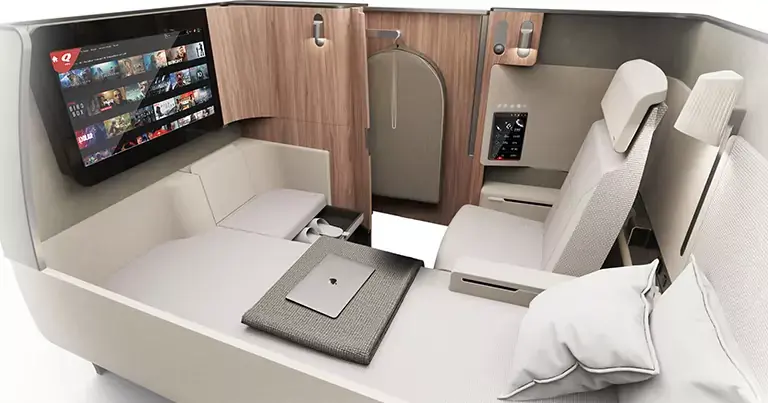
Project Sunrise also introduces entirely new cabin concepts. While not necessarily the most luxurious cabins ever created, they are certainly designed for comfort during flights lasting more than 20 hours. Based on current renderings, the First Class suites are particularly impressive, while the Business Class cabin meets—and in some respects exceeds—modern international standards.
Officially customized and designed by Qantas, this configuration features the lowest seat density of any Airbus A350-1000 in commercial service, surpassing even Singapore Airlines' ultra-long-range variants. Passenger wellness is a major focus, with advanced circadian-rhythm lighting throughout the aircraft and a dedicated stretch and movement area known as the Wellbeing Room, located between Premium Economy and Economy.
Cabin Classes
Project Sunrise will offer four distinct cabin classes: First Class, Business Class, Premium Economy, and Economy.
The First Class cabin consists of six suites arranged in a 1-1-1 configuration across two rows. Each suite includes a separate bed and seat, featuring an 80-inch flat bed alongside a reclining armchair. A 34-inch entertainment screen is mounted on an adjustable arm. The suites are fully enclosed with floor-to-ceiling walls and privacy doors.
As an additional feature, First Class passengers can enjoy in-suite dining for two. The flexible workspace allows a guest to join the occupant for a private meal.
Project Sunrise will also offer 52 Business Class suites equipped with sliding privacy doors—a first for Qantas. While privacy doors are no longer a unique innovation across the airline industry, they represent a significant enhancement for the carrier.
The Business Class cabin is arranged in a 1-2-1 configuration, ensuring every passenger has direct aisle access. Adjustable dividers between center seats allow travelers either complete privacy or the option to travel together comfortably.
Premium Economy consists of 40 seats arranged in a 2-4-2 configuration across multiple rows. The seats feature custom-designed 8-inch winged headrests for enhanced privacy and comfort. Additional amenities include specialized calf rests and ergonomic memory foam cushioning to improve comfort on ultra-long-haul flights.
Economy Class, which accounts for 140 seats, has also been redesigned. Passengers will enjoy a generous 33-inch seat pitch, exceeding the standard found on many long-haul aircraft.
An Economy Plus section will be located at the front of the Economy cabin, offering a 34-inch seat pitch and priority overhead-bin access. Seats throughout the cabin are upholstered with woven Pilbara wool-blend fabrics designed to regulate body temperature during flights exceeding 20 hours—a welcome feature on a journey from Sydney to London that may last nearly 22 hours.
What We Know So Far About Project Sunrise
This is what we know so far about Project Sunrise ahead of its planned October 2027 launch.
American travelers can already purchase tickets for nonstop services between New York and Sydney. While pricing has not yet been fully finalized across all routes, it is safe to assume these flights will command a premium due to their unprecedented range and specialized onboard experience.
You can simplify the planning process by booking your itinerary through Brooke In The Air Travel LLC at brookeintheairtravel.net.