Recruiting is Brokent
Rebuilding Trust and Intention in a Broken Hiring System

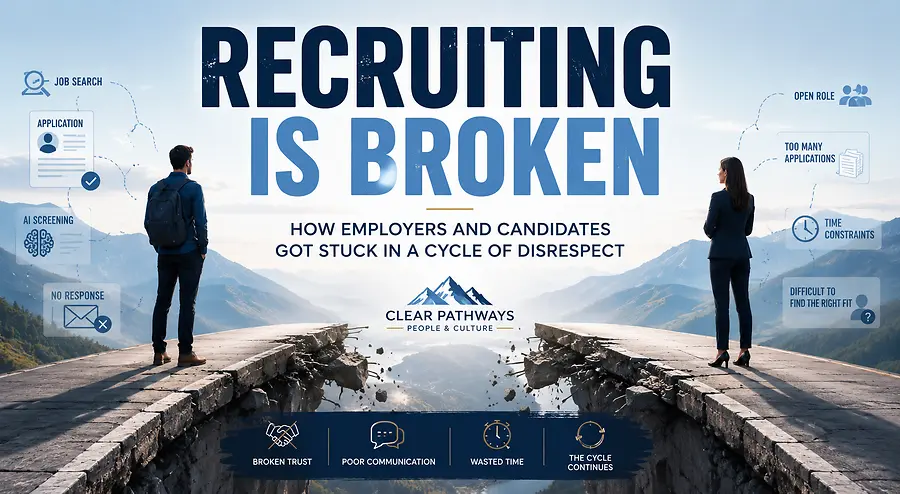
It’s Time to Fix Recruiting!
We’ve spent so much time debating whether candidates or employers are behaving worse that we’ve forgotten the real problem:
The hiring relationship has lost trust.
After nearly two decades in HR, I have watched recruiting change.
I have recruited through different labor markets. I have sat beside hiring managers trying desperately to fill positions. I have spoken with candidates who were excited, nervous, discouraged, hopeful, and exhausted. I have watched technology fundamentally change how people find jobs and how organizations find people.
But lately, the frustration feels different.
My social media feeds are increasingly filled with candidates, recruiters, HR professionals, and hiring managers saying some version of the same thing:
The process is broken.
One job seeker described the cycle this way:
“The system is eating itself.”
In another discussion, a recruiter described candidates taking longer to respond, offers getting more pushback, hiring managers becoming simultaneously pickier and slower, and roles that once took three weeks to fill stretching to six or eight. The recruiter summed up the mood simply:
“Everyone is just... hesitant.”
And another recruiter, overwhelmed by enormous application volume and AI-polished résumés, wrote:
“The process is broken right now.”
These are individual public comments, not scientific evidence. But they illustrate the emotion surrounding recruiting right now from both sides.
Source: Reddit
And the broader data suggests that frustration is not confined to social media.
LinkedIn reported in 2025 that 50% of job seekers and 64% of hirers said the hiring process had become harder. Thirty-seven percent of job seekers said they were applying to more jobs than ever but hearing back less. On the employer side, 22% of HR professionals said they were spending three to five hours a day reviewing applications, while 73% said fewer than half of the applications they received met all the criteria listed for the position.
Source: LinkedIn
Think about what that creates.
Candidates aren’t hearing back, so they apply to more jobs.
Employers receive more applications, so they look for faster ways to screen them.
Candidates know they are being screened, so they optimize harder to get through the system.
Employers become increasingly skeptical about whether what they are seeing accurately represents the candidate.
So they add more screening, more interviews, more assessments, or more technology.
Then candidates respond again.
And around and around we go.
Candidates don’t trust the process. Employers don’t trust the applications.
Maybe the most important thing we can do now is stop arguing about who started it.
Stop Arguing About Who Started It
Spend enough time talking about recruiting right now, and eventually the conversation becomes a competition over who is behaving worse.
Candidates say employers ghost them.
Employers say candidates ghost them.
Candidates say companies make them complete five interviews and then disappear.
Recruiters say candidates schedule interviews, accept offers, or even commit to start dates and then stop responding.
Candidates say employers use algorithms and AI to reject them before another human being ever meaningfully considers their experience.
Employers say candidates are submitting AI-generated résumés and applications that sometimes bear little resemblance to the person they eventually meet.
Both sides have legitimate complaints.
Greenhouse reported that 61% of job seekers surveyed in 2024 said they had been ghosted after an interview. Its later workforce research found candidate ghosting going the other direction as well: 50% of U.S. candidates surveyed said they had ghosted an employer during the hiring process.
Source: Greenhouse
So who started it?
At this point, I don’t think it matters.
We can keep tracing bad behavior backward forever.
What concerns me more is that we have started using someone else’s disrespect as justification for our own.
“Employers don’t respond, so why should I bother responding to the recruiter?”
“Candidates disappear anyway, so why should we personally close the loop?”
“No one reads cover letters, so why put effort into one?”
“Most applicants aren’t qualified, so automate everything.”
“The process is automated anyway, so let AI create everything and apply everywhere.”
That is how bad experiences become norms.
And eventually, everybody lowers their expectations of everybody else.
I don’t think that is acceptable.
Both things can be true at the same time.
Candidates are allowed to be frustrated with employers.
Employers are allowed to be frustrated with candidates.
Recruiters can be overwhelmed.
Hiring managers can be frustrated.
But none of us gets to use someone else’s behavior as permission for our own.
That is why I keep coming back to one principle:
It may not be my fault, but it is my responsibility.
No individual candidate created today’s labor market.
No individual recruiter created it either.
Neither did one hiring manager or one HR professional.
But each of us controls how we participate in it.
We cannot continue participating in a broken system and then complain that the system is broken.
What I’ve Watched Happen From Inside HR
Over the years, I have watched candidates apply for positions without knowing what role they applied for.
I have literally had conversations where the response was some variation of:
“Which job is this again? I’ve applied to so many.”
I have seen outdated résumés that don’t match what comes out during the interview.
I have seen candidates arrive without researching the organization or understanding the position.
I have watched people disappear halfway through a process.
And increasingly, I have seen application materials so polished that the person behind them cannot explain the experience or accomplishments being presented.
That is frustrating.
But employers do not get a free pass.
I have watched managers enter interviews late and unprepared.
I have watched hiring managers walk in without having read the résumé, without questions prepared, and without a clear idea of what they were evaluating.
I have watched someone decide they “liked” one candidate and quietly change the standard for everyone who came after.
I have seen Candidate A rejected for something completely overlooked in Candidate B.
I have seen strong candidates lost because nobody could make a decision.
I have watched organizations change what they wanted halfway through the search.
And I have heard a phrase throughout my career that still makes me cringe:
“We just need a body in the seat.”
A person is not a body in a seat.
That person may become responsible for your customers.
Your employees.
Your production.
Your safety.
Your culture.
Your reputation.
Your next generation of leadership.
The person you hire today can strengthen an organization for years—or create problems that take years to unwind.
So why are we treating hiring like an administrative inconvenience?
We know hiring matters. We just don’t always behave like it does.
And I do not believe every recruiting problem is actually a recruiting problem.
Sometimes the job was never clearly defined.
Sometimes the manager doesn’t know what success looks like.
Sometimes compensation is misaligned.
Sometimes leadership created an emergency because there was no succession planning.
Sometimes the hiring manager was never taught how to interview.
Sometimes employer branding is completely disconnected from the lived culture.
And sometimes HR has been reduced to scheduling interviews and processing paperwork instead of being empowered to challenge the process.
That is why recruiting must be treated as an organizational discipline, not simply an HR task.
Volume Has Replaced Intention
Somewhere along the way, recruiting became a numbers game.
Candidates are told to apply to more jobs.
Recruiters are told to generate more applicants.
Hiring managers ask to see more résumés.
Technology promises to process more people faster.
And eventually, we start celebrating activity without asking whether any of that activity is producing better decisions.
More applications do not automatically mean more qualified candidates. More interviews do not automatically mean better hiring decisions. More automation does not automatically mean a better recruiting process.
Sometimes it just means more noise.
Ashby’s 2026 Talent Trends work illustrates how intensive hiring has become. Its recruiting-operations analysis covers 54 million applications and 93,000 jobs, while a separate productivity analysis covering 109 million applications found that by Q1 2026, an average technical hire involved 23.3 hours of interview time and an average business hire involved 12.2 hours.
Source: Ashby
Candidates feel pressure to play the volume game too.
And I understand why.
If you have applied to 100 jobs and heard almost nothing, applying to another 100 can feel like the only rational response.
But eventually:
Click.
Submit.
Next.
Click.
Submit.
Next.
The strategy becomes:
“If I apply to enough jobs, eventually somebody has to respond.”
Meanwhile, employers look at enormous applicant pools and ask how a recruiter could possibly review everything thoughtfully.
So we automate more.
Which encourages candidates to optimize more.
Which generates more volume.
Which drives more automation.
Volume has started replacing intention on both sides.
And employers need to look in the mirror too.
“Posting and praying” is not a recruiting strategy.
Recruiting should begin with understanding who you need, what they need to accomplish, what capabilities matter, what the organization can realistically pay, where that talent might be found, and what process will help both sides determine whether they can succeed together.
Candidates deserve the same challenge.
I am not asking a struggling job seeker to spend three hours rewriting every application.
I am asking them to stop spending three minutes applying for jobs they don’t actually want.
Read the posting.
Research the company.
Use the cover letter when it gives you an opportunity to connect your experience to the role.
Show relevant work samples when appropriate and when you can do so without exposing confidential information.
Network like a human being.
And tailor your story toward outcomes, not merely keywords.
A difficult labor market may still require volume.
But volume needs strategy.
I would rather see ten jobs you seriously pursued than 100 jobs you barely remember applying for.
AI Didn’t Break Recruiting—But It Can Magnify What Was Already Broken
I am not anti-AI.
I use AI.
I think it can be an incredible tool.
But there is a difference between using technology to help us think and asking technology to do the thinking for us.
Candidates are using AI to create and tailor résumés, draft cover letters, prepare interview responses, find opportunities, and navigate application systems.
Employers are using AI for sourcing, screening, job-posting assistance, scheduling, candidate matching, communication, interview support, and analysis.
The question is not whether AI belongs in recruiting.
It already does.
The better question is:
Where does AI make this process better, and where does a human still need to show up?
Greenhouse’s 2026 U.S. AI-in-hiring research surveyed 1,200 job seekers, 219 recruiters, and 446 hiring managers. It found that nearly three-quarters of candidates were using AI somewhere in their job search, while 46% of job seekers said trust in the hiring process had declined. Greenhouse’s accompanying guidance emphasizes transparency about AI use and keeping humans visibly involved in hiring decisions.
Source: Greenhouse
That tension matters.
Employers may be experiencing efficiency.
Candidates may be experiencing opacity.
Both can be true.
If AI helps draft a posting, great.
Someone who understands the position still needs to confirm that the posting accurately describes the real job.
If AI helps organize an overwhelming application pool, useful.
The recruiting team still needs to understand how the system is being used and retain meaningful human judgment over important decisions.
If AI helps a candidate improve the wording of a résumé, fine.
The accomplishments, capability, judgment, and experience being represented still need to belong to the candidate.
Because ultimately:
We are not hiring a résumé. We are hiring a person.
And candidates are not choosing a careers page.
They are choosing an organization full of people.
That is why I worry about an algorithm talking to another algorithm until two human beings finally meet near the end.
Where are the humans in Human Resources?
Automation absolutely has a place.
Not every applicant needs a personal phone call.
Scheduling is a fantastic place to remove administrative burden. Ashby’s 2026 operational benchmarks, for example, found automated interview scheduling was faster than manual scheduling in its dataset.
Source: Ashby
The purpose of technology should be to create more room for meaningful human judgment and interaction, not remove it altogether.
Use AI.
Use it responsibly.
Use it thoughtfully.
Use it to remove work that keeps recruiters away from people.
But don’t turn the recruiting relationship over to it.
Candidates are using technology to get past employer technology, while employers are using technology to sort through increasingly technology-assisted applications. Somewhere in the middle, the actual relationship can disappear.
The Employment Relationship Starts Before Day One
One of the biggest mistakes organizations make is acting as though the employment relationship begins when someone signs the offer.
It doesn’t.
The employment relationship starts before Day One.
Gallup’s employee-experience framework explicitly includes attraction and hiring as part of the employee journey. Gallup also notes that what candidates experience during hiring communicates the organization’s culture and decision-making style, and that onboarding should fulfill the promises made during recruitment.
Source: Gallup
That means recruiting is already teaching candidates what it might feel like to work for you.
If communication is one of your values but you disappear for three weeks between interviews, what did the candidate learn?
If respect matters but the hiring manager arrives twenty minutes late without reading the résumé, what did they learn?
If development matters but nobody can explain what success or growth looks like, what did they learn?
If transparency is a value but the compensation, schedule, or responsibilities suddenly change halfway through the process, what did they learn?
Candidates are evaluating the gap between what you say your culture is and what your behavior tells them it actually is.
They should be.
The organization is interviewing the candidate.
The candidate is interviewing the organization too.
The power dynamic should not be:
“We have the job. You want it. Convince us.”
It should be mutual evaluation.
Can we be successful together?
And candidates who do not get hired still matter.
They may apply again.
They may become customers.
They may know your next great hire.
They may recommend your organization.
Or they may tell everyone in their network never to apply.
That is employer brand.
Not the careers-page video.
Not the stock photo.
Not the beautifully written values statement.
Employer brand is what people experience and then repeat to other people.
One standard I would love organizations to adopt is this:
A candidate should be able to walk away disappointed about the outcome without being disappointed in the organization.
That candidate should be able to say:
“I really wanted the job, but I would apply there again.”
That is not a failed recruiting experience.
It is relationship building.
And it matters because retention starts earlier than we think.
If a person leaves six months later, do not immediately say:
“Bad hire.”
Ask when the relationship actually started breaking.
Did the posting accurately describe the job?
Did we oversell the team?
Were barriers to success disclosed?
Did the manager follow through on promises?
Was onboarding built around what the employee actually needed?
Was there a disconnect between the person we interviewed and the position we placed them into?
Turnover doesn’t always begin when an employee decides to leave. Sometimes it begins in the job posting, the interview, the promises we make, the questions we fail to ask, or the first weeks when what we sold and what they experienced stop matching.
Write Better Jobs Before You Recruit Better People
One of the fastest ways to create a bad recruiting process is to begin recruiting before anybody clearly defines the job.
Someone resigns.
The manager says:
“We need to replace them.”
HR finds the old job description.
The posting goes live.
Only after interviews begin does everyone start debating what they actually need.
That is backwards.
Before asking candidates to prove they are qualified, the organization should be able to explain what they are being hired to accomplish.
What problems must this person solve?
What does success look like in 90 days? Six months? A year?
Which capabilities do they need immediately?
What can be taught?
What environment are they entering?
Why would a strong candidate want this job?
A job description documents the job. A job posting should communicate the opportunity.
And stop using credentials as a shortcut for thinking.
There are absolutely positions where degrees, licenses, or specific credentials are legitimate requirements.
But when they are not, ask what they are supposed to prove.
Harvard Business School research on skills-based hiring found that at companies leading the shift, non-degree workers hired into roles that previously required degrees had retention rates 10 percentage points higher than their degree-holding colleagues. The same research also warns that removing degree requirements on paper has translated into relatively modest actual hiring changes overall—a reminder that changing language alone is not enough.
Source: Harvard Business School
The same reasoning applies to years of experience.
If you require seven years, ask:
What should a person actually be capable of doing after seven years?
Then evaluate that.
Years ≠ competence.
Credentials ≠ competence.
Hire for the demonstrated skills, behaviors, judgment, capability, and potential required to succeed.
And be honest about pay.
Post a realistic hiring range.
Not the theoretical minimum-to-maximum someone could earn over their entire lifetime in the position.
If you need to hire between $80,000 and $90,000, tell people that.
If the candidate requires $110,000, you may simply not be a match.
That is okay.
What is not okay is discovering it after four interviews.
And please stop saying:
“Come in lower, prove yourself for six months, and then we’ll increase you.”
If you have conducted a good selection process and believe this person is worth the compensation required for the role, pay them appropriately and then manage performance.
Don’t ask a candidate to subsidize your uncertainty.
And if you are afraid your current employees will see the posted salary and become angry?
The salary posting probably isn’t the problem.
It may be exposing an equity problem that already exists.
If You Don’t Have a Job, Don’t Advertise a Job
Candidates are also increasingly skeptical about whether openings are truly active.
There is evidence behind at least some of that concern. St. Louis Fed analysis has noted that some job postings appear weakly connected to immediate hiring activity, consistent with what has become known as “ghost jobs.” Ashby’s analysis of more than 22,000 jobs gives useful nuance: 82% of jobs in its 2024 customer data were filled, while 18% closed without a hire for a variety of reasons; only 3.5% had no reason given. In other words, a job closing without a hire is not automatically proof of a fake opening, but candidates can and do encounter advertised roles that never result in a hire.
Source: St. Louis Fed
So I do not want to sensationalize this.
Hiring plans change.
Budgets change.
Positions get paused.
That is business.
What matters is honesty.
If you are building a future talent pipeline, say:
“We regularly hire for this role and are accepting interest for future opportunities.”
If you are creating a talent community, call it a talent community.
Do not say:
“We’re hiring!”
when what you mean is:
“We might hire someday and would like your information just in case.”
You cannot demand that candidates take your opportunities seriously while advertising opportunities your organization is not serious about filling.
If you don’t have a job, don’t advertise a job.
If circumstances change, communicate.
Transparency does not require perfection.
Structure. Structure. Structure.
If I could change one thing about the way many organizations hire:
Structure. Structure. Structure.
Not more bureaucracy.
Not more interviews.
Not another twenty-page HR form nobody uses.
Structure means deciding before candidates enter the process how you intend to make a good decision.
Who are we looking for?
What capabilities matter?
What will each interview evaluate?
Who needs to be involved?
How long should the process take?
What evidence will lead us to yes?
What evidence will lead us to no?
How will candidates be evaluated consistently?
OPM’s guidance is clear that interviews with greater structure show higher validity, rater reliability, rater agreement, and less adverse impact. Structured interviews use predetermined, job-related questions and common evaluation standards rather than relying primarily on interviewer discretion.
Source: U.S. Office of Personnel Management
That does not remove human judgment.
It gives human judgment somewhere useful to go.
Candidates interviewing for the same position should be asked the same essential questions.
Follow-ups can differ.
Probe.
Be curious.
Ask what happened next.
Ask what they personally did.
Ask what failed.
Ask how they measured success.
But the core competencies being assessed should stay consistent.
And use rubrics.
Decide what “good” looks like before meeting the person.
Otherwise, hiring quickly becomes:
“I liked her.”
“He seems confident.”
“She’d fit in.”
“I don’t know. Something just felt off.”
That is not enough.
If a manager says:
“I just don’t think they’re a fit.”
Ask:
Why?
What did you observe?
Which job-related competency was missing?
Was that requirement established before the interview?
Did we evaluate every candidate against that same standard?
A feeling may be pointing to something legitimate.
So name it.
But sometimes “fit” means familiarity.
They talk like me.
They remind me of someone I liked.
Their career path looks familiar.
We clicked.
That is why:
Hiring should involve judgment. It should not be driven by vibes.
And stop adding interviews because somebody suddenly decides another person should “just meet them.”
Ask:
“What are we going to learn in Interview #4 that we could not intentionally evaluate in Interviews #1–3?”
If there is a meaningful answer, do it.
If there isn’t, stop wasting everyone’s time.
Candidate time is not free simply because the employer isn’t paying for it.
Develop Interviewers Before Giving Them Hiring Authority
We do something strange in organizations.
We promote someone to manager and then assume they automatically know how to interview.
They don’t.
Interviewing is a skill.
Probing is a skill.
Evaluating evidence is a skill.
Recognizing bias is a skill.
Giving feedback is a skill.
Representing the organization honestly is a skill.
Don’t give someone hiring authority simply because they became a manager. Develop them into an interviewer first.
Train managers in behavioral and situational interviewing.
Teach them how to use rubrics.
Teach them how to probe.
Then let them shadow the best interviewers in the organization.
Not simply the most senior people.
The people who consistently run excellent, structured, respectful processes.
And let them see more than one interview.
Let them see intake.
Candidate evaluation.
Interviewing.
Debrief.
Decision-making.
Candidate communication.
And the handoff into onboarding.
Then let them practice with support.
That is development.
And managers need to understand why the process exists.
Why consistency matters.
Why timelines matter.
Why candidate communication matters.
Why evidence matters.
Why “gut feeling” needs to be examined.
Because:
Compliance creates participation. Understanding creates ownership.
When a manager struggles to follow the process, determine whether you have a can’t do or won’t do problem.
Can’t do?
Develop them.
Won’t do?
That is a performance problem from the beginning.
If somebody understands the expectations, has the resources and development they need, and repeatedly decides the process does not apply to them, leadership should ask:
“What else will this manager decide doesn’t apply to them?”
A manager who repeatedly refuses to follow a fair, structured hiring process may not have a recruiting problem.
The organization may have a manager problem.
HR Must Own the Integrity of the Process
HR should not simply schedule interviews and forward résumés.
HR should be pushing the process.
Educating managers.
Watching timelines.
Challenging inconsistencies.
Looking for potential bias.
Helping managers distinguish evidence from preference.
And being willing to ask uncomfortable questions.
“What specifically concerns you?”
“Is that related to success in the job?”
“Did we evaluate every candidate against that standard?”
“Why did this requirement change?”
“What evidence supports the decision?”
HR should not take operational decision-making away from managers.
Managers understand the work and team.
HR brings expertise in selection, organizational consistency, candidate experience, process design, and the broader people system.
Those perspectives need each other.
HR owns the integrity of the process. The hiring manager owns the operational hiring decision. Together, they own the quality of the hire.
And I do not want HR handing managers a new process and saying:
“Here. Follow this.”
Bring them together.
Workshop it.
Ask where the process breaks.
Ask what slows them down.
Ask where candidates leave.
Ask which interview stages actually provide value.
Ask what managers need.
Redesign the process together.
Then everybody understands the outcome they are trying to create.
That is how HR becomes a strategic partner rather than the process police.
Leadership Cannot Demand Better Hiring While Undermining It
Sometimes HR has built the process.
The hiring manager understands it.
And executive leadership creates the conditions that undermine it.
The requirements change halfway through.
A thoughtful search becomes:
“I need somebody by Friday.”
Compensation does not support the experience leadership wants.
Someone overrides the process because they “just know.”
Or the message becomes:
“Get a body in the seat.”
When that happens, HR needs to have a direct conversation.
Not:
“You’re ruining HR’s process.”
But:
“Here’s what I’m seeing. Here’s the impact it is having. Here’s how it is undermining the outcome we are both trying to achieve. What are you trying to solve, and how can we partner to get there?”
Find the pressure underneath the behavior.
Maybe production is suffering.
Maybe a client deadline is at risk.
Maybe the team is burned out.
Maybe the executive has lost confidence in how long recruiting takes.
Great.
Now we can solve the real problem.
When leadership starts undermining the hiring process, don’t just fight the behavior. Find the pressure underneath it.
Partnership does not mean silence.
If the issue continues and materially undermines the organization, move the conversation to the appropriate next level.
The point is not for HR to win.
HR’s job is to help leadership see the root cause, understand the impact, and build a better solution.
If Every Resignation Is an Emergency, Look at Workforce Planning
Urgency is real.
Positions sometimes need to be filled quickly.
But there is a difference between:
“We need to fill this role.”
and:
“We need literally anybody immediately or everything falls apart.”
The second one is often a workforce-planning problem masquerading as a recruiting problem.
Cross-training matters.
Succession planning matters.
Documentation matters.
Skill development matters.
If pieces of a critical role can temporarily be distributed among trained employees, the organization gains something incredibly valuable:
time to make a good hiring decision.
In my view, organizations should be thinking at least 12 months ahead, with a formal workforce conversation annually and smaller pulse conversations quarterly.
Who could leave?
Who wants to grow?
Who changed their goals?
What critical knowledge sits with one person?
Which roles may change?
What capabilities will we need?
Who could step in temporarily?
Who could become ready with development?
Life changes.
People change.
Business changes.
That is why:
Your workforce plan should have a 12-month horizon, but it needs a quarterly pulse.
Recruiting is not just something you have to do right now.
It is something you are doing to set your organization, your team, and the person you hire up for success in the future.
Stop Using Management as a Reward for Being Good at Something That Isn’t Management
This connects directly to succession.
Organizations routinely take an outstanding individual contributor and conclude:
“You’re great at this work. You should manage the people doing it.”
Maybe.
But being a great individual contributor and being a great manager are not the same thing.
Management requires coaching, delegation, feedback, accountability, conflict resolution, hiring, development, communication, and the ability to succeed through other people.
Technical expertise helps.
It is not the job.
Too many people also feel pressured to accept management positions because management is the only clear pathway to significantly higher compensation.
That is an organizational design problem.
Employees should have credible individual-contributor growth tracks too.
And employees interested in management should have a management development track before they get the title.
Let them mentor.
Lead projects.
Participate in interviews.
Facilitate meetings.
Practice feedback.
Take on stretch assignments.
Let them experience leadership while both sides can still ask:
Do I want this?
and:
Am I developing the capability to do this well?
A succession plan should not simply say:
“If Susan leaves, Mark gets Susan’s job.”
That is not succession planning.
That is a name in a box.
Ask what the future job requires, what the potential successor already demonstrates, what they need to develop, whether they even want the job, and how you are going to help them become ready.
Internal Candidates Deserve More
When an external finalist is rejected, they deserve respectful, objective feedback.
An internal candidate deserves that plus a path forward.
If you tell an employee:
“You need more leadership experience,”
and then send them back to their job without a stretch assignment, mentoring opportunity, development plan, or way to gain leadership experience, what exactly are they supposed to do with that feedback?
Don’t identify the gap and then abandon the employee inside it.
Tell internal candidates what went well.
Tell them objectively what separated the decision.
Then talk about how they can become stronger for the next opportunity.
And in healthy cultures, managers should already know where employees want to grow.
Ideally, when a role opens, the manager is sometimes the person saying:
“You told me you wanted to move in this direction. I saw this opportunity and thought of you.”
That is employee development.
But organizations need enough self-awareness to recognize when their culture is not there yet.
If employees believe their manager will punish them emotionally, stop investing in them, or interpret internal mobility as disloyalty, requiring employees to tell the manager before exploring another role may do more harm than good.
You cannot design a policy for the culture you wish you had and ignore the culture you actually have.
And:
You cannot say you support employee development while making employees afraid to pursue development opportunities.
Candidates: Your Responsibility Matters Too
Employers have a lot to fix.
Candidates do too.
Be selective.
Know what job you are applying for.
Research the organization.
Understand whether you actually want the work.
Do the cover letter when it gives you an opportunity to explain something meaningful.
Show evidence of capability where appropriate.
Tailor your story toward outcomes.
Know your real strengths and your real limitations.
Ask questions.
Know what you need from the employer.
If you require $90,000, say so.
If you are no longer interested, withdraw.
If your circumstances changed, communicate.
If you accepted another offer, say that.
If you made a mistake, own it.
For the love of God, communicate.
And use AI responsibly.
Do not let technology create a version of you that you cannot defend when another human being starts asking questions.
A rejection does not mean you are a failure.
Sometimes you were not the right person for that job.
That distinction matters.
Why would you want to work somewhere that was genuinely uncertain whether you could succeed?
The goal should not be to convince every employer to hire you.
The goal is to find the place where both sides can say:
“Yes. This can work.”
Rejection Should Still Look Like Respect
Everyone deserves closure.
That does not mean every applicant receives a personal phone call.
Automation has a legitimate place.
Someone who applied and never engaged beyond the application can receive a timely, respectful automated message.
But the deeper someone gets into the process, the more human the rejection should become.
After a screen, communicate personally where practical.
For finalists, give meaningful feedback.
And make that feedback:
Objective.
Professional.
Specific.
Actionable.
Hard to misinterpret.
Not:
“We went with someone who was a better fit.”
If the deciding difference was experience, say experience.
If it was work history, say work history.
If they did not demonstrate a competency at the necessary level, explain that professionally.
And tell them what went well too.
Someone who reached your final stage clearly did something right.
Feedback should not be a list of deficiencies.
It should provide clarity.
Feedback should leave a candidate with clarity, not a new mystery to solve.
And if the process is truly objective and structured, you should be able to explain the decision.
If someone gave you hours of their time, you can give them more than a template.
The Offer Should Feel Like an Accomplishment
Getting the job should feel good.
Really good.
The person should be excited.
Proud.
Confident.
Ready and raring to go.
By offer stage, they should understand the role, expectations, team, next steps, compensation, culture, potential barriers, and what success looks like.
They should not be sitting at home wondering:
Was the job misrepresented?
Can I actually do this?
What am I walking into?
Did they just pick me because they were desperate?
Tell the candidate why you chose them.
Tell them what you saw.
Tell them what they bring.
Tell them where they may need support.
Do not sell them a perfect job.
Help them make an informed decision about a real one.
A good hiring process should not make getting the job easy. It should make getting the job meaningful.
And the offer should not feel like:
“The employer won and the candidate was chosen.”
It should feel like both sides reached the same conclusion:
“We can be successful together.”
Recruiting Does Not End at Acceptance
The offer is not the finish line.
It is the handoff.
What happened during recruiting should inform onboarding.
If the candidate expressed concern about one aspect of the role, the manager should know.
If they need development in a particular area, build that support.
If there were strengths the organization was excited about, create opportunities to use them.
Set 30-, 60-, and 90-day expectations.
Actually conduct the check-ins.
Ask:
Is the job what you thought it would be?
Is the manager what you expected?
Is the team what we represented?
Do you understand how success is measured?
Do you have what you need?
What surprised you?
And perhaps the most useful question:
“Knowing what you know now, what do you wish we had told you during the interview process?”
Give new employees access to people beyond their immediate manager.
Let them understand leadership’s perspective and the organization’s purpose.
Consider mentors who do not control their performance evaluation so new employees have a safe person to ask questions they might feel embarrassed asking their boss.
And when someone says:
“This isn’t what I thought the job would be,”
do not immediately become defensive.
Get curious.
What is different?
Can it be fixed?
What support is needed?
Is there another role?
Or is the healthiest answer ultimately helping that person transition out respectfully?
Retention does not mean keeping everyone at all costs.
Sometimes a successful employment relationship includes recognizing that the fit is not right and helping someone leave without turning the experience into a battle.
Culture is watching how you handle those moments too.
Measure Whether Recruiting Actually Worked
If your recruiting dashboard stops when the offer is accepted, you are missing the most important part.
Did the hire work?
Did the person succeed?
Did the manager get what they needed?
Did what we represented match what the employee experienced?
Did the source produce good hires—or merely lots of applications?
Did the recruiting process predict anything useful?
I would want leadership reviewing a recruiting-health scorecard that includes application-to-offer time, application-to-rejection time, candidate feedback scores, offer-decline reasons, hiring-manager satisfaction, source effectiveness, 90-day performance scores, new-hire engagement, eNPS, and first-year retention.
Ashby’s own hiring-excellence guidance similarly emphasizes going beyond basic time-to-fill measures to examine candidate experience, funnel performance, interview hours, and post-hire quality.
Source: Ashby
And source effectiveness cannot mean:
“Indeed gave us 4,000 applications.”
Great.
How many were qualified?
How many interviewed?
How many were hired?
How did they perform at 90 days?
How many stayed a year?
Ashby’s source research shows just how differently channels can convert through the funnel; for example, internal and referral candidates in its dataset moved from application to interview at far higher rates than general inbound candidates.
Source: Ashby
The same thinking applies to process speed.
If your application-to-offer time looks terrible, where is the delay?
Recruiting review?
Scheduling?
Hiring-manager feedback?
Executive approval?
Compensation?
Find the bottleneck instead of simply yelling at HR to hire faster.
And if you collect candidate surveys, new-hire feedback, offer-decline reasons, and exit interviews but never change anything?
That is not measurement.
That is theater.
Collect.
Analyze.
Change.
Communicate.
Repeat.
Recruiting metrics should not stop at the offer letter. If we don’t know whether the person succeeds after we hire them, we don’t actually know whether our recruiting process worked.
What Everyone Needs to Do Starting Tomorrow
Candidates:
Apply more intentionally. Put more effort into the opportunities you actually want. Research the organization. Tailor your materials toward outcomes. Network better. Show evidence when you can. Be honest. Communicate. Use AI as assistance rather than a substitute for your own thinking.
Hiring managers:
Treat hiring as part of your job, not something HR interrupts your day with. Know what success looks like. Prepare. Follow the structure. Use the rubric. Make timely decisions. Challenge your own assumptions. Remember that while you are interviewing the candidate, the candidate is interviewing you.
HR and recruiters:
Stop accepting broken recruiting as “just the way it is.” Get managers into workshops and redesign the process with them. Teach the why. Push the timeline. Challenge bias. Give candidates closure. Use AI thoughtfully, but stop allowing automation to become the entire experience. Own the integrity of the process.
Leadership:
Give recruiting the resources and attention it deserves. Build workforce plans before vacancies happen. Develop internal talent. Make compensation realistic. Hold managers accountable. Stop turning poor planning into recruiting emergencies. And recognize that every hiring decision is a decision about the future of your organization.
And all of us?
Start taking recruiting seriously again.
Not as an administrative task.
Not as a numbers game.
Not as an algorithm.
Not as an inconvenience.
Not as something candidates do while watching television and clicking “Easy Apply” 75 times.
Hiring changes lives.
It changes teams.
It affects culture.
Engagement.
Productivity.
Retention.
Managers.
Customers.
Reputation.
It deserves more intentionality than we are giving it.
We Can Keep Feeding the Cycle—or We Can Break It
I don’t believe recruiting needs another villain.
Candidates are not the enemy.
Employers are not the enemy.
Recruiters are not the enemy.
Technology is not the enemy.
The bigger problem is a system where frustration has slowly justified less effort, less communication, less trust, and less humanity from everyone involved.
And we do not fix that by waiting for someone else to behave better first.
It may not be my fault, but it is my responsibility.
That applies to candidates.
Hiring managers.
Recruiters.
HR.
Executives.
All of us.
The recruiting process I want to see is not easier simply for the sake of being easy.
I want it to be intentional.
Shorter where it should be shorter.
More rigorous where rigor actually provides value.
Transparent.
Structured.
Human.
I want better applications instead of simply more applications.
I want hiring managers who understand what they are looking for before candidates walk into the room.
I want candidates who know why they want the job.
I want HR professionals empowered to challenge decisions that do not make sense.
I want leaders who understand that succession planning and workforce development are recruiting strategies too.
I want candidates who reach an offer to feel like they accomplished something.
I want people entering organizations with clarity instead of suspicion.
I want managers prepared to support the people they hire.
I want rejected candidates who can still say:
“I would recommend that organization.”
I want us to stop measuring recruiting success by whether someone filled the empty seat.
Because:
The goal of recruiting isn’t to fill an opening. The goal is to create the beginning of a successful employment relationship.
Recruiting isn’t just something you have to do right now.
It is something you are doing to set yourself up for success in the future.
And if none of us changes our behavior, none of us gets to be surprised that recruiting stays broken.
About the Author
Amanda Dobson is an HR leader and the founder of Clear Pathways People & Culture. She works with organizations to create clearer people practices, stronger leaders, healthier cultures, and HR systems designed to support both people and business results.
Clarity for Your People. Confidence for Your Business.
If your organization is struggling with hiring, turnover, manager capability, or a recruiting process that has grown more complicated without producing better results, sometimes the answer is not another recruiting tool. It is stepping back, identifying what is actually breaking, and rebuilding the process around the outcomes you need.


