She Lived in the Ink
How journaling became the most honest relationship I had with myself.

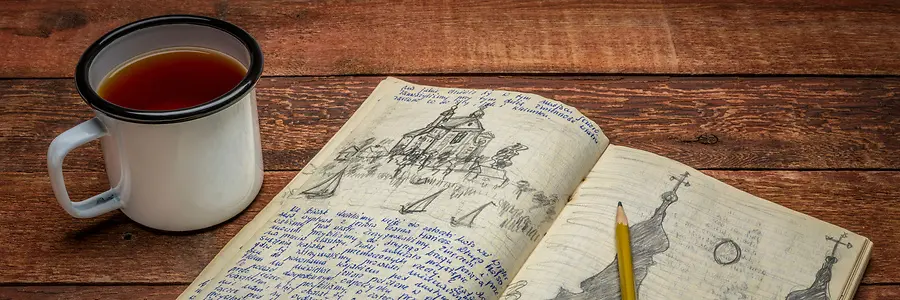
The Woman Who Kept Writing
I have been writing since I was a girl.
Not to become a writer. Not to be impressive. Because something in me needed a place that would not talk over her.
A journal does not need you to be easy.
It does not need you to be fine.
It does not reward the polished version.
That is why I kept one.
People see the life that turned out. The work. The composure. The woman who can hold a hard room and still sound steady. They see the outcome.
They do not see the years of sentences that never left the page.
I wrote the crush.
The prayer.
The thing I could not say at the table.
The feeling that arrived before I had language for it.
The question I was not supposed to ask out loud.
I wrote because the inner world was already loud, and the outer world had very little room for it.
There is a particular kind of girl who learns to keep the real conversation on paper. She looks agreeable. She looks thoughtful. She looks like she is listening.
She is also filing evidence.
Not against anyone, at first. Against disappearance. Against the slow leak of herself that happens when you keep translating your truth into something more acceptable.
A journal is not a diary of events.
It is a witness.
It remembers the sentence you swallowed.
It remembers the night you understood something and had nowhere to put it.
It remembers the version of you that did not get used in the room.
I still write that way.
Not every day like a performance. When the inside of me starts to outrun the face I am wearing. When I can feel myself becoming useful again instead of honest. When a feeling is too exact to leave unnamed.
The page is not self-help.
It is contact.
Some women run. Some women talk. I have done both. But the thing that has never failed me is the moment the pen meets the sentence I almost didn't let myself have.
That sentence is usually plain.
This hurts.
I am disappearing again.
I do not want to be the strong one tonight.
I need to be met.
I know what I know.
No audience would have given me permission for those lines when I was young. So I gave it to myself, privately, again and again, until the private record became the most honest relationship I had.
That is not sad to me.
It is how I stayed.
The world likes a woman who has done well. It likes proof. It likes the finished surface. It rarely asks what she had to keep offstage in order to remain intact.
I'm not ashamed of how well I've done.
I am finished letting that be the only story in the room.
The deepest part of me has never lived in the résumé of a life.
She has lived in the ink.
In the cheap notebooks and the nicer ones. In the pages that got lost and the ones I still have. In the handwriting that changed and the voice that didn't.
If I am going to be known, it will not be by the life that photographs well.
It will be by the woman who kept writing when there was no audience, no praise, and no guarantee that anyone would ever meet her there.
I am not offering my journals to the world.
I am offering the fact of them.
The fact that I have always been in conversation with myself, even when the rest of the world only wanted the capable one.
That conversation is not a hobby.
It is the place I did not abandon her.
And if another woman reads this and thinks of a notebook she stopped opening, or one she still hides, she already knows what I mean.
You do not write like that because you have nothing.
You write like that because something in you refused to go missing.