Show Up Anyway
Why being underestimated should never determine your potential.



I've walked into rooms where I could tell I was being judged before I'd even said a word.
I'm heavily tattooed, and I don't exactly fit the traditional image of a corporate professional. Throughout my career, I've encountered people who have underestimated my intelligence, questioned my professionalism, or simply assumed I was flat-out incapable. The last thing they'd have imagined was that I'm someone who sits at the leadership table across multiple companies and industries.
It's an interesting experience, being evaluated before you've had the opportunity to demonstrate what you're capable of.
While attitudes toward tattoos have certainly evolved, the stigma hasn't disappeared. There are still environments where visible tattoos are associated with a lack of education, professionalism, or credibility. None of those assumptions are inherently true, but that doesn't mean they don't influence how people perceive you. I can attest to that firsthand.
But tattoos are just one example. Women are underestimated every day for reasons that have absolutely nothing to do with their capabilities. Age, appearance, background, education, personality, or an unconventional career path can all influence how someone is perceived before they've had the opportunity to prove themselves.
For some, it's being the youngest person in the room. For others, it's entering a male-dominated industry, pursuing leadership without a traditional educational background, or having a personality that doesn't fit the expectations placed on women in professional settings.
The circumstances may differ, but the underlying challenge is the same: being judged for how you're perceived rather than what you're capable of contributing. What I've learned is that competence doesn't have a particular look.
My career has taken me through design, construction, project management, and now executive leadership and operations across multiple industries.
Along the way, some of the qualities that have helped me succeed are the very things that make me a little unconventional. I'm creative, outspoken, adaptable, and willing to challenge the status quo. I don't believe in doing something a certain way simply because that's how it's always been done.
Interestingly, some of the people who initially underestimated me eventually became those who valued my contributions the most. Not because I changed who I was, but because they had the opportunity to see beyond their first impression.
But the most important lesson I've learned isn't how to change someone's mind. It's how to keep showing up before they do.
Being underestimated can be discouraging. It can make you second-guess how you present yourself, question whether you belong in certain spaces, or feel as though you have something extra to prove. It's easy to wonder whether you'd be taken more seriously if you looked different, spoke differently, or made yourself a little less noticeable.
Sometimes, those concerns are rooted in very real experiences. But I don't believe the answer is to make ourselves smaller to accommodate someone else's expectations.
Professionalism isn't defined by tattoos, hairstyles, clothing, or whether someone fits a conventional image of success.
It's demonstrated through accountability, integrity, communication, knowledge, and the way we treat others. It's reflected in the quality of our work and how we handle responsibility.
A polished appearance can create a positive first impression, but it cannot substitute for competence. Likewise, an unconventional appearance doesn't negate it. That distinction matters, particularly for women navigating leadership roles.
We're encouraged to be confident, but not intimidating. Assertive, but not difficult. Passionate, but not emotional. Creative and innovative, but still expected to operate within fairly narrow definitions of what's considered acceptable. Those contradictions can become especially apparent in leadership positions and male-dominated industries, where women may already feel pressure to establish their credibility.
But here's something worth remembering:
Someone else's assumptions about you are not an accurate assessment of your abilities. And you don't have to accept them as one. Ever.
We can't always control how others perceive us. Bias exists, and sometimes it creates very real obstacles. But we can recognize when those experiences begin to influence our confidence, our decisions, and our willingness to pursue opportunities. Don't disqualify yourself before anyone else has had the chance to consider you.
Apply for the position. Ask for the promotion. Introduce yourself. Speak up in the meeting. Pursue the opportunity that feels slightly outside your comfort zone. You don't need to be certain of the outcome to give yourself the opportunity to succeed.
I've learned that demonstrating your capabilities and advocating for yourself go hand in hand. Women shouldn't feel obligated to constantly prove their worth to people who have already made unfair assumptions. At the same time, we shouldn't be afraid to communicate our accomplishments, contribute our perspectives, or pursue positions of influence.
If you have an idea, share it. If you've accomplished something meaningful, acknowledge it. If you bring a different perspective to the table, recognize that it may be exactly what's needed.
There's a difference between seeking validation and confidently communicating the value you bring. You can be humble without minimizing yourself. And you can be professional without sacrificing the qualities that make you different.
Perhaps one of the most freeing realizations is that not everyone will see you the way you deserve to be seen. Some people will change their opinions once they get to know you. Others will hold on to their assumptions regardless of your accomplishments. Neither determine your potential.
You cannot build your career around trying to win over every person who underestimates you. What you can do is continue developing your skills, building meaningful relationships, seeking opportunities, and surrounding yourself with people who recognize your contributions.
And when you find yourself in a position of leadership, you have the opportunity to challenge those same assumptions for someone else: consider how your own expectations might affect the people around you.
Are you evaluating individuals based on their abilities and contributions, or are you unconsciously favoring those who fit a familiar image of professionalism?
Are you giving unconventional candidates the same opportunities to demonstrate their potential?
Creating more inclusive professional environments doesn't require abandoning standards. It requires making sure those standards actually reflect the qualities necessary to succeed. That responsibility belongs to all of us, especially those who have earned a seat at the leadership table.
I've built my career by being willing to learn, adapt, take risks, and bring a different perspective into the industries I've worked in. My tattoos are part of who I am, but they're not a measure of my intelligence, my professionalism, or my ability to lead. And I know I'm not the only woman who's had to navigate the space between how she's perceived and what she's actually capable of.
We won't always be able to change the stigma surrounding what makes us different. But we can refuse to let it dictate our ambitions. You don't need to fit someone else's definition of what success should look like to be successful.
If there's one thing I'd encourage other women to take from my experience, it's this:
Show up anyway.
Take the opportunity. Walk into the room. Bring your ideas, your experience, your individuality, and your ambition.
You may be underestimated. Show up anyway.
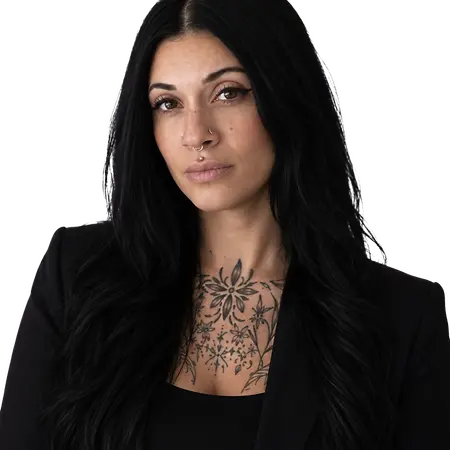
Gina Cooper serves on the leadership team at Inked Partners, DataVestra, and SIMERPU, companies serving in the employee benefits and data licensing space based in Jacksonville, Florida. She previously worked in project management, design, and construction, bringing creative and managerial experience to her current role reimagining employee access to healthcare. With a diverse background, she brings a strategic and…