Stay in Your Lane
Bridging the Gap: How Athletic Trainers Connect Coordinated Sports Medicine Care

Athletic Trainer Clinical Perspective
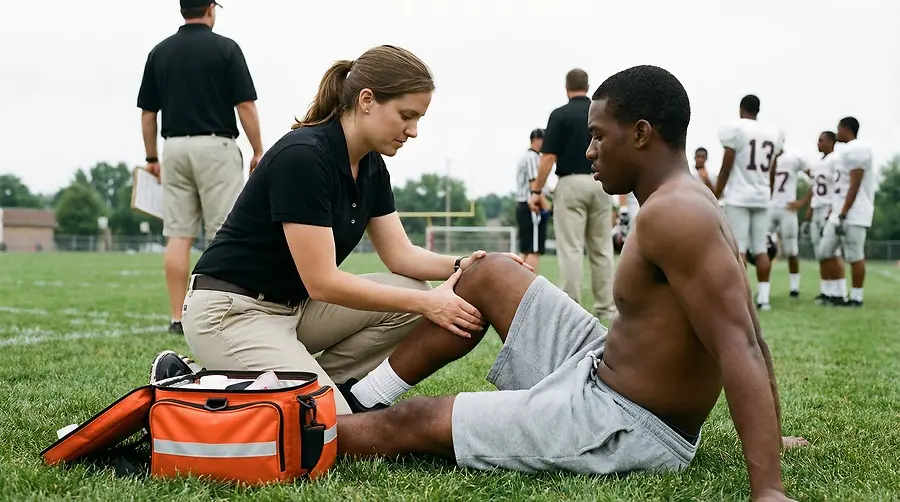
Athletic trainers occupy a unique position within sports medicine because our involvement extends beyond the examination room. We cover practices and competitions and interact with athletes consistently, often on a daily basis. That continuity allows us to develop a familiarity with the athlete that cannot be established through an isolated clinical encounter. Over time, we become attuned to an athlete's baseline, including how they move, communicate, perform, and carry themselves, allowing us to recognize subtle changes when something seems off. That insight provides valuable context when evaluating concerns and communicating with other healthcare professionals.
Athletes frequently seek the athletic trainer as their initial point of contact when an injury or concern arises. We evaluate the presentation, determine the appropriate course of action within our scope, and recognize when further evaluation or intervention is warranted. When referral is necessary, our role does not end with directing the athlete elsewhere. We remain connected to the athlete and the broader sports medicine team, providing consistency of care as treatment progresses.
When specialized expertise is needed, collaboration allows each healthcare professional to contribute within their respective area of expertise. Physicians, physical therapists, chiropractors, and specialists each contribute their knowledge, while the athletic trainer provides the ongoing context that connects those perspectives to the athlete's daily sporting environment. Effective sports medicine care is strengthened when those approaches are connected rather than functioning independently.
The Plug Connecting Every Socket
The athletic trainer frequently serves as the central connection point between the people involved in an athlete's care. When an injury or significant issue occurs, the parent or guardian is typically among the first people notified. We communicate the initial concern, explain when further evaluation is warranted, and help guide the family through the next steps. When referral is necessary, we facilitate the athlete's transition to the designated orthopedic provider or specialist while providing relevant information from our evaluation and maintaining communication between the athletic and clinical environments.
From there, the network of care can extend to a physical therapist, chiropractor, dentist, mental health professional, or another specialist, depending on the athlete's needs. This can include specialists practicing under the direction or referral of an MD, DO, or primary care provider. The athletic trainer helps connect the necessary professionals while maintaining communication across disciplines. Each provider contributes within their respective skill set, but the value of that expertise is strengthened when the professionals involved understand how their role fits within the broader care of the athlete.
Once the involved medical providers and family are engaged and a plan of care is established, the athletic trainer communicates pertinent information to the coach. Coaches need to understand participation restrictions and expectations without being placed in the position of making medical decisions. Communication should also follow HIPAA standards, providing the coach with what is necessary to support the athlete while protecting confidential medical information. The athletic trainer serves as the plug connecting each outlet, but effective collaboration requires every professional to know their lane and respect the expertise of others.
Scope, Boundaries, and Professional Responsibility
Every healthcare profession has its own education, training, competencies, and professional responsibilities. NATA identifies athletic trainers as healthcare professionals who collaborate with physicians and practice according to their education, training, and state statutes, rules, and regulations. Athletic trainers are educated to examine patients, establish a clinical diagnosis within their scope, provide care, recognize when consultation is warranted, and facilitate referral when necessary.
Knowing your lane does not mean practicing in isolation. It means understanding your own responsibilities while recognizing the expertise and scope of the professionals around you. An athletic trainer does not walk into a chiropractic office and begin performing adjustments. In the same way, another healthcare professional should not assume responsibilities that fall outside their own training or scope. NATA's educational competencies specifically call for athletic trainers to recognize the unique skills of other healthcare professionals, understand their scopes of practice, and work collaboratively toward positive patient outcomes.
Physician collaboration is an important component of athletic training practice, but collaboration does not erase the athletic trainer's professional role. NATA's guidance on team physician relationships describes a collaborative relationship between the physician and athletic trainer while emphasizing that physician agreements should not prevent an athletic trainer from practicing to the full scope permitted by the applicable state practice act. The same principle applies across the healthcare team. Different clinical opinions can strengthen care when communicated professionally; problems arise when a provider disregards another professional's scope, expertise, or involvement.
When Rapport Fails, the Athlete Pays
The athlete should never be placed between healthcare professionals or expected to determine whose recommendations to follow. Clinical disagreements should be addressed directly between providers rather than through the athlete. When conflicting guidance reaches the athlete, uncertainty can replace confidence and trust at a time when clarity is essential to recovery.
Professional rapport extends beyond the provider-athlete relationship. It also shapes how healthcare professionals work with one another. Mutual respect allows providers to exchange relevant information, address concerns, and appreciate the clinical context behind another provider's decisions. When professional relationships turn adversarial, teamwork suffers, creating unnecessary barriers to care.
When coordination fails, care becomes fragmented. Recommendations made without consideration of the athlete's history, current treatment, or sporting demands can create conflicting expectations. Parents and coaches may receive inconsistent guidance, leaving the athlete to navigate a system that should function as a unified team.
The consequences ultimately reach the athlete. A disconnect among providers can affect confidence, trust, rehabilitation, and return to participation. Clinical expertise is valuable, but expertise alone does not create effective care. Healthcare professionals do not have to agree on every clinical decision. They do have a responsibility to respect one another's roles and remain focused on the athlete's well-being. When professional pride takes precedence over teamwork, the athlete is the one who pays the price.
Sports medicine works best when professionals recognize that no single provider can meet every need of an athlete. Athletic trainers connect the people, knowledge, and care surrounding the athlete, but an effective system depends on each professional respecting their role and the contributions of those around them.
Stay in your lane, because the athlete deserves a coordinated team—not competing providers.


