
Staying Positive During the Storm
Finding Purpose and Resilience When Career Expectations Don't Match Reality

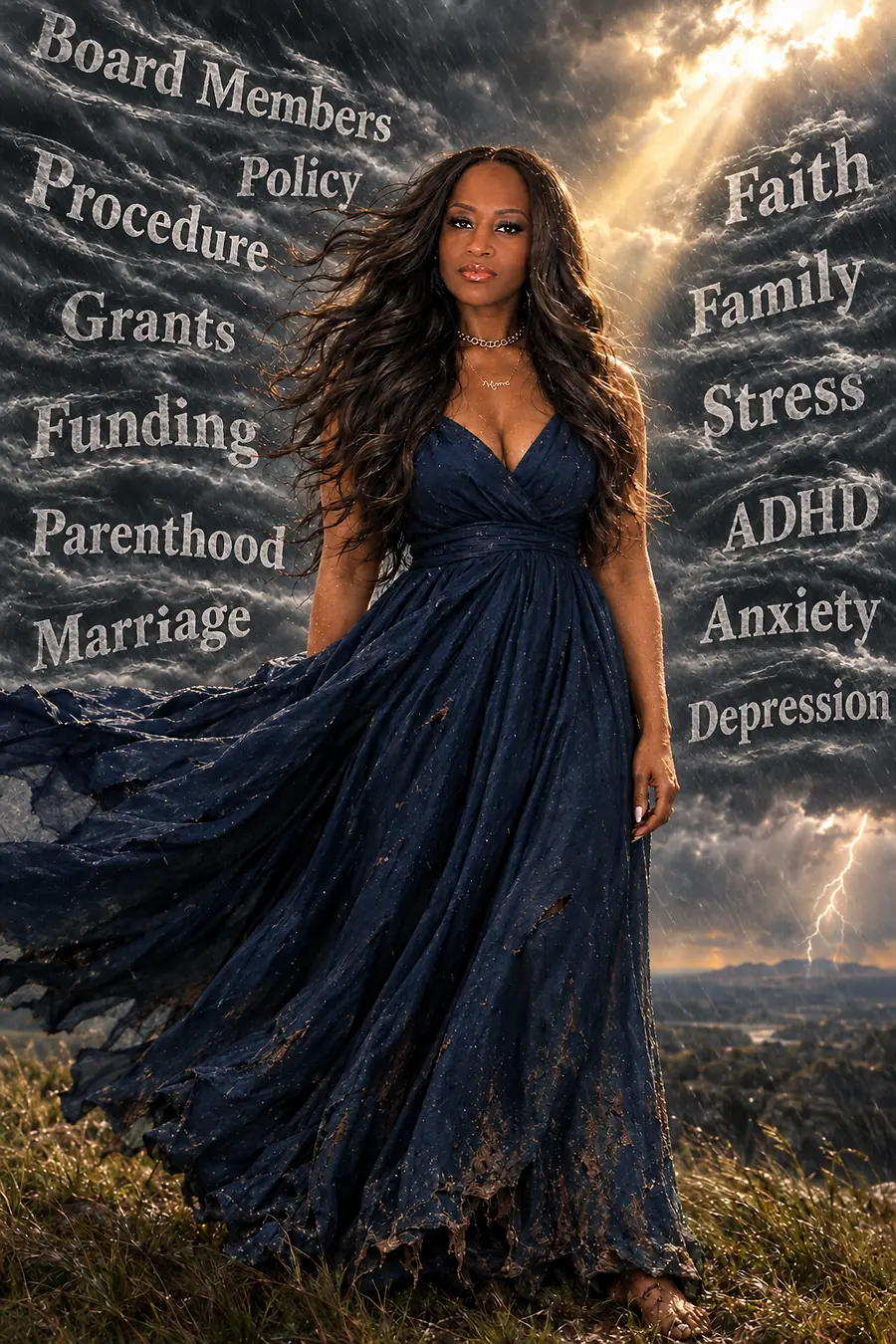
Staying Positive During the Storm
There are seasons in life when experience, education, preparation, and hard work do not seem to produce the outcome you expect. I am in one of those seasons now.
After nearly thirty years in the nonprofit sector, including years in executive leadership, I find myself navigating a professional transition that has been far more difficult than I anticipated. I have led organizations, managed complex programs, overseen operations, developed strategy, supervised large teams, worked within highly regulated systems, managed multimillion-dollar budgets, and spent much of my career serving vulnerable and underserved communities. And yet, securing the next opportunity has not been easy.
Some of the feedback I received is, "You're too smart." I usually translate that to mean, "You may be overqualified." Other times, I encounter positions that appear to be executive leadership roles but ultimately seem to require what I jokingly describe as "1,000 years of fundraising and development experience."
Of course, I am being facetious. But there is something very real underneath the humor. I have reached a point in my career where I have significant executive, operational, programmatic, and strategic experience. I understand organizational infrastructure. I understand compliance. I understand government systems. I understand programs, budgets, people, quality, risk, and strategy.
What I am discovering, however, is that many nonprofit executive searches increasingly place fundraising and development experience at the center of the leadership profile. That has left me navigating a professional space that, quite candidly, I am still trying to understand.
When Experience Becomes Complicated
We are often told that experience is an asset. And it is. But there comes a point in a career when extensive experience can create its own challenges. Employers may wonder whether you will be satisfied in the role. They may question whether the salary will be sufficient.
They may assume you will want more authority than the position provides. Or they may decide that your experience exceeds what they believe they need.
The irony is that many experienced leaders are not necessarily looking for the biggest title. Sometimes we are looking for the:
- Right mission.
- Right leadership team.
- Right organizational culture.
- Right opportunity to contribute.
After decades in this sector, I know what I bring to an organization. But I am also clear that leadership is not about needing to be the smartest person in the room. It is about bringing the right experience to the right environment and using it in service of the mission. That distinction is not always easy to communicate during a hiring process.
The Nonprofit Executive Role Is Changing
The nonprofit sector has also changed. Executive leaders are increasingly expected to be strategists, operators, fundraisers, public speakers, government relations professionals, financial managers, brand ambassadors, community leaders, and organizational visionaries—all at the same time.
In many organizations, fundraising has become one of the defining qualifications for executive leadership. I understand why.
Nonprofits cannot accomplish their missions without resources. Revenue diversification, donor cultivation, foundation relationships, corporate partnerships, government funding, and individual giving are all essential to sustainability. But I also believe we have to be careful not to define nonprofit leadership too narrowly. Organizations need leaders who understand how to build strong programs. They need leaders who know how to manage operations.
They need people who understand compliance, quality, risk, workforce development, organizational culture, strategic planning, and systems change. They need leaders who know what happens after the money is raised. Because raising resources is only one part of sustainability. Using those resources effectively, building the infrastructure to support the mission, developing employees, measuring impact, maintaining compliance, and creating strong organizations are equally important. That is where much of my career has been built.
Sitting in the Unknown
Perhaps the hardest part of this experience is not rejection itself. Rejection is part of every career. The harder part is uncertainty. There are moments when I genuinely do not know what the next chapter is supposed to look like.
- Do I continue pursuing executive leadership?
- Do I expand my consulting work?
- Do I transition into a different sector?
- Do I identify organizations that place greater value on operations and program strategy?
- Do I strengthen my development experience further?
- Do I create something of my own?
Those are not rhetorical questions. They are questions I am actively asking myself. And that can be uncomfortable for someone who has spent much of her career being the person expected to have a plan. Leadership teaches you to solve problems. Professional transition teaches you that sometimes the problem you are solving is your own next chapter.
Staying Positive Does Not Mean Pretending
I think we sometimes misunderstand what it means to stay positive. Positivity does not mean pretending everything is fine. It does not mean ignoring disappointment. It does not mean acting as though rejection does not hurt. And it certainly does not mean convincing yourself that every closed door is somehow wonderful. Sometimes a closed door is disappointing. Sometimes you thought you were the right person for the opportunity.
Sometimes you leave an interview feeling confident and still receive the email that begins with, "Thank you for your interest…" You are allowed to be disappointed. But you cannot build a permanent residence there. For me, staying positive means acknowledging the disappointment and then asking:
- What can I learn from this?
- Is there something I need to strengthen?
- Is there something I need to communicate differently?
- Am I targeting the right opportunities?
- Do I need to reposition my experience?
- Or was this simply not the right organization for me?
Those questions allow disappointment to become information rather than identity.
I Still Know What I Bring to the Table
A job search can challenge your confidence in ways you do not always expect.
When you have been successful throughout your career and suddenly find yourself repeatedly trying to convince someone of your value, it can be humbling.
That is when I have to remind myself that a hiring decision does not erase thirty years of experience.
- It does not erase the organizations I have led.
- It does not erase the teams I have developed.
- It does not erase the programs I have strengthened.
- It does not erase the difficult decisions I have made.
- It does not erase the communities I have served.
And it certainly does not erase what I know. A "no" from an organization means I was not selected for that particular opportunity. It does not mean I no longer have value. That distinction matters.
Perhaps the Storm Is Also a Transition
There is another possibility I am beginning to consider. Maybe this season is not simply about finding another job. Maybe it is about redefining what the next phase of my career should look like. After decades in nonprofit leadership, perhaps success does not have to mean finding another organization willing to give me a title.
- Perhaps it means consulting.
- Advising boards.
- Helping organizations strengthen operations.
- Developing emerging leaders.
- Supporting nonprofits through strategic planning and organizational change.
- Teaching.
- Coaching.
Or combining several of those things while continuing to pursue the right executive opportunity. I do not have all of those answers yet. And I am becoming increasingly comfortable saying that. Ultimately, what is loud and clear: IT IS TIME TO PIVOT! I have spent much of my career telling other people that they do not have to know everything immediately. Now I have to extend that same grace to myself.
Experience Still Has Value
There is something important that those of us who have spent decades in this work have to remember.
Our experience matters.
- We have institutional knowledge.
- We have pattern recognition.
- We know what organizational dysfunction looks like before it becomes a crisis.
- We know that every strategic plan eventually has to become an operational plan.
- We understand that mission without infrastructure is difficult to sustain.
- We know that leadership decisions have consequences for employees, communities, families, and organizations.
And many of us have learned these lessons not from textbooks but from decades of actually doing the work. That experience has value.
The challenge is finding organizations that recognize it.
Continuing Through the Storm
So how do I stay positive?
- I keep applying.
- I keep networking.
- I keep learning.
- I continue developing my consulting practice.
- I continue writing and sharing what I have learned.
- I continue looking for organizations whose needs genuinely align with my strengths.
And I remind myself that my career is larger than any single job search. Some days that perspective comes easily. Other days it requires intention. But I keep moving. Because one thing thirty years in nonprofit leadership has taught me is that difficult seasons do not last forever. Organizations change. Opportunities emerge. Relationships open doors. Careers evolve.
And sometimes the path forward looks very different from the one we originally imagined. I may not know exactly where this season is leading me. But I know what I have built. I know what I have learned. I know the value I bring. And I know that uncertainty does not mean the story is over. Sometimes it simply means the next chapter has not been written yet. Staying positive during the storm does not mean pretending the rain is not falling. It means trusting that you still know how to navigate—even when you cannot see the shore.

Nakia Marshall, MPA is a nonprofit executive, organizational strategist, management consultant, and life and career coach with more than 25 years of experience advancing organizations and programs that strengthen children, families, and communities. Her career spans executive leadership, child welfare, behavioral health, developmental disabilities, education, residential services, community-based programming, and…





