STEAM Building Foundational Skills: The Future is Now
Transforming Simple Classroom Activities into Comprehensive Interdisciplinary Learning Experiences Through STEAM Pedagogy

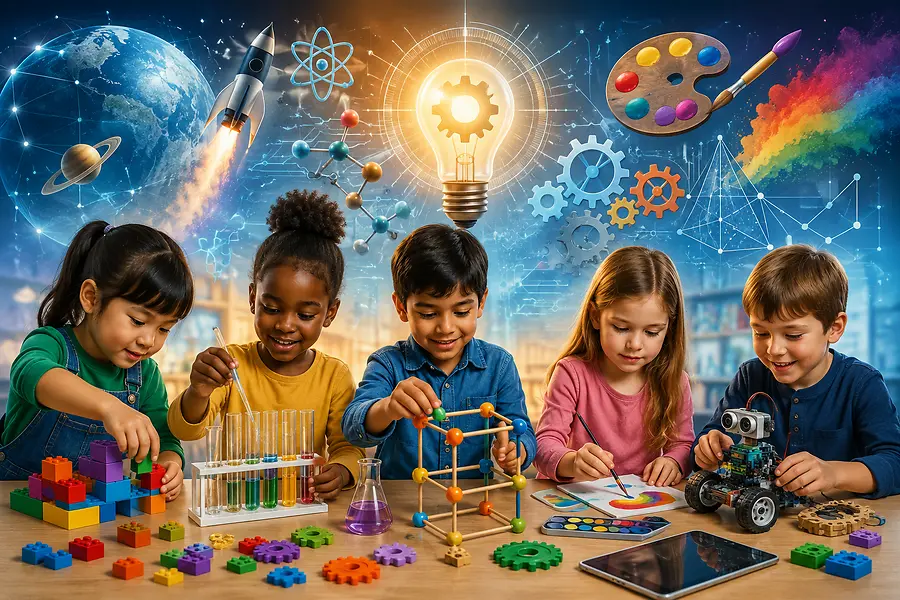
In the evolving landscape of contemporary education, traditional disciplinary boundaries are increasingly giving way to interdisciplinary pedagogical approaches designed to prepare learners for the intellectual, technological, and social complexities of the modern world. Science, technology, engineering, arts, and mathematics (STEAM) education represents a significant dimension of this transformation, particularly within early childhood and elementary education. Rather than presenting academic disciplines as isolated areas of knowledge, an intentionally designed STEAM curriculum integrates multiple domains through inquiry-based, experiential, and hands-on learning opportunities. For young children, this approach extends beyond the acquisition of discrete facts or procedural knowledge by cultivating curiosity, creativity, critical thinking, collaboration, and sustained engagement in the process of discovery. Consequently, effective STEAM curriculum development requires educators to design developmentally appropriate learning experiences that are interactive, play-based, culturally responsive, and meaningfully connected to children's everyday experiences. Within preschool and early elementary classrooms, these experiences should provide opportunities for exploration, experimentation, and problem-solving while simultaneously supporting language, physical, cognitive, and social-emotional development.
A seemingly simple learning experience, such as sorting colorful counting bears, illustrates how educators can transform familiar classroom materials into an interdisciplinary STEAM investigation. From a mathematical perspective, children engage with foundational concepts such as sorting, counting, classification, comparison, pattern recognition, and early data organization. Simultaneously, the activity introduces scientific practices by encouraging children to observe physical characteristics, identify similarities and differences, and classify objects according to observable attributes. The integration of art and design emerges as children organize materials into visual patterns, create imaginative arrangements, or represent their findings through drawings and other visual expressions. Throughout this learning process, the educator assumes the role of facilitator rather than simply transmitting information. Through intentional modeling, scaffolding, observation, and questioning, teachers can extend children's thinking and encourage them to articulate the reasoning behind their decisions. Questions such as, "Why did you place all of the red bears together?" or "Can you think of another way to organize these bears?" promote metacognitive awareness, expressive language, logical reasoning, and cognitive flexibility—competencies that support learning across all STEAM disciplines.
Transforming a basic sorting activity into a comprehensive STEAM learning experience requires clearly articulated learning objectives, carefully selected materials, and an instructional structure that balances intentional teacher guidance with child-directed exploration. The activity may begin with an open-ended investigation in which children examine the bears' colors, sizes, shapes, and other observable characteristics, thereby strengthening foundational scientific skills related to observation, comparison, and classification. Children can then be challenged to sort the materials according to increasingly complex criteria, reinforcing mathematical concepts while developing an emerging understanding of data organization. Patterning experiences, such as creating an alternating red-blue-red-blue sequence, introduce foundational algebraic reasoning by helping children recognize, predict, and extend relationships within sequences. Incorporating fine-motor tools, including child-safe tongs or tweezers, adds another developmental dimension by strengthening hand-eye coordination, dexterity, and the fine-motor control necessary for emerging writing skills.
Technology can further enhance the learning experience when it is integrated intentionally and used to extend, rather than replace, hands-on exploration. For example, children may use tablets, digital cameras, or interactive whiteboards to document their sorting strategies, photograph completed patterns, count objects, or create simple digital graphs and representations of their findings. These multimodal learning opportunities make abstract mathematical concepts, including quantity and data representation, more accessible and concrete for young learners. Educators can deepen children's conceptual understanding through open-ended questions that encourage prediction, experimentation, and revision. Asking, "What do you predict will happen if we mix all of the bears again?" invites children to formulate hypotheses and test their ideas through direct investigation. Similarly, encouraging children to design a sorting station using available classroom materials introduces elements of engineering and design thinking as they plan, construct, evaluate, and refine their creations.
The collaborative dimension of STEAM learning is equally significant. When children work in small groups to develop sorting rules, construct patterns, design organizational systems, or solve teacher- and peer-generated challenges, they engage in communication, negotiation, shared decision-making, and collaborative problem-solving. These interactions reinforce the understanding that meaningful learning is both a cognitive and a social process. A structured reflection period at the conclusion of the experience provides children with opportunities to communicate their observations, explain their strategies, compare different approaches, and consider what they might investigate next. Reflection not only strengthens oral language and communication skills but also supports metacognition by encouraging children to recognize and articulate their own learning processes.
Ultimately, expanding a familiar activity, such as sorting and counting bears, into a multidimensional learning experience demonstrates the potential of interdisciplinary STEAM pedagogy in early childhood education. When thoughtfully implemented, STEAM education enables educators to move beyond fragmented, subject-specific instruction toward a more holistic model in which children investigate authentic questions through multiple disciplinary perspectives. The objective is not simply to introduce young children to science, technology, engineering, art, and mathematics as individual subjects, but to cultivate the intellectual dispositions that underlie meaningful learning: curiosity, creativity, persistence, collaboration, critical thinking, and a willingness to experiment with multiple solutions. Through developmentally appropriate, play-based, and inquiry-driven STEAM experiences, educators can establish a foundation that helps children understand learning as an interconnected and dynamic process of exploration, problem-solving, innovation, and discovery.


