Stop Calling Employees Resistant to Change When They’ve Survived Six Versions of the Same Failed Initiative By Lynn Cirillo
Why employees who seem resistant to change might actually be demonstrating organizational wisdom.

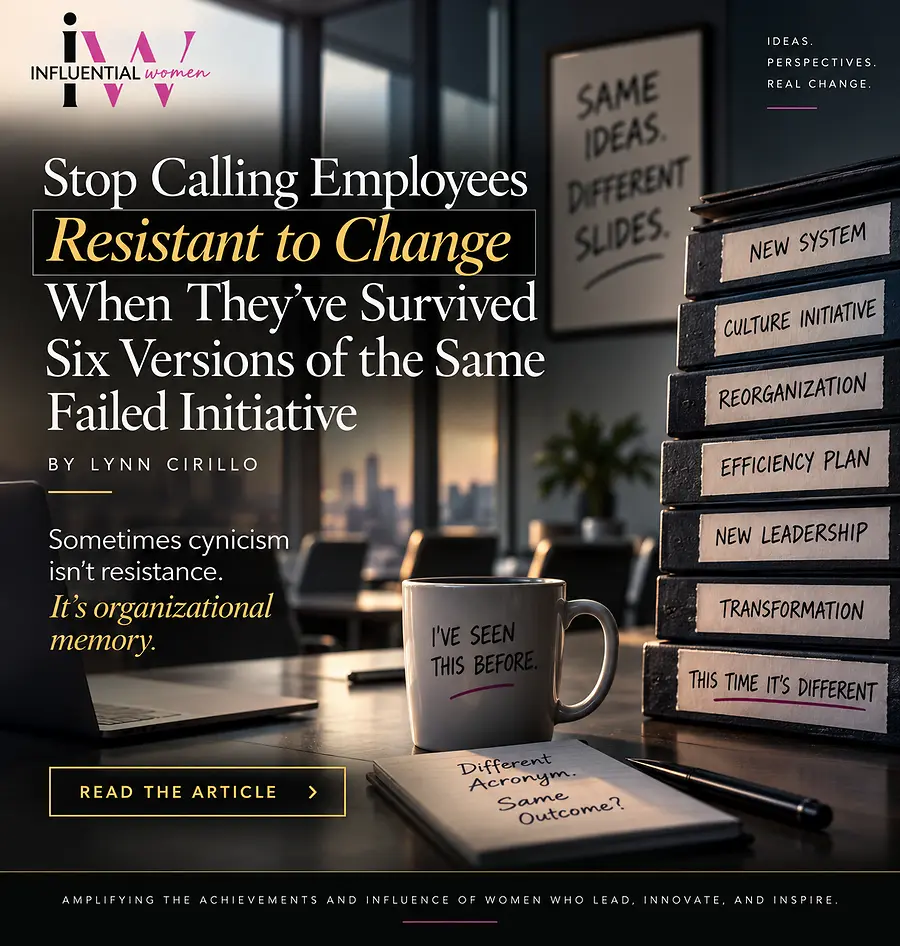
Organizations love change.
Or, more accurately, organizations love announcing change.
There is usually a kickoff meeting. A new initiative. A new system. A new consultant. A new acronym. Someone creates a PowerPoint explaining why this time things will be different.
And somewhere near the back of the room, an employee who has been there for fifteen years quietly folds their arms.
They have seen this before.
Leadership notices the crossed arms. They hear the skepticism. They see the eye roll exchanged between two longtime employees.
And eventually, someone says it:
"They're resistant to change."
Maybe.
But sometimes cynicism isn't resistance. It's organizational memory.
Before You Diagnose Resistance, Ask What They Remember
Employees do not experience organizational change in isolation.
They remember the last initiative. And the one before that.
- They remember the employee survey everyone was encouraged to complete honestly, followed by months of silence.
- They remember being asked for ideas and watching those ideas disappear into a committee.
- They remember the expensive new system that was supposed to make their jobs easier but created three additional steps.
- They remember the reorganization that was going to improve communication.
- They remember the leadership retreat.
- The culture initiative.
- The task force.
- The listening session.
They also remember which problems everyone knew existed but nobody was willing to address.
So when leadership arrives with the next great transformation and employees seem less than enthusiastic, it is worth considering what the organization itself may have taught them.
Employees learn from patterns just like organizations do.
If the pattern has been announcement, enthusiasm, implementation, inconsistency, abandonment, skepticism is not particularly surprising. It may actually be rational.
Experienced Employees Carry Data You Cannot Find on a Dashboard
One of the biggest mistakes leaders can make is dismissing long-tenured employees as people who are simply stuck in their ways.
Certainly, some people resist change because they prefer what is familiar.
Tenure also creates something incredibly valuable: context.
Longtime employees know where previous attempts failed.
- They know which processes exist because of decisions made ten years ago.
- They know where the unofficial workarounds live.
- They know which departments have tried to solve the same problem independently.
- They know why something that looks inefficient on a process map may have evolved that way in the first place.
- They also know the difference between what the organization says happens and what actually happens at 4:30 on a Wednesday afternoon when nobody from leadership is in the room.
- That knowledge is not an obstacle to transformation.
It is data.
Leaders who dismiss it because they do not like the way it is delivered risk throwing away some of the most valuable institutional knowledge available to them.
There Is a Difference Between "We've Tried That Before" and "That Will Never Work"
Leaders understandably become frustrated when every new idea is met with:
"We already tried that."
There is an important question hiding behind that sentence: What happened when you tried it? That changes the conversation.
Instead of interpreting the statement as opposition, get curious.
- What worked?
- What didn't?
- Where did implementation break down?
- What did employees tell leadership at the time?
- Was the idea itself flawed, or did the organization fail to support it?
- Did priorities change?
- Did accountability disappear?
- Did the person championing the initiative leave?
- Did employees eventually stop participating because nothing happened when they did?
There is an enormous difference between an employee saying, "I refuse to change," and an employee saying, "I have evidence that we are about to repeat the same mistake."
Good leadership learns to hear the difference.
Psychological Safety Is Tested After Someone Speaks
Organizations frequently say they want employees to speak up.
- They want ideas.
- Feedback.
- Innovation.
- Candor.
Until someone says something uncomfortable.
That is when psychological safety actually gets tested.
If employees raise concerns about a new initiative and leadership immediately labels them negative, difficult, uncooperative, or resistant, the organization has communicated something very clearly: We want feedback as long as it confirms what we already decided.
Employees notice.
The next time leadership asks for input, some of them will stay quiet.
After enough repetitions, leaders may begin wondering why nobody contributes anymore. Sometimes the employee wasn't silent.
The organization taught them silence was safer.
That is not an engagement problem.
That is feedback.
Change Fatigue Is Not the Same as an Unwillingness to Change
There is another possibility leaders should consider.
Employees may actually support the destination while having very little confidence in the organization's ability to get there.
Those are two completely different things.
Someone can believe a process desperately needs improvement and still question whether the current initiative will improve it.
An employee can support modernization while challenging the implementation plan.
A team can want cultural change while being skeptical that leadership behavior will change with it.
None of those positions are inherently anti-change.
In fact, the people asking difficult questions may be demonstrating greater investment in the outcome than the people nodding through the presentation.
Agreement is not always engagement.
And disagreement is not always resistance.
Leaders Have Organizational Memory Too
This conversation is not about blaming leadership.
Most leaders inherit systems they did not create, cultures they did not design, and histories they were not present for.
A leader may genuinely be introducing something different while employees perceive it as version seven of the same thing.
That creates responsibility on both sides.
Employees need room to recognize when circumstances really have changed.
Leaders need enough humility to understand why employees may not immediately believe them.
Trust cannot be demanded simply because leadership has changed.
Sometimes it has to be rebuilt because the organization remembers, even when the current leader was not responsible for what happened before.
That is one of the uncomfortable realities of leadership.
You inherit some of the trust you did not personally break. And you may have to participate in repairing it anyway.
Before Launching the Next Initiative
Before asking employees to embrace another change, leaders might ask a few different questions. Not:
"Why are these people so resistant?"
Instead:
- What happened here before I arrived?
- What have employees already been asked to try?
- What promises were made?
- Which ones were kept?
- Which ones quietly disappeared?
- What would make this attempt meaningfully different?
Perhaps most importantly: What would employees need to see from us before they have reason to believe that?
Those questions require more humility than labeling people resistant.
They also produce considerably better information.
Sometimes Cynicism Is Organizational Memory
Change requires participation. Participation requires trust.
Trust is built partly by what leaders say and largely by what organizations repeatedly do.
If employees have watched six versions of the same initiative arrive with enthusiasm and disappear without accountability, the seventh announcement is not occurring on a blank slate.
There is history in the room.
There are receipts.
There is organizational memory.
Before asking employees to forget it, leaders might learn from it.
Because the fastest way to repeat an organization's mistakes is to dismiss the people who remember them.
Lynn Cirillo is an author, leadership mentor, and founder of Grounded Leadership LLC. After more than three decades in the corporate world, including serving as an Executive Vice President of Corporate Operations, she began examining the relationship between leadership, workplace culture, achievement, identity, and the systems we learn to accept as normal. She is the author of The Breaking Point, Book 1 of the six-book Musings of a Recovering Executive series.


