Success Isn’t the Same as Fulfillment: Why Accomplished Women Still Need a Life of Their Own
Redefining success beyond achievement: How to build a fulfilling life that's authentically yours.

Success Isn't the Same as Fulfillment: Why Accomplished Women Still Need a Life of Their Own
By Susan Page
Professional women are often very good at knowing what comes next. They earn the degree, build the career, take the promotion, lead the team, meet the deadline, and support the family—all while being dependable and focused on moving forward.
From the outside, a woman may appear to have built a successful life. Yet somewhere along the way, she may find herself asking a surprisingly difficult question: "Is the life I have built actually the life I want?"
I hear versions of this question often in my work coaching women through major life transitions. Sometimes it surfaces after a divorce or the end of a significant relationship. Sometimes the children leave home. A career that once felt meaningful no longer does. A woman loses someone important to her, faces an unexpected change, enters a new stage of life, or simply realizes that she has spent years meeting everyone else's needs while becoming increasingly disconnected from her own.
These moments can be unsettling. But they can also be an invitation—not necessarily to start over, but to start paying attention.
When Your Roles Become Your Identity
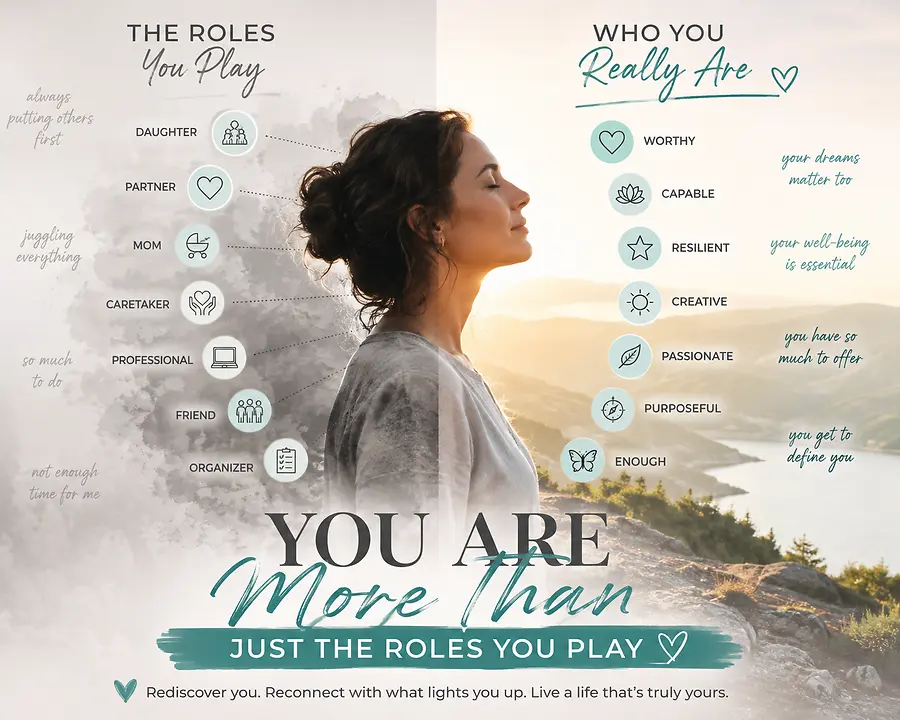
Professional women carry many roles: executive, entrepreneur, manager, colleague, partner, mother, daughter, caregiver, friend, and community leader. There is nothing wrong with being proud of those roles. The problem begins when we become so identified with them that we lose sight of the woman underneath them.
Ask a woman, "Who are you?" and notice how quickly the answer can become a résumé of roles and responsibilities. But who are you when you remove the job title? Who are you when your children no longer need you in the same way? Who are you outside of your relationship? What do you value when no one else is defining success for you? What makes you feel alive, fulfilled, curious, peaceful, or purposeful?
Those questions can be surprisingly difficult for women who have spent much of their lives being responsible, capable, and productive.
They are also some of the most important questions we can ask.
The Transition Isn't Always the Problem
We tend to view transitions as disruptions to overcome so that we can "get back to normal." But what if the goal isn't to return to who you were? What if a transition is giving you an opportunity to decide who you want to become?
I know this personally as well as professionally. My own life has included marriage, raising children, career changes, returning to school, divorce, loss, moving, and rebuilding. Those experiences taught me that resilience is about more than getting through difficult circumstances. It is also about learning to trust yourself enough to create what comes next.
That belief became central to my work with women and eventually to the framework I explore in my book, A Life Before Love: Why the Best Relationships Begin with You. I call it the SELF Path™.
Although the book explores the framework through the lens of relationships, its principles extend far beyond romantic relationships. At its core, SELF is about creating a strong relationship with yourself and building a life that reflects who you are—not simply who others need or expect you to be.
S – See Yourself Clearly
Meaningful change begins with awareness. Seeing yourself clearly means becoming curious about the patterns, beliefs, expectations, strengths, fears, and assumptions that influence your choices.
Professional women are often excellent problem-solvers. We analyze data, manage competing priorities, anticipate challenges, and make decisions every day. Yet it can be much harder to turn that same thoughtful attention inward. We may continue pursuing goals simply because they were once important to us. We may say yes because we have always been the dependable one. We may remain in situations that no longer serve us because changing direction feels like failure.
Seeing yourself clearly requires asking: "What do I believe about myself—and is it still true?"
Self-awareness gives us the ability to choose rather than simply repeat.
E – Establish Your Own Life
Independence isn't about doing everything alone. It is about developing a life with enough substance, meaning, and stability that your identity isn't dependent on one role, one relationship, or one measure of success.
For a professional woman, this can be particularly important. Careers can become powerful sources of identity. So can marriage, motherhood, caregiving, and leadership. But every role can change.
Establishing your own life means creating multiple sources of meaning. It means nurturing friendships, interests, financial confidence, personal goals, community, health, curiosity, and experiences that belong to you. A fulfilling life needs more than one pillar holding it up.
L – Love Your Life First
Many women postpone happiness.
"I will be happy after I get the promotion, after the children are older, after this difficult season passes, after I meet the right person, or after I finally have more time."
The problem is that "after" keeps moving.
Loving your life first doesn't mean loving every circumstance or abandoning ambition. It means refusing to treat your current life as a waiting room for the life you hope to have someday. It means asking: "What would make my life feel more like mine right now?"
Sometimes the answer requires a major change. More often, it begins with smaller choices: reclaiming time, setting a boundary, returning to an interest you abandoned, pursuing something that excites you, reconnecting with people who energize you, or simply allowing yourself to want something without first determining whether everyone else approves.
F – Find a Partner to Complement, Not Complete
This principle applies to romantic relationships, but there is a broader lesson here for professional women. Wholeness doesn't come from another person. It doesn't come from a title, a company, a marriage, a promotion, or someone else's approval.
Healthy relationships are built when two people bring their own identities, values, interests, and sense of worth into the relationship. The same principle can guide how we approach work, friendship, leadership, and life. When you know who you are, you become more intentional about what—and whom—you allow into your life.
You stop asking, "What do I need to become so this works?"
And begin asking, "Does this fit the person I am becoming?"
That is a very different question.
Success Can Be Redefined
One of the most powerful parts of a life transition is that it can force us to reconsider definitions we inherited rather than consciously chose. What does success mean to you now?
Perhaps it once meant achievement, advancement, income, recognition, or reaching the next milestone. Maybe today it also means freedom, peace, time, authentic relationships, meaningful work, health, creativity, adventure, or simply waking up and recognizing yourself in the life you have created.
There is no universal definition of a successful life. There is only the question of whether the definition you are living by actually belongs to you.
You Are More Than the Roles You Play
Women are often praised for how much we can carry. But perhaps the more important measure of a life is not how much we can manage, accomplish, or do for everyone else. Perhaps it is whether we have created enough space to know ourselves.
Life transitions have a way of stripping away certainty. They can challenge our identities and make us question what comes next.
But they can also reveal something important:
You are more than your career. More than your relationship status. More than motherhood. More than your responsibilities. More than the roles you have played successfully for everyone else.
You are the person underneath all of them.
And when you can see her clearly, establish a life that supports her, learn to love the life she is creating, and choose relationships that complement rather than define her, something changes.
You are no longer simply responding to the life that happens to you.
You begin intentionally creating the life that belongs to you.
About Susan Page
Susan Page, MPS, is a Certified Life Coach, author, and founder of Best Life Coaching LLC. She works with women navigating major life transitions—including divorce, career change, empty nest, loss, identity shifts, and personal reinvention—helping them reconnect with who they are, build confidence, and intentionally create what comes next.
She is the author of A Life Before Love: Why the Best Relationships Begin with You, which introduces the SELF Path™: See Yourself Clearly, Establish Your Own Life, Love Your Life First, and Find a Partner to Complement, Not Complete.


