The Anatomy of a High-Functioning Transformation
How disciplined execution, aligned leadership, and operational integrity turn strategy into sustainable enterprise impact

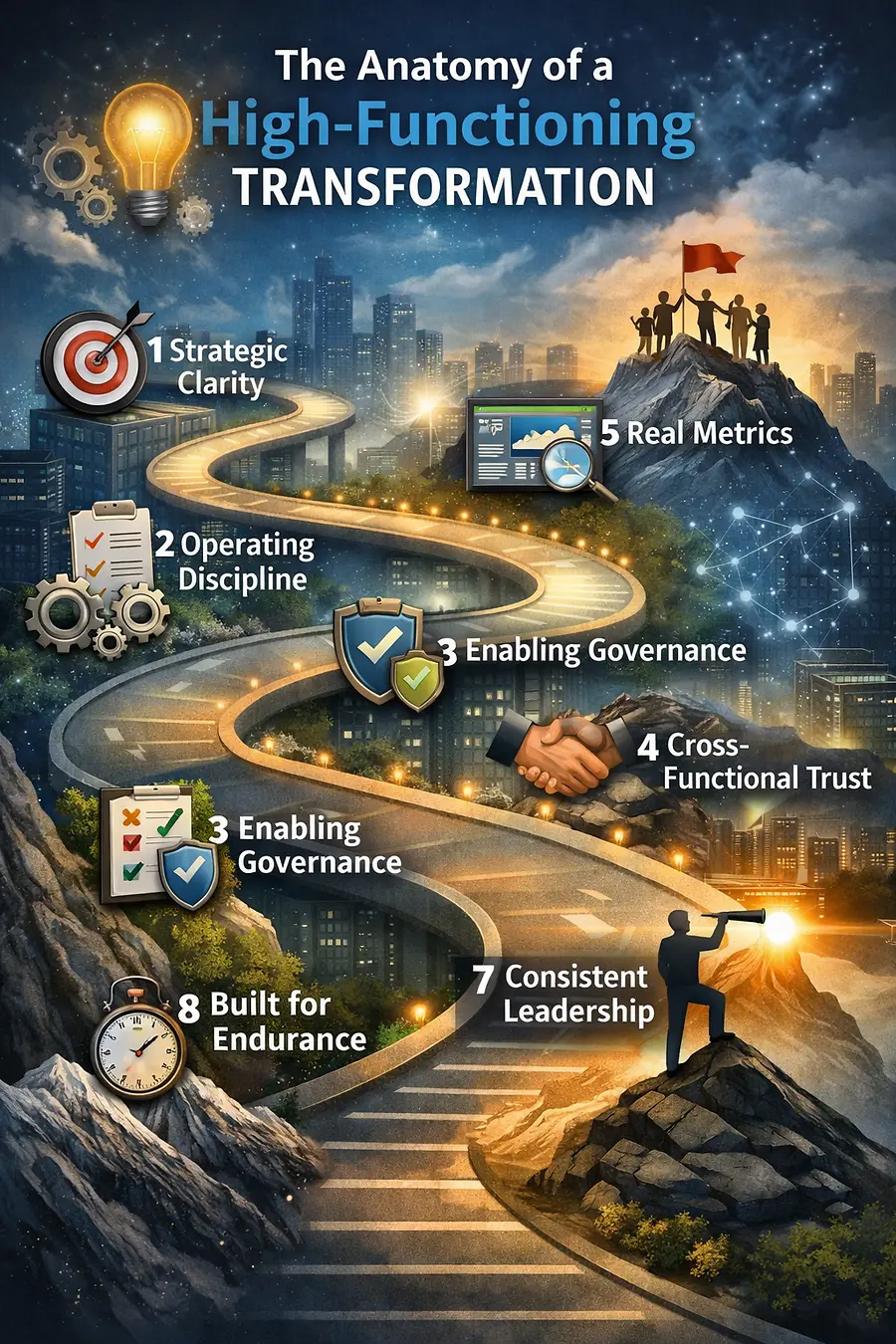
Transformation is often spoken about as if it begins with a major announcement and ends with a visible milestone: a new platform launch, a restructured operating model, a cost-saving initiative, or an updated customer experience. But in reality, high-functioning transformation is not defined by the announcement. It is defined by the invisible architecture that holds change together when pressure, ambiguity, and resistance begin to surface.
A transformation becomes high-functioning when it is not merely aspirational, but operationally real. It is not driven by noise, urgency theater, or endless reorganization. Instead, it moves with intention. It connects strategy to execution, people to purpose, and governance to outcomes. The strongest transformations are not just ambitious. They are structurally sound.
Strategic Clarity Comes First
At the center of every successful transformation is clarity. Not vague ambition. Not broad corporate language. Real clarity. Teams need to understand what is changing, why it matters now, what success looks like, and what must stop in order for the new direction to take hold.
Organizations often struggle because they confuse motion with alignment. Multiple initiatives may be running at once, but without a clearly defined transformation thesis, people begin working hard in different directions. High-functioning transformation requires leadership to articulate a focused narrative: what problem is being solved, what future state is being built, and what trade-offs are being accepted along the way.
When strategic clarity is weak, transformation becomes fragmented. When it is strong, decisions accelerate because teams are no longer guessing what matters most.
Operating Discipline Turns Vision Into Movement
A compelling vision may inspire people, but discipline is what sustains progress. High-functioning transformation depends on execution systems that are structured enough to create consistency, yet flexible enough to adapt to changing realities.
This means roles are clear. Decision rights are understood. Dependencies are visible. Risks are surfaced early rather than buried in status updates. Milestones are tied to measurable outcomes instead of vanity deliverables. Leaders are not simply reviewing work; they are removing friction.
Transformation weakens when organizations rely too heavily on charisma, heroics, or last-minute problem solving. Those patterns may create temporary wins, but they do not create scalable execution. Mature transformation environments replace chaos with operating rhythm. There are regular review cadences, escalation paths, ownership models, and a shared understanding of how work moves from idea to implementation.
Execution excellence is not about rigidity. It is about reliability.
Governance Must Enable, Not Suffocate
Governance is frequently misunderstood. In struggling organizations, governance becomes either performative or oppressive. It turns into endless meetings, redundant approvals, or reporting rituals that consume energy without improving decisions. In high-functioning transformation, governance serves a different purpose: it protects momentum.
Good governance creates visibility, accountability, and decision quality. It ensures that leaders are seeing the same realities at the same time. It helps organizations identify where investments are producing value, where risks are accumulating, and where intervention is needed. Most importantly, it separates signal from noise.
Effective governance is not about controlling every detail. It is about creating enough structure to support scale. When done well, governance becomes the mechanism that links strategic intent with execution truth. It gives transformation resilience because it prevents drift, confusion, and unmanaged complexity.
Cross-Functional Trust Is Non-Negotiable
Transformation rarely fails because the strategy was impossible. More often, it fails because the organization could not work across its own boundaries. Functional silos, competing incentives, unclear handoffs, and political defensiveness can quietly erode even the strongest initiatives.
A high-functioning transformation requires cross-functional trust. Product, engineering, operations, finance, compliance, customer teams, and leadership cannot behave as isolated domains protecting their own priorities. They must operate as interconnected parts of the same system.
This does not mean everyone agrees all the time. Healthy transformation includes tension. But the tension must be productive. It must sharpen thinking rather than fracture alignment. Trust allows teams to challenge assumptions, raise concerns, and confront trade-offs without turning every disagreement into a territorial battle.
The real test of transformation maturity is not how people behave when things are easy. It is how they behave when timelines slip, budgets tighten, or unexpected risks emerge.
Metrics Must Reflect Reality
One of the most dangerous features of a weak transformation is the illusion of progress. Slide decks look polished. Dashboards show green. Teams report momentum. Yet underneath the surface, adoption is low, process friction remains high, and value realization is delayed.
High-functioning transformation relies on metrics that reveal truth, not comfort. That means measuring more than activity. It means asking whether outcomes are changing, whether customer experience is improving, whether cycle times are reducing, whether reliability is increasing, whether costs are becoming more efficient, and whether teams are operating with greater clarity and less friction.
The best metrics do not merely prove success after the fact. They help leaders steer in real time. They show what is working, what is stalled, and what requires course correction. Honest measurement is one of the most powerful stabilizers in any transformation effort because it prevents narrative from outrunning evidence.
Culture Determines Sustainability
Transformation can be launched through structure, but it is sustained through culture. If the culture punishes transparency, resists accountability, or rewards politics over performance, then even the best-designed transformation will struggle to stick.
A high-functioning transformation creates a culture where ownership is normalized, learning is continuous, and adaptation is expected. Teams are not shamed for raising risks. Leaders do not confuse control with leadership. People are encouraged to think systemically, not just functionally.
Culture shows up in subtle ways. It shows up in whether teams escalate issues early or hide them. It shows up in whether leaders invite dissent or suppress it. It shows up in whether change is treated as a shared enterprise or as something imposed from above.
Sustainable transformation happens when the organization’s behaviors begin to evolve alongside its processes and systems.
Leadership Must Be Consistent Under Pressure
In calm moments, most leaders can sound aligned. Transformation reveals leadership quality under pressure. When uncertainty rises, a high-functioning transformation needs leaders who can stay clear, calm, and decisive without becoming reactive or vague.
This kind of leadership does not rely on overpromising certainty. It provides steadiness. It communicates frequently, names reality honestly, and reinforces priorities when distractions multiply. It also understands that transformation is not just about systems and structures. It is about human energy. Leaders must manage morale, attention, and confidence as deliberately as they manage timelines and budgets.
Employees can absorb difficult change if they trust the leadership guiding it. What they cannot absorb for long is inconsistency, silence, or executive misalignment.
Transformation Must Be Designed for Endurance
Many organizations know how to launch transformation. Far fewer know how to sustain it long enough to realize lasting value. That is because real transformation is not a campaign. It is a capability.
A high-functioning transformation is designed for endurance. It builds repeatable mechanisms, not temporary bursts of effort. It develops internal leadership capacity, strengthens decision systems, and embeds ways of working that remain effective after the initial push has passed. It recognizes that change is not complete when the implementation is done. It is complete when the organization can reliably operate in the new model without constant intervention.
This is the difference between activity and evolution. One is exhausting. The other is enduring.
Final Thought
The anatomy of a high-functioning transformation is not mysterious, but it is demanding. It requires strategic clarity, disciplined execution, enabling governance, cross-functional trust, truthful metrics, cultural maturity, and leadership consistency. When these elements work together, transformation stops being a disruptive event and becomes an organizational strength.
The real goal is not simply to change. The goal is to change well — with enough structure to hold complexity, enough agility to adapt, and enough integrity to ensure that progress is real.


