The Art We Pass Down: How Creativity Becomes a Family Legacy
How creativity becomes the most precious inheritance we pass to our children across generations.
The Magic That Travels Through Generations
Some of the most meaningful things we leave our children cannot be measured in dollars, placed in a bank account, or divided among family members.
They are the things we teach without always realizing we are teaching them.
The curiosity we encourage. The stories we tell. The music we share. The imagination we protect. The permission we give our children to explore a world beyond what they can see.
For me, one of those gifts has always been art.
I have spent more than fifty years creating art in its many forms. From theater and stage production to painting, puppetry, storytelling, and education, creativity has been woven into the fabric of my life.
Along the way, I have met extraordinary artists, worked behind the curtains of remarkable productions, and witnessed moments of imagination that audiences rarely get to see.
But when I think about the true legacy of those years, my thoughts do not necessarily turn to the famous performers I have encountered or the productions I helped bring to life.
They turn to something much simpler.
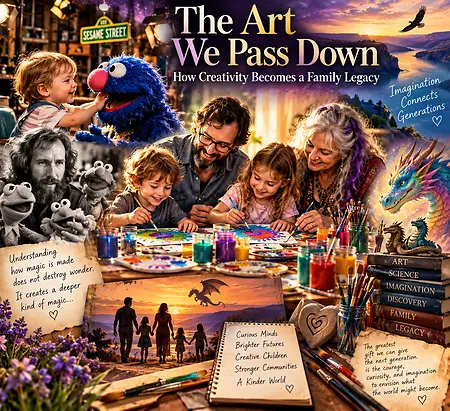
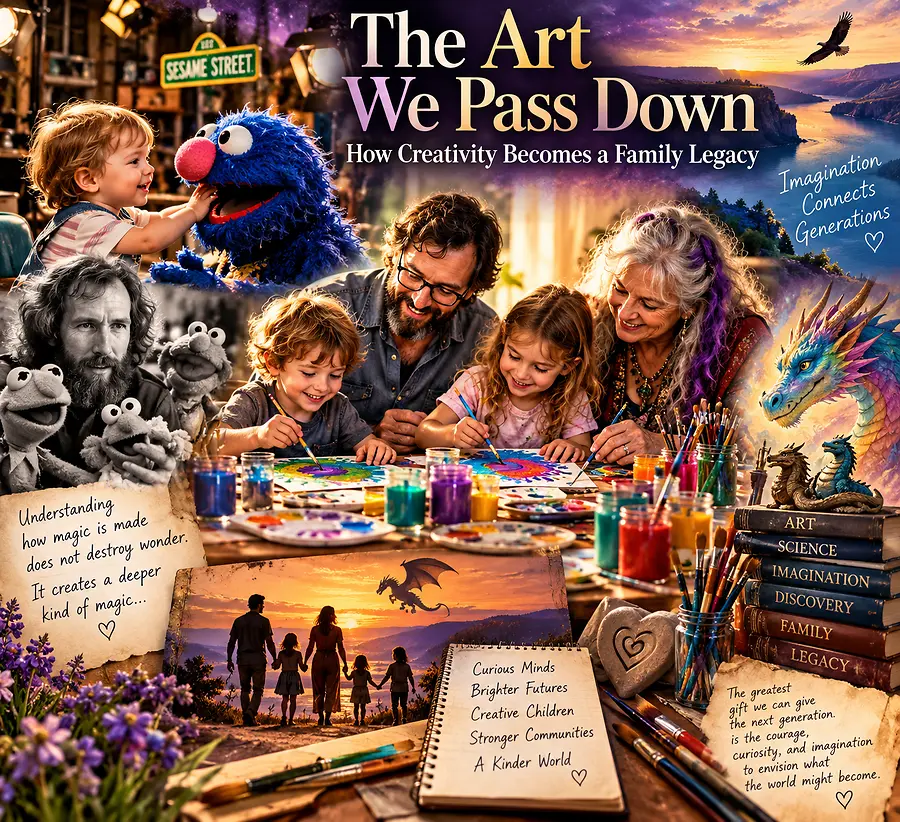
My son sitting with his children, painting together as a family.
And I realize that perhaps the greatest work of art we create is not something we hang on a wall.
Perhaps it is the creativity we pass along.
A Little Boy Behind the Magic
Many years ago, while I was in the hospital giving birth to my youngest son, my oldest son had an extraordinary experience.
At just two years old, he spent a week on the set of Sesame Street.
It was an unusual opportunity.
Productions involving beloved children's characters often protect the illusion that makes those characters so magical. Allowing very young children to see the people and mechanisms behind the puppets can change how they experience that imaginary world.
But my son was an exceptionally curious little boy.
Even at two, he wanted to understand how things worked.
Rather than simply seeing a puppet as a character, he was interested in discovering how someone could bring that character to life.
He learned about the larger puppets and the artistry involved in making them move.
I have often wondered how much that experience influenced the person he would become.
Today, he is both an artist and a scientist.
And that combination makes perfect sense to me.
Because art and science are not opposites.
They are two expressions of the same human curiosity.
One asks, "How does this work?"
The other asks, "What could this become?"
Both begin with wonder.
Understanding the Magic Does Not Destroy It
Over the years, I have heard people suggest that children eventually have to outgrow their belief in magic.
That imagination belongs to childhood, while adulthood belongs to facts, responsibilities, and practical thinking.
I have never agreed.
I believe understanding how something works can deepen our appreciation of its beauty.
A child who sees a puppet come alive experiences one kind of wonder.
A child who discovers the hands, craftsmanship, imagination, and collaboration behind that puppet experiences another.
Neither is less meaningful.
One celebrates the story.
The other celebrates the power of human creativity.
I had the opportunity to meet Jim Henson during my years working in theater.
What stayed with me was not simply his remarkable professional accomplishments. It was his quiet yet powerful presence and what seemed to me an imagination without boundaries.
His work demonstrated something I have carried throughout my own artistic journey: imagination is not a frivolous luxury.
It is a way of exploring possibility.
And possibility is where discovery begins.
When we encourage children to create, we are doing more than keeping them entertained.
We are inviting them to become curious about their world and confident enough to imagine changing it.
The Artist and the Scientist
I find it interesting that we often separate art and science in education.
We encourage some children toward mathematics, engineering, and scientific discovery, while directing others toward music, painting, literature, and the performing arts.
But why must curiosity be divided into categories?
An artist observes patterns, experiments with materials, studies relationships, and searches for solutions.
A scientist imagines possibilities, asks questions, tests ideas, and often relies on creativity to approach problems from unfamiliar directions.
Both require patience.
Both involve mistakes.
Both ask us to look beyond the obvious.
And both can teach children that failure is not the opposite of learning. It is often part of the process.
When a child mixes two colors and discovers a third, that is an experiment.
When a child builds something that falls apart and tries again, that is problem-solving.
When a child draws an imaginary creature, they are exploring a possibility that exists first in their mind.
These experiences may appear simple, but they encourage ways of thinking that extend far beyond the art table.
My son's life as both a scientist and an artist reminds me that we do children a disservice when we ask them to choose between creativity and intellect.
The two can enrich one another beautifully.
The Family That Paints Together
Today, my son shares his love of art with his children.
As a family, they sit down and paint together.
When I learned this, I found myself reflecting on the journey that brought us here.
A little boy once fascinated by the mechanisms of puppets is now a father encouraging his own children to explore their imaginations.
The creative thread continues.
And what makes this especially meaningful is that he is not simply providing art supplies or telling his children to go make something.
He is participating.
He is creating alongside them.
There is a difference.
When adults sit with children and create together, the experience becomes more than an activity.
It becomes shared time.
An opportunity for conversation.
A place where everyone can explore ideas without needing to be the expert.
The adult may have more experience, but the child may imagine something the adult would never have considered.
And suddenly, learning flows in both directions.
The child discovers new techniques.
The parent discovers a new way of seeing.
Neither needs to produce a masterpiece.
The value lies in the experience of creating together.
Art Is Not About Perfection
One of the greatest obstacles to creativity is the belief that we must be good at something before we are allowed to enjoy it.
How many adults have said, "I can't draw," or "I'm not artistic," because someone once criticized their work?
How many children have stopped experimenting because they became afraid of making mistakes?
Somewhere along the way, we began treating creativity as a talent possessed by a fortunate few rather than a natural human capacity that can be nurtured.
But art does not have to be perfect to be meaningful.
A painting can be messy.
A sculpture can be crooked.
A story can wander in unexpected directions.
A puppet can have mismatched eyes and a wonderfully ridiculous personality.
What matters is the freedom to explore.
This is especially important in childhood.
Children need opportunities to experiment without constantly being evaluated.
They need adults who recognize that the process of making something can be as valuable as the finished product.
And sometimes, they need us to put down our expectations and pick up a paintbrush beside them.
Not to demonstrate how things should be done.
But to discover what might happen.
Creativity, Connection, and Healing
My work as an educator, artist, and guide has also taught me that creativity can offer something important beyond artistic expression.
It can provide opportunities for connection.
For people who have experienced trauma, grief, isolation, or difficult life transitions, finding words for an experience is not always easy.
Sometimes a color expresses something that language cannot.
Sometimes shaping clay, painting a landscape, writing a story, or creating a character offers a gentle way to explore an emotion.
Art does not erase trauma, nor should creative activities be presented as substitutes for professional mental health care when it is needed.
But creativity can be one meaningful part of a broader process of self-expression, reflection, and reconnection.
And this matters within families as well.
A child does not always know how to explain what they are feeling.
But while painting beside a parent or grandparent, they may begin to talk.
Or they may simply enjoy being together without the pressure to explain anything at all.
That shared presence matters.
In a world where families are often pulled in different directions by schedules, responsibilities, technology, and economic pressures, creating together can offer something increasingly precious.
Time to connect.
Time to listen.
Time to belong.
What Are We Really Passing Down?
When we speak of generational inheritance, we often think about property, money, possessions, and family traditions.
But families pass down much more than material things.
We pass down attitudes toward learning.
We pass down ways of responding to mistakes.
We pass down stories about what is possible.
We pass down beliefs about who deserves to be heard and whose ideas matter.
We can pass down fear of failure.
Or we can pass down curiosity.
We can teach children that their worth depends on producing something impressive.
Or we can teach them that the joy of creating has value in itself.
We can dismiss imagination as childish.
Or we can recognize it as a lifelong human resource.
I believe these choices matter.
Because the way we respond to a child's creativity can influence whether they continue exploring it.
A child who is encouraged to ask questions may become an adult who challenges assumptions.
A child who is allowed to experiment may become an adult who approaches problems with confidence.
A child who grows up surrounded by stories and imagination may carry those gifts into parenting, teaching, science, community leadership, or countless other areas of life.
Not every child will become a professional artist.
Nor should that be the goal.
The goal is to help children recognize that they have something meaningful to contribute.
A Legacy Larger Than a Canvas
When I reflect on my years in the arts, I remember remarkable moments.
I remember working backstage, meeting extraordinary performers, and watching imagination become something an audience could see, hear, and feel.
I remember the elaborate world of theater, where countless hands work together to create a few hours of magic.
I remember the artistry of puppetry and the power of storytelling.
And I remember that little boy who wanted to know how the puppets worked.
But perhaps what moves me most is knowing that the story did not end there.
That little boy grew up.
He developed his own talents and interests.
He became a scientist and an artist.
And now he shares the joy of painting with his children.
There is something profoundly beautiful about that continuity.
I cannot know exactly which childhood experiences shaped his artistic journey or how his children will remember their family painting sessions years from now.
But I know that those moments are worth having.
And I hope they become memories his children carry with them.
Not because every painting will be saved.
Not because every creative experiment will become something extraordinary.
But because they will remember that their ideas were welcomed.
That their imaginations had room to grow.
That someone they loved took the time to create beside them.
The Art We Leave Behind
At this stage of my life, I find myself thinking more deeply about legacy.
Not legacy as recognition, awards, or public accomplishments.
But legacy as the things that continue because we cared enough to nurture them.
A story told to a child.
A song shared across generations.
A recipe prepared together.
A garden planted.
A puppet brought to life.
A family sitting around a table with paintbrushes in their hands.
These moments may seem ordinary.
Yet they are the experiences through which families build memories, share knowledge, and pass along the values that matter to them.
For more than fifty years, art has been one of the great threads weaving through my life.
And now I see that thread continuing through my son and into the lives of my grandchildren.
I do not know what they will create.
Perhaps they will become artists, scientists, storytellers, inventors, or something none of us has imagined yet.
That is their journey to discover.
My hope is simply that they never lose the freedom to wonder.
Because the greatest gift we can give the next generation is not a perfect picture of the world as it is.
It is the courage, curiosity, and imagination to envision what the world might become.
And perhaps, many years from now, one of my grandchildren will sit beside a child of their own, open a box of paints, and say:
"Let's see what we can create together."
And the legacy will continue.
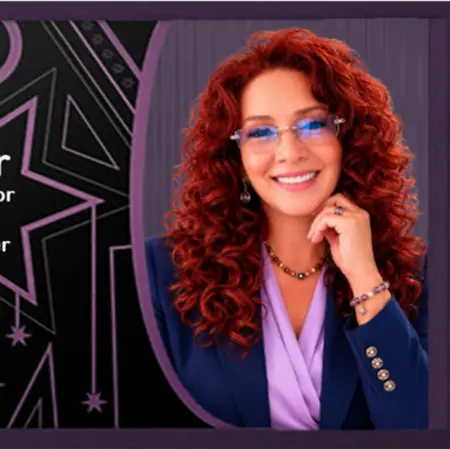
Mylee Star Hawk, MAED, founded Mama Star's Healing Circle to support healing through education, art, and community. With 25+ years in education and community support, Star specializes in addressing generational trauma through creative expression, culinary arts, and spiritual practices. An ordained minister and master chef pursuing a doctorate in Transpersonal Psychology, she integrates education, creativity, and…