The Boeing 737!
From Innovation to Crisis: The Complete History of Aviation's Most Prolific Aircraft

Welcome back dear travelers! Today is a special article; we need to discuss the most popular yet troubled aircraft in aviation history. The aircraft that has more versions of it and erstwhile iterations and is flown, despite intense competition, by innumerable airlines around the world. This is our short history, analysis, and deep-dive into the Boeing 737.
When one looks up the 737, the base description is fairly straightforward. The Boeing 737
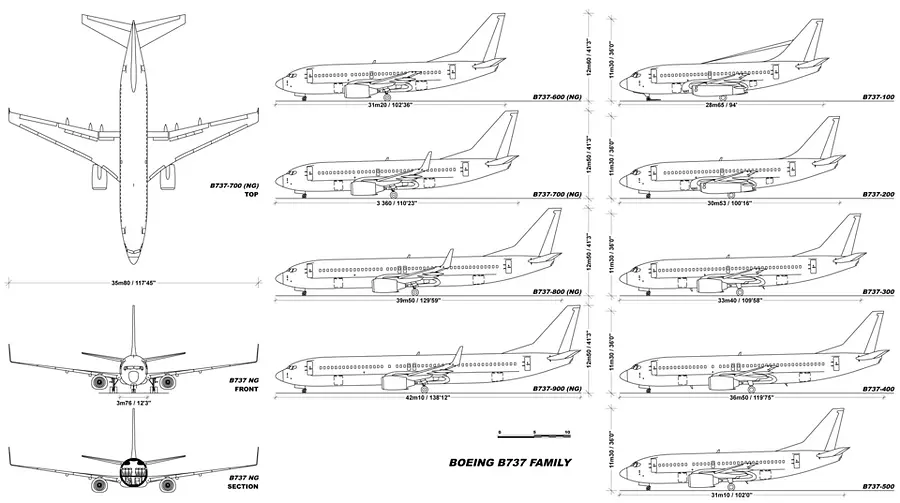
“is an American narrow-body aircraft produced by Boeing at its factories in Washington state.” Simple correct? Not quite. That is what the 737 is at the base level but the aircraft and its story easily becomes far more complicated. Envisioned in 1964, the initial 737-100 made its first flight in April 1967 and entered service in February 1968 with the German f;ag carrier, Lufthansa. The lengthened 737-200 entered service with Lufthansa as well, four years, to the day, later, in April 1968, and evolved through four generations, offering several variants for 85 to 215 passengers; the 737-200 as mentioned, succeeded by the 737-300, -400, -500, and lastly, what would become known as the 737 Classic ended with the -600 version before the Next Generation 737 was declared (-700, -800, -900) and the current 737-MAX series.
But first, let’s go back in time, dearest readers, to 1964. Boeing had been studying short-haul jet aircraft designs, and saw a strong need for a new aircraft to supplement the 727 on short and thin (light demand) routes. Design work on the as-yet-unknown aircraft began on May 11, 1964, based on research that indicated a market demand for a fifty to sixty passenger airliner flying routes of 50 to 1,000 miles. The initial engineering concept featured podded engines on the aft fuselage, a T-tail as with the 727, and five-abreast seating. Obviously this did not occur, but how interesting this prototypical 737 would have been if it had been brought to life. To clarify, podded engines are engines that had short nacelles unlike moderate-length nacelles that the vast majority of, if not all modern aircraft do, but instead were built into the wing or fuselage itself, in encapsulated “pods” within the wing or hull with no pylons at all (for visual context, I’d suggest looking up the de Havilland Comet, it’s a beautiful plane, and you can learn a from its downfall and initial successes). Boeing’s aviation engineer Joe Sutter relocated the engines to the wings which lightened the structure and simplified the accommodation of six-abreast seating in the fuselage. Many designs for the engine attachment strut were tested in the wind tunnel laboratory, and the optimal shape for high speed was found to be one which was relatively thick and, as a result, low to the ground, filling the narrow channels formed between the wing and the top of the nacelle, particularly on the outboard side of the aircraft.
All aircraft are initially designed with a single-class configuration in mind for ease of design and subsequent marketing. Everyone knows that with the exception of low-cost carriers, no self-respecting mainline legacy or flag carrier will use any aircraft in a single-class configuration, but the single-class is necessary for design purposes, long before any airline lines up as a customer.
At the time, Boeing was far behind its competitors; the French-made Sud Caravelle SE 210 Caravelle had been in service since 1955 and with its immense popularity, it was going strong with no signs of slowing down. More pointedly, the British Aerospace Corporation (BAC, together with the French Aerospatiale, were co-designers of the supersonic Concorde in the late 1970s) One-Eleven (BAC-111), Douglas DC-9 (of McDonnell-Douglas, they would later merge with Boeing in 1995, but not at this time), and the Scandinavian design, the Fokker F28 were all already well into flight certification. To expedite development, Boeing used 60% of the structure and systems of the existing 727, particularly the fuselage, which differs in length only. This 148-inch (3.76 m) wide fuselage cross-section permitted six-abreast seating compared to the rivals' five-abreast. The 727's fuselage was derived directly from the long-range 707.
The proposed wing airfoil sections were based on those of the 707 and 727, but somewhat thicker; altering these sections near the nacelles achieved a substantial drag reduction at high Mach numbers. The engine chosen for the production model was the Pratt & Whitney JT8D-1 low-bypass ratio turbofan engine, delivering 14,500 pounds-force of thrust each.
The concept design of the newly named 737 was presented in October of 1964 at the Air Transport Association maintenance and engineering conference by chief project engineer Jack Steiner, where its elaborate high-lift devices raised concerns and suspicions about maintenance costs and overall reliability.
The launch decision for the $150 million (around $1.14 billion in 2024 dollars) development was made by the board on February 1, 1965, just ten months after the initial decision was created on its drafting paper.
The fuselage cross section and nose are derived from that of the Boeing 707 and Boeing 727. Early 737 cockpits also inherited the "eyebrow windows" positioned above the main glareshield, which were a feature of the original 707 and 727 to allow for better crew visibility. Contrary to popular belief, these windows were not intended for celestial navigation (only the military T-43A and B had a sextant port for manual star navigation, which the civilian models lacked as there was no need.) With modern avionics, the windows became redundant, and many pilots placed newspapers or other objects in them to block out sun glare. They were eliminated from the 737 cockpit design in 2004 as part of the “glass cockpit” update and construction of the new 737-Next Generation models, although they are still installed upon customer request. The eyebrow windows were sometimes removed and plugged, usually during maintenance overhauls, and can be distinguished by the metal plug which differs from the smooth metal in later aircraft that were not originally fitted with the windows. The 737's main landing gear, under the wings at mid-cabin, rotates into wheel wells in the aircraft's belly. The legs are covered by partial doors, and "brush-like" seals aerodynamically smooth (or "fair") the wheels in the wells. The sides of the tires are exposed to the air in flight. "Hub caps" complete the aerodynamic profile of the wheels. It is forbidden to operate without the caps, because they are linked to the ground speed sensor that interfaces with the anti-skid brake system. The dark circles of the tires are clearly visible when a 737 takes off, or is at low altitude. From July 2008, the steel landing gear brakes on new NGs were replaced by Messier-Bugatti carbon brakes, achieving weight savings to 550–700 pounds (250–320 kg) depending on whether standard or high-capacity brakes were equipped.
737s are not equipped with fuel dump systems. The original design was too small to require this feature, and adding a fuel dump system to the later, larger variants would have incurred a large weight penalty. Boeing instead demonstrated an "equivalent level of safety". Depending on the nature of the emergency, 737s either circle the designated airport to burn off fuel or land overweight and absorb the force of the landing. If the latter is the case, the aircraft must be inspected by maintenance personnel for damage before being returned to service.
The Original 737-100, and -200 series were built without wingtip devices, but these were later introduced to improve fuel efficiency. The 737 has evolved four winglet types: the 737-200 Mini-winglet, 737 Classic/NG Blended Winglet, 737 Split Scimitar Winglet, and 737 MAX Advanced Technology Winglet. Blended winglets were standard on the 737 NG (Next Generation) since 2000 and are available for retrofit on 737 Classic models. These winglets stand approximately 8 feet (2.4 m) tall and are installed at the wing tips. They improve fuel efficiency by up to 5% through lift-induced drag reduction achieved by moderating wingtip vortices.
An optional Enhanced Short Runway Package was developed for use on short runways, to optimize the 737’s short-runway performance.
A plethora of other variants exist, including the ER variant, or Extended Range (for the Next Generation series), the BBJ, that is the Boeing Business Jet variant, which is a private business-exclusive model of the 737. Other notable variants include the E7 Wedgetail, an airborne warning and electronic countermeasures platform designed for NATO-aligned militaries and to augment then eventually take over the duties of the USAF’s E-3 Sentry AEWS. The BCF project is another notable variant, short for Boeing Conversion Freighter program, which as the name implies, converts a passenger aircraft to a freighter variant with limited modifications.
The sales pitch was simple for Boeing’s marketing department yet surprisingly (for the art of marketing) and refreshingly honest: “big-jet comfort on short-haul routes.”
The 737 went on to become the highest-selling commercial aircraft in terms of orders until surpassed by the competing Airbus A320 family in October of 2019, and maintained the lead in total deliveries until October of 2025 when Airbus finally overtook Boeing in popularity and success.
Lufthansa was designated as the official launch customer a week later, with an order for 21 aircraft, worth $67 million USD (around $507 million USD in 2024 dollars) after the airline had been assured by Boeing that the 737 project would not be canceled. This was huge for the, at the time, West German flag carrier (reunification between East and West Germany would not occur for another two and a half decades).
Consultation with Lufthansa over the previous winter had resulted in the seating capacity of the initial deliveries of the 737-100 and -200 being increased to a minimum of 100.
The first 737-100 variant was rolled out on January 17, 1967, and took its maiden flight, carrying no passengers, on April 9, 1967, two years after customer contracts were signed. With this rollout, the 737 was issued Type Certificate A16WE; regulatory jargon aside, this officially certified the 737-100 for commercial passenger-carrying flight in December of 1967. It was the first aircraft to have, as part of its initial certification, approval for Category II approaches, which would, essentially, mean that the 737 was certified for Instrument Landing System (ILS) approaches. This was the first aircraft to ever be dual certified at this type rating in aviation history.
The 737 original model with its initial variants, known later as the Boeing 737 Original, initially competed with SE 210 Caravelle and BAC-111 due to their earlier entry into service and later primarily with the McDonnell Douglas DC-9, then its MD-80 derivatives as the three European short-haul single aisles slowly withdrew from the competition. Sales were low in the early 1970s and, after a peak of 114 deliveries in 1969, only 22 737s were shipped in 1972 with 19 in the backlog of orders. The US Air Force saved the program by ordering T-43 twin-engine jet training aircraft (the USAF uses T-43s to this day -advanced models obviously- to train crews for their cargo and tanker aircraft), which were initially modified Boeing 737-200s. African airline orders kept the production running until the 1978 US Airline Deregulation Act, which improved demand for six-abreast narrow-body aircraft as numerous startup airlines vied for success amongst increasing competition. Demand further increased after the 737 was officially re-engined with the CFM56 high bypass turbofan engine. The fuselage has been and is still manufactured in Wichita, Kansas, by Boeing spin-off company Spirit AeroSystems, before being moved by rail to Washington state.
The 737 continued to evolve into many variants but still remains, to this day, recognizable as the 737. These are divided into four generations but all are based on the same basic design; the Original (only the 737-100), the Classic (includes the 737-200, -300, -400, and -500), the Next Generation or NG (includes the 737-600, -700, -800, and 737-900), and the MAX (737-MAX 7, -MAX 8, -MAX 9, and the yet-to-be certified MAX 10). Each of these could have its own article written in its own right, to be honest. Aside from minor or highly specialized carriers such as Canada North Airways which uses an arctic-capable 737-1 and -200 to deliver supplies, goods, and select passengers to remote communities in Canada’s Northern Territories, no carrier currently uses the Original or Classic versions of the 737. The Next Generation variants are still largely in service. The MAX 7 has only just been certified for passenger flight, and the MAX 10, the largest version, is still sitting on Boeing’s factory floor.
The competition in the narrow-body airline market has always been stiff. The Boeing 737 Classic, Next Generation and MAX series have faced significant competition from the Airbus A320 family first introduced in 1988. The relatively recent Airbus A220 family now also competes against the smaller capacity end of the 737 variants. The A320 was developed to compete also with the McDonnell-Douglas MD-80/90 and 95 series; the 95 later became the Boeing 717 after McDonnell-Douglas and Boeing merged and the former disappeared. Since July of 2017, Airbus had a 59.4% market share of the re-engined single aisle market, while Boeing had 40.6%; Boeing had doubts on over-ordered A320neos by new operators and expected to narrow the gap with replacements not already ordered. However, in July 2017, Airbus had still 1,350 more A320neo orders than Boeing had for the 737-MAX. That number has only increased.
As of June 2026, 17,497 Boeing 737s have been ordered and 12,615 delivered. It was the best-selling commercial aircraft until being surpassed by the competing Airbus A320 family in October 2019, and maintained the lead in total deliveries over the A320 until September 2025. Initially, its main competitor was the McDonnell-Douglas DC-9, followed by its MD-80/MD-90 derivatives. In 2013, the global 737 fleet had completed more than 184 million flights over 264 million block hours since its entry into service. The 737-MAX, designed to compete with the A320neo, was grounded worldwide between March 2019 and November 2020 following two fatal crashes.
Speaking of the MAX, before we close out this article, we need to touch on the failure of the 737-MAX. Two fatal accidents, Lion Air Flight 610, in October 2018 and Ethiopian Airlines Flight 302, in March 2019, led to the global grounding of the entire 737 MAX fleet from March 2019 to November 2020. The crashes were linked to the Maneuvering Characteristics Augmentation System (MCAS), which activated erroneously due to continuously faulty angle-of-attack sensor data. Investigations revealed that Boeing had not adequately disclosed MCAS to operators and identified shortcomings in the FAA's certification process. The incidents caused significant reputational and financial damage to Boeing, including billions of dollars in legal settlements, fines, and cancelled orders. Following modifications to the flight control software and revised pilot training protocols, the aircraft was cleared to return to service. By late 2021, most countries had lifted their grounding orders. However, the type came under renewed scrutiny after a January 2024 incident in which a door plug detached mid-flight on Alaska Airlines Flight 1282, causing a rapid decompression. The FAA temporarily grounded affected MAX 9 aircraft, and investigations raised further concerns about production quality and safety (Q&S) or “quality control” practices at Boeing. The general characteristics of the 737 MAX, in service today include the following: (data taken from the flight dynamics institute)
- Crew: 2
- Origin: Renton, WA, USA
- Capacity: 189 passengers in one class or realistically, 178 in a two-class configuration, 1,540 cubic feet of cargo
- Length: 129 ft 8 in (39.52 m)
- Wingspan: 117 ft 10 in (35.92 m)
- Width: 12 ft 4 in (3.76 m) (fuselage)
- Height: 40 ft 10 in (12.45 m)
- Max takeoff weight: 182,200 lb (82,644 kg)
- Fuel capacity: 6,820 US gal by volume, 45,694 lb by weight
- Powerplant: 2 × CFM International LEAP-1B28 high-bypass turbofan, 28,690 lbf (pounds-thrust) of thrust each
Honestly, an entire article could be dedicated to the errors and malpractices uncovered at Boeing. For now though, we hope you enjoyed learning about the famous and infamous Boeing 737! Remember to book us for your itinerary at brookeintheairtravel.net