The CARES Framework
Master the five trust moments that transform customer interactions into lasting relationships.

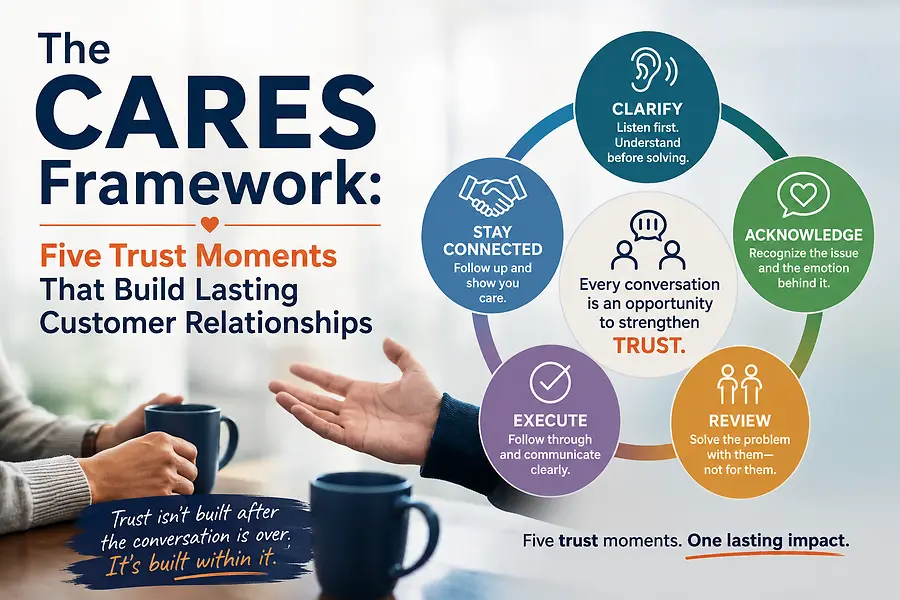
The CARES Framework: Building Trust One Conversation at a Time
We've all been there.
You're standing in a retail store looking for help. You're calling your internet provider because your service suddenly stopped working. You're chatting with technical support about software your team depends on every day.
Sometimes the issue is resolved quickly. Sometimes it takes longer than expected. Yet when we think back on those experiences, we rarely remember every technical detail.
We remember the conversation.
Were we listened to? Did someone understand our concern? Did they partner with us to find a solution? Did we leave feeling confident that someone genuinely cared?
Those small interactions may seem insignificant in the moment, but they aren't.
I think of them as micro-conversations.
Every meaningful customer conversation contains a series of trust moments-brief opportunities that shape how customers feel about the relationship long after the issue has been resolved.
Each trust moment leaves the relationship in one of two places: either stronger than it was before... or weaker than it was before.
Over the years, I realized that my most successful customer interactions weren't defined by having all the answers immediately. They were defined by how I navigated those trust moments.
That realization became the foundation of what I now call the CARES Framework.
The CARES Framework isn't about five separate customer conversations. It's about the five trust moments that naturally occur within almost every meaningful customer interaction-whether you're welcoming a new client, answering a support question, or helping someone navigate an unexpected challenge.
C - Clarify
Trust begins when customers know you're truly listening.
- Listen first.
- Ask thoughtful questions.
- Understand before solving.
A - Acknowledge
Trust grows when customers feel understood.
Recognize both the issue and the emotion behind it. Sometimes something as simple as,
"I understand why that's frustrating."
can change the entire tone of the conversation.
R - Review
Trust deepens when customers know you're solving the problem with them-not for them.
- Share your screen.
- Invite them into the process.
- Teach while troubleshooting whenever possible.
Partnership creates confidence.
E - Execute
Trust is reinforced when you follow through.
- Communicate clearly.
- Explain what you're doing.
- Celebrate progress-or clearly explain the next steps if additional help is needed.
S - Stay Connected
Trust endures when customers know they haven't been forgotten.
- Follow up.
- Confirm the solution worked.
- Offer additional resources.
Leave customers knowing they have someone they can count on.
This is what I call the CARES Framework. It isn't a support checklist. It isn't a script. It's a philosophy of customer communication built around one simple idea: Every customer interaction is an opportunity to strengthen trust.
As AI continues to transform customer support, it can answer questions faster than ever before. But every customer interaction still comes down to one simple question:
Did this conversation leave the relationship stronger than it was before?
When customers consistently experience trust, something remarkable happens. They become more confident in the product, more willing to ask questions, more open to new ideas, and more likely to view you as a trusted partner rather than simply a support resource. Over time, those conversations create stronger relationships that benefit both the customer and the organization.
And that's the long game of Customer Success.
Long-term customer relationships aren't built by solving one problem. They're built by consistently showing customers they matter. That trust leads to stronger partnerships, greater product adoption, customer loyalty, and, ultimately, business longevity.
Because trust isn't built after the conversation is over. It's built within the conversation itself-one trust moment at a time.
I'd love to hear your thoughts. What are some of the trust moments that have shaped your own experiences as a customer-or as someone who serves customers?


