The Climate Costs of War
How war's hidden climate cost threatens our future even as it destroys our present.

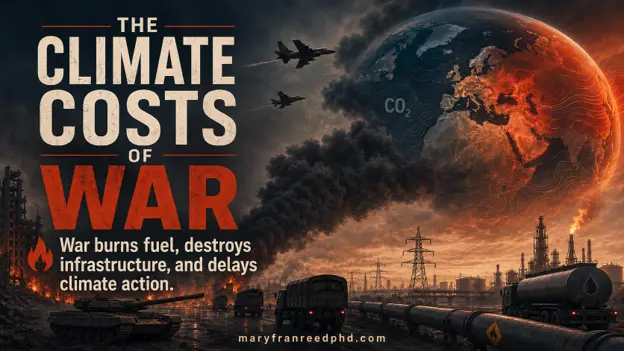
War is usually counted in lives lost, cities destroyed, money spent, borders changed, and political consequences.
Those costs are real and devastating.
But there is another cost we rarely count clearly enough: the climate cost of war.
Modern war burns enormous amounts of fuel. It moves aircraft, ships, tanks, trucks, drones, weapons, troops, supplies, and heavy equipment. It destroys buildings, roads, bridges, ports, power plants, factories, pipelines, farms, forests, and water systems. It starts fires, creates debris, disrupts agriculture, damages energy infrastructure, and forces reconstruction on a massive scale.
The emissions do not stop when the fighting pauses.
Rebuilding bombed cities requires concrete, steel, diesel machinery, transport, electricity, and new materials. Displaced people need shelter, food, water, transport, and emergency services. Damaged energy systems often fall back on whatever fuel is available. Environmental protections weaken. Climate action is delayed.
War does not only burn fuel.
It burns time.
And time may be its most dangerous climate cost.
War Has a Carbon Footprint
The world is already struggling to cut greenhouse gas emissions fast enough to avoid the worst consequences of global warming. Every year of delay adds more heat-trapping gases to the atmosphere. Every new source of emissions makes the task harder.
Yet military emissions and war-related emissions remain poorly reported and often poorly understood.
Military operations are energy-intensive even in peacetime. Bases must operate. Vehicles must train. Aircraft must fly. Ships must patrol. Equipment must be manufactured, maintained, transported, and replaced. Global supply chains support military readiness long before any conflict begins.
During war, those demands increase dramatically.
Fuel is burned directly in combat and logistics. Infrastructure is destroyed. Fires release carbon. Supply chains are rerouted. People are displaced. Emergency generators replace damaged grids. Reconstruction becomes another major source of emissions.
This does not mean climate concerns outweigh the human tragedy of war. They do not. War is first and foremost a human catastrophe.
But if we fail to count its climate damage, we misunderstand its full cost.
Ukraine Shows the Scale
The war in Ukraine offers one of the clearest examples.
Recent assessments estimate that Russia's full-scale invasion of Ukraine has generated hundreds of millions of tons of carbon dioxide-equivalent emissions. These estimates include military activity, attacks on energy infrastructure, fires, disrupted aviation routes, population displacement, and future reconstruction.
That is a staggering climate burden from a single war.
The destruction of energy infrastructure is especially important. Russian attacks have repeatedly damaged Ukraine's power system, including generation and transmission infrastructure. When power plants, grids, substations, and heating systems are attacked, civilians suffer immediately. Homes lose heat. Hospitals need backup power. Businesses close. Food storage, water systems, and communications are disrupted.
This turns energy infrastructure into a civilian survival issue.
It also creates climate consequences. Damaged power systems may require emergency fossil-fuel generation, electricity imports, diesel generators, reconstruction materials, and long-term rebuilding. A country trying to defend itself must also try to keep the lights on.
That is one of war's cruelties: it forces societies to spend energy and resources surviving destruction when those same resources should be building resilience.
Gaza Shows the Hidden Cost of Reconstruction
The Israel-Gaza war also shows how large the hidden climate costs of conflict can be.
Recent research has estimated that the conflict generated tens of millions of tons of carbon dioxide-equivalent emissions when including direct wartime emissions and broader pre- and post-conflict activities such as reconstruction.
That last word matters: reconstruction.
Destroyed buildings do not rebuild themselves. Roads, schools, hospitals, water systems, housing, power lines, and public infrastructure must be rebuilt with materials that carry heavy carbon footprints. Cement and steel are among the most carbon-intensive materials used by modern civilization. Heavy machinery burns fuel. Transport adds emissions. Debris must be cleared. New supply chains must be mobilized.
War creates destruction, and then reconstruction creates another wave of emissions.
Again, the human suffering is the central tragedy. But climate damage compounds the tragedy because it adds another burden to a world already struggling with heat, storms, droughts, floods, food insecurity, and displacement.
The climate system does not set aside wartime emissions as exceptions.
Carbon dioxide released during war still traps heat.
War Delays Climate Action
Direct emissions are only part of the problem.
War also delays climate action.
It diverts money, attention, diplomacy, industrial capacity, and political leadership away from the clean-energy transition. It makes governments focus on emergency supply rather than long-term resilience. It raises fuel prices. It disrupts trade. It hardens political divisions. It pushes climate cooperation lower on the agenda.
When war involves oil- and gas-producing regions, shipping routes, pipelines, refineries, or energy infrastructure, the effect is even more dangerous.
Fossil fuels become geopolitical weapons. Oil prices move on fears of supply disruption. Gas pipelines become tools of leverage. Fuel shortages create panic. Governments scramble for supply. The argument for drilling, burning, and delaying clean-energy transition becomes louder.
This is the vicious circle of fossil-fuel dependence.
- Fossil fuels drive climate change.
- Climate change increases political instability.
- Instability contributes to conflict and displacement.
- Conflict disrupts energy markets.
- Disrupted energy markets strengthen the argument for more fossil fuels.
That circle must be broken.
Fossil Fuels and War Are Entangled
For more than a century, fossil fuels have shaped global power.
Oil supply routes have influenced military strategy. Gas pipelines have shaped political dependence. Energy chokepoints have affected alliances and conflicts. Countries rich in fossil fuels have gained leverage far beyond their borders. Countries dependent on imported fuel have remained vulnerable to price shocks and supply disruptions.
This is not only an environmental problem.
It is a security problem.
A country that depends heavily on imported fossil fuels does not fully control its energy future. It is exposed to foreign suppliers, shipping lanes, price spikes, political blackmail, sabotage, and war. Even countries with domestic fossil fuels remain exposed to global markets and the climate consequences of burning them.
Traditional energy security often meant securing access to fossil fuels.
In the climate era, true energy security must mean needing them less.
That requires a different kind of energy system: cleaner, more reliable, more domestic, more resilient, and less vulnerable to global shocks.
Clean Power Is Security Infrastructure
Clean energy is often described as climate policy.
It is also security policy.
A stronger clean-energy system reduces dependence on fossil fuels. It reduces exposure to oil and gas shocks. It reduces air pollution. It reduces greenhouse gas emissions. It can strengthen domestic industry, protect public health, and make communities more resilient during crises.
But the word "clean" is not enough.
The power system must also be reliable.
Hospitals need electricity during war, heat waves, hurricanes, and cyberattacks. Water systems need power. Food storage needs refrigeration. Communications need power. Military bases, emergency services, transportation systems, and critical industries all require dependable electricity.
That is why the clean-energy transition must include firm clean power.
Solar and wind are essential. Batteries are essential. Transmission, efficiency, demand management, hydropower, geothermal, and grid modernization all matter. But a resilient clean-energy system also needs power that can operate around the clock, through difficult weather and high demand.
That is where nuclear power belongs in the security conversation.
Nuclear power provides large amounts of low-carbon electricity day and night. It does not depend on sunshine or wind. Its fuel is extraordinarily energy-dense. Safe existing reactors are climate assets. New nuclear, where it can be built responsibly, can help provide the clean firm power needed for a more secure and less fossil-dependent future.
Nuclear power will not end war.
No energy source can do that.
But reducing dependence on fossil fuels can reduce some of the vulnerabilities that make the world more unstable.
The Climate Cost Is Also a Moral Cost
The climate cost of war is not only measured in tons of emissions.
It is measured in lost time.
Every year spent rebuilding what war destroyed is a year not fully spent building the clean-energy future. Every dollar spent repairing bombed infrastructure is a dollar not spent on resilient grids, clean power, flood protection, drought preparation, or public health. Every diplomatic crisis that pushes climate cooperation aside makes the path harder.
Future generations will inherit the consequences of both war and climate delay.
That is the moral weight of this issue.
We are already asking the young to live with a hotter planet. We should not also leave them a world where conflict keeps pushing climate action further out of reach.
War does not only destroy the present.
It mortgages the future.
A Different Definition of Strength
A truly strong society is not one that can only fight for fuel.
It is one that needs less of the fuel that makes it vulnerable.
- Strength means resilient infrastructure.
- Strong science.
- Reliable clean electricity.
- Modern grids.
- Domestic low-carbon power.
- Reduced dependence on fossil fuels.
- Communities that can withstand shocks.
- A future not held hostage by every war, pipeline, tanker route, or fuel-price spike.
This is not naïve.
It is practical.
The climate crisis is already here. The energy system is already under strain. War makes both worse. If we want a safer future, climate policy, energy policy, and security policy can no longer be treated as separate conversations.
They are connected.
The climate costs of war should be counted.
The fossil-fuel roots of vulnerability should be faced.
And clean, reliable energy should be understood for what it is: not only climate infrastructure, but resilience infrastructure, public-health infrastructure, economic infrastructure, and security infrastructure.
War does not only burn cities, fuel, and money.
It burns the time we need to build a livable future.
We cannot afford to keep losing that time.
The climate-energy story is moving fast. Join my weekly newsletter for clear, science-based updates on climate change, clean energy, nuclear power, and the urgent choices shaping our future. https://bit.ly/4gdDlu8