The Crown of United States' Aviation: JFK (airport analysis #13)
Look into the Crown Glory of Aviation in the US and the defining example of travel

Welcome back everyone, Today we're entering the last leg of our airport analysis series. We have four, perhaps five left to analyze. We would indeed be remiss if we did not cover the most important airport in the continental United States and the airport that identifies itself as the representative of the United States to millions of passengers each year.
It is an airport that I have mentioned in passing dozens of times across numerous articles; I refer to none other than John F. Kennedy International Airport in New York City (IATA code: JFK).
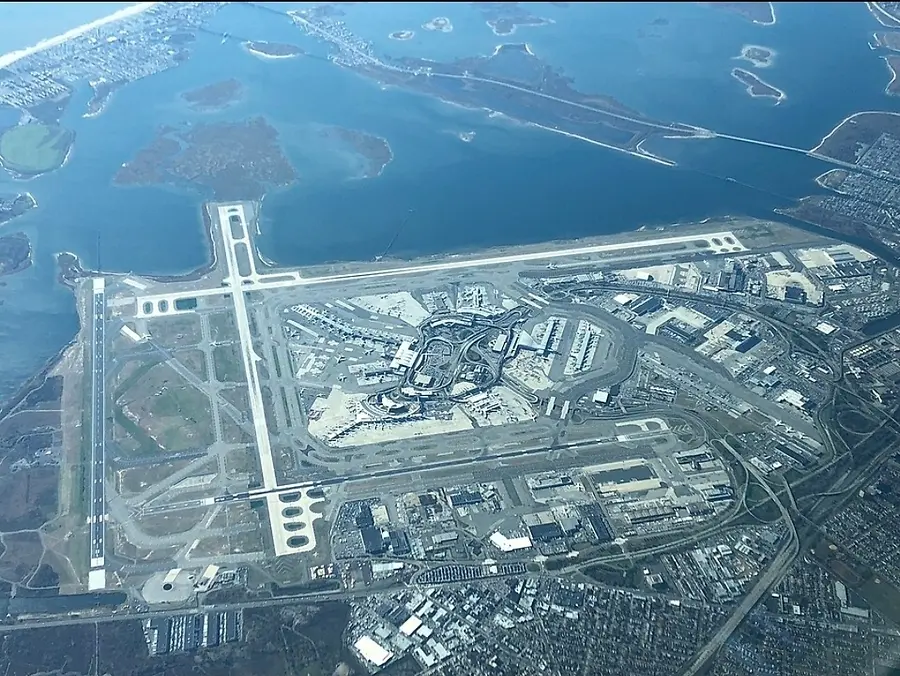
Specifically, JFK is located on the southwestern shore of Long Island, in the borough of Queens, New York City, bordering Jamaica Bay. It is the busiest of the three airports in the New York airport system (LaGuardia, JFK, and Newark-Liberty International Airport) the sixth-busiest airport in the United States (Atlanta being #1 followed by Dallas, Los Angeles, Chicago-O'Hare, and Denver, in positions 1-5 respectively). Four airlines officially call JFK a hub. American Airlines, Delta Air Lines, Kalitta Air Cargo, and Atlas Air Cargo but that simply indicates their presence at the airport (JetBlue alternates their hub operations between JFK and Boston).
The facility opened in 1948 simply as New York International Airport and was commonly known as Idlewild Airport until 1963. The airport was renamed John F. Kennedy International Airport in late 1963 by Lyndon B. Johnson in tribute to President Kennedy following his assassination earlier in the year. As of 2026, JFK has four operational runways and two reserves which are converted taxiways.
The History of JFK!
A little history is noted here for background as is our custom. Enjoy!
JFK was commonly known as Idlewild Airport (IATA: IDL, ICAO: KIDL, FAA LID: IDL) after the Idlewild Beach Golf Course that it displaced. It was built to relieve LaGuardia Field, which had become overcrowded after its 1939 opening. In late 1941, mayor Fiorello La Guardia announced that the city had tentatively chosen a large area of marshland on Jamaica Bay, which included the Idlewild Golf Course as well as a summer hotel and a landing strip called the Jamaica Sea-Airport, for a new airfield.
The title to the land was given to the city of New York at the end of December 1941 (ironically, the start of World War II for the US which saw the use of, or commandeering of numerous airports and airfields during the 1940s to train fighter or bomber pilots and crews).
Nevertheless, construction began in 1943, though the airport's final layout was not yet decided upon, especially in the midst of World War II. This meant the city had to ask the War Department (now, the department of defense) if they had input as to the airport's layout. Fortunately, the federal government allowed the airport to proceed with development as the war wrapped up in 1945.
You'll recall Mayor Fiorello La Guardia from my LaGuardia Airport analysis article earlier. He's a prominent figure in virtually all of New York's aviation infrastructure. Though he quickly stepped away from what would become JFK as it quickly became evident it was not what he wanted.
About US$60 million was initially spent with governmental funding, but only 1,000 acres (400 ha) of the Idlewild Golf Course site were earmarked for use. The project was renamed Major-General Alexander E. Anderson Airport in 1943 after a Queens resident who had commanded a Federalized National Guard unit in the southern United States and died in late 1942. The renaming was vetoed by Mayor La Guardia and reinstated by the New York City Council; nevertheless, in common parlance, the airport was still called "Idlewild.”
The Port of New York Authority (now, the Port Authority of New York and New Jersey) leased the Idlewild property from the City of New York in 1947 and maintains this lease today (the initial lease was for 100 years with renegotiation planned in 2047). In March 1948, the New York City Council changed the official name to New York International Airport, Anderson Field, but the common name still remained "Idlewild" until Christmas Eve, December 24, 1963. The airport was intended as the world's largest and most efficient in the world, with "no confusion and no congestion" according to planners.
The first flight from Idlewild was on July 1, 1948, with the opening ceremony attended by U.S. President Harry S. Truman and Governor of New York Thomas E. Dewey, who were both running for president in that year's presidential election. Significant animosity existed between the two men who were forced to appear cordial together.
The Port Authority cancelled foreign airlines' permits to use LaGuardia, forcing them to move to Idlewild during the next couple of years. This would ultimately force LaGuardia into a primarily regional airport role. See my article on LaGuardia for more on that bureaucratically besieged airport.
Idlewild, at the time, had a single 79,280-square-foot terminal building; by 1949, the terminal building was being expanded to 215,501 square feet. Further expansions would come in following years, including a control tower in 1952, as well as new and expanded buildings and taxiways.
Idlewild opened with six runways and a seventh under construction. This was astonishing for the time, by comparison, even Chicago-O'Hare only has four primary runways plus two reserves.
The Jet Age Dawns on New York
The first jet airliner to ever land at Idlewild was an Avro Jetliner flying from Malton Airport in Toronto carrying the world's first cargo of jet airmail on April 18, 1950.
Idlewild opened with six runways and a seventh under construction. This was astonishing for the time, by comparison, even Chicago-O'Hare only has four primary runways plus two reserves.
"Cowboy Diplomacy" Between the US and Soviets
Later in 1957, the Soviet Union sought approval for two jet-powered Tupolev Tu-104 flights carrying diplomats to land at Idlewild; the Port Authority did not allow them, saying noise tests had to be done first. This was, quite obviously, a politically expedient excuse given the tensions between the USSR and the United States. This was the Cold War after all.
Much of Newark Airport's traffic shifted to Idlewild (which averaged 242 daily airline operations as of 1952) when Newark was temporarily closed in February of 1952 after a series of three plane crashes in the two preceding months in Elizabeth, the area of New Jersey in which Newark Airport is located. All of these crashes ended in fatalities; flights were shifted to Idlewild and LaGuardia, which were both able to have planes take off and land over the water, rather than over the densely populated areas surrounding Newark Airport. The airport remained closed in Newark until November 1952, with new flight patterns that took planes away from Elizabeth.
By 1954, Idlewild had the highest volume of international air traffic of any airport globally. The Port of New York Authority originally planned a single 55-gate terminal, but the major airlines did not agree with this plan, arguing that the terminal would be far too small for future traffic. They were right and as a result, Architect Wallace Harrison then designed a plan for each major airline at the airport to be given its own space to develop its own terminal. In other words, instead of “Terminal 3” you would go to the Pan Am Worldport. Or instead of Terminal 5, you went to the TWA Flight Center. Obviously, those airlines don't exist anymore, but you get the idea.
This scheme made construction more practical, made terminals more navigable, and introduced incentives for airlines to compete with each other for the best design, catering to the passengers (as arguably they should).
The revised plan met unanimous airline approval in 1955, with seven terminals initially planned. Five terminals were for individual airlines, one was for three airlines, and one was for international arrivals (National Airlines and British Airways arrived later). In addition, there would be an 11-story control tower, roadways, parking lots, taxiways, and a reflecting lagoon in the center.
The International Arrivals Building, or IAB, was the first new terminal at the airport, opening in December 1957.
The terminal stretched nearly 2,300 feet and was parallel to runway 7R. The terminal had "finger" piers at right angles to the main building allowing more aircraft of various types to park, an innovation at the time but commonplace now. The building was expanded in 1970 to accommodate jetways and the massive Boeing 747 aircraft. Nonetheless, by the 1990s the overcrowded building was showing its age and it did not provide adequate space for security checkpoints. It was demolished in 2000 and replaced with Terminal 4 (T4).
The Historical Pier-Terminals and Airline Specific Terminals
United Airlines and Delta Air Lines opened a temporary Terminal 7 (later renumbered Terminal 9), a design similar to the IAB, in October of 1959. It was finally demolished in 2008.
Eastern Air Lines opened terminal 1 in November 1959.The terminal was demolished in 1995 and replaced with the current Terminal 1 after Eastern had largely gone out of business.
American Airlines, interestingly, opened Terminal 8 in February of 1960 and had a 317-foot stained-glass facade designed by artist Robert Sowers, the largest stained-glass installation in the world until 1979. The facade was removed in 2007 as the terminal was demolished to make room for the new Terminal 8; American cited the prohibitive cost of removing the enormous installation and asked the Port Authority of New York and New Jersey to perform the removal.
Pan American World Airways opened their Worldport in 1960. This would later become Terminal 3. The Worldport embodied the golden age of aviation and was showcased in cinema from the 1960s through 1990s. It featured a large, elliptical roof suspended by 32 sets of radial posts and cables; the roof extended 114 feet beyond the base of the terminal to cover the passenger loading area. It was one of the first airline terminals in the world to feature jetways that connected to the terminal and that could be moved to provide an easy walkway for passengers from the terminal to a docked aircraft. Jetways replaced the need to have to board the plane outside via airstairs that descend from an aircraft, truck-mounted mobile stairs, or wheeled stairs. The Worldport was demolished in 2013 and rebuilt as Terminal 3.
Trans World Airlines opened the TWA Flight Center in 1962 with a distinctive winged-bird shape. With the demise of TWA in 2001, the terminal remained vacant until 2005 when JetBlue and the Port Authority of New York and New Jersey (PANYNJ) financed the construction of a new 26-gate terminal partly encircling the old terminal building. Called Terminal 5 (Now T5), the new terminal opened on October 22, 2008. T5 is connected to the old central building through the original passenger departure-arrival tubes that connected the building to the outlying gates. The original terminal, also known as the head house, has since been converted into the current TWA Hotel.
National Airlines opened the Sundrome (later Terminal 6 or T6) in 1969. It was unique for its use of all-glass mullions dividing the window sections, unprecedented at the time. On October 30, 2000, United Airlines and the Port Authority of New York and New Jersey announced plans to redevelop this terminal and the TWA Flight Center as a new United terminal. Terminal 6 was used by JetBlue from 2001, until JetBlue moved to Terminal 5 in 2008. The Sundrome was demolished in October 2011 to make room for additional gates at JetBlue's Terminal 5 after National had long gone extinct. Ultimately, United Airlines pulled out of JFK entirely, centering all their New York operations at nearby Newark, with the exception of some United Express flights at LaGuardia.
New York's Renaming!
The airport's renaming event took place in 1963.
The airport was renamed John F. Kennedy International Airport on December 24, 1963, a month and two days after the assassination of President John F. Kennedy; Mayor Robert F. Wagner Jr. (No relation to the actor) proposed the renaming. The now-renamed Kennedy International Airport was given the code KIA, which was changed in 1968 to JFK to avoid an association with the term killed-in-action in the Vietnam War era.
The IDL and KIDL codes have since been reassigned to Indianola Municipal Airport in Mississippi.
Airlines began scheduling jets to Idlewild in 1958–59; LaGuardia did not get jets until 1964, and JFK became New York's busiest airport according to various sources. It had more airline takeoffs and landings than LaGuardia and Newark combined from 1962 to 1967 and was the second-busiest airport in the country, peaking at 403,981 airline operations in 1967. LaGuardia received a new terminal and longer runways from 1960 to 1966. By the mid-1970s, the two airports had roughly equal airline traffic (by flight count); Newark was in third place until the 1980s, except during LaGuardia's reconstruction.
Concorde, operated by Air France and British Airways, made scheduled trans-Atlantic supersonic flights to JFK from London-Heathrow and Paris-Charles De Gaulle, from November 22, 1977, until its retirement by British Airways on October 24, 2003. Air France had already retired the aircraft earlier that year.
Construction of the AirTrain JFK people-mover system began in 1998, after decades of planning for a direct rail link to the airport. Although the system was originally scheduled to open in 2002, it opened on December 17, 2003, after delays caused by construction and a fatal car crash.
The airport's new Terminal 1 opened on May 28, 1998. Terminal 4, the $1.4 billion replacement for the International Arrivals Building, opened on May 24, 2001. JetBlue's Terminal 5 incorporates the TWA Flight Center, and Terminals 8 and 9 were demolished and rebuilt as Terminal 8 for the American Airlines hub. The Port Authority Board of Commissioners approved a $20 million planning study for the redevelopment of Terminals 2 and 3, the Delta Air Lines hub, in 2008. The airport became a story of consolidation and remodeling, not necessarily expansion. This is especially true given its position just five miles south of LaGuardia Airport. On March 19, 2007, JFK was the first airport in the United States to receive a passenger Airbus A380 flight. The route, with an over-500-passenger capacity, was operated by Lufthansa and Airbus and arrived at Terminal 1. On August 1, 2008, it received the first regularly scheduled commercial A380 flight to the United States (on Emirates' New York–Dubai route) at Terminal 4. Although the service was suspended in 2009 due to poor demand, the aircraft was reintroduced in November 2010. Airlines operating A380s to JFK include Singapore Airlines (on its New York–Frankfurt–Singapore route), Lufthansa (on its New York–Frankfurt route), Korean Air (on its New York–Seoul route), Asiana Airlines (on its New York–Seoul route), Etihad Airways (on its New York–Abu Dhabi route), and Emirates (on its New York–Milan–Dubai and New York–Dubai routes).
On December 8, 2015, JFK was the first U.S. airport to receive a commercial Airbus A350 flight when Qatar Airways began using the aircraft on one of its New York–Doha routes.
The Longest Scheduled Flight!
JFK is the home of the world's longest aviation route.
To elaborate, the airport currently hosts the world's longest flight, which is Singapore Airlines Flights 23 and 24 (SQ23 and SQ24), at 15,349 km (9,537 mi, 8,288 nmi -nautical miles- respectively). The route was launched in 2020 between Singapore and New York-JFK, and uses the Airbus A350-900ULR. This will soon be supplanted by Qantas’ Sydney-New York route with Project Sunrise, utilizing the new A350-1000ULR. New York will eventually host both routes, to Singapore and Sydney, increasing its global importance.
For transit, it is important to note that none of the terminals are connected post-security; many inter-terminal connections require passengers to exit security, then use the AirTrain to get to the other terminal, then re-clear security.
On that note, all lines of AirTrain JFK, the airport's dedicated rail network, stop at each passenger terminal for individual embarkation. The system also serves the JFK long-term parking lot, and two multimodal rapid transit stations: Howard Beach and Jamaica, plus six other stations in the borough of Queens. While AirTrain travel within airport property is complimentary, external transfers at the latter locations are paid via OMNY or MetroCard and provide access to the New York City Subway, Long Island Rail Road, and MTA Bus services.
As of 2025 (no 2026 numbers have been aggregated yet), only the Q3 bus line serves Terminal 8 and no other terminal. The Q6 and Q7 bus lines serve JFK's cargo terminals. The Q10, Q80 and B15 (three bus lines) serve the Lefferts Boulevard station on the AirTrain and it includes a free transfer. Bus fares are paid via OMNY or MetroCard, like any other bus stop with free transfers provided to New York City Subway services.
Vehicles primarily access the airport via the Van Wyck Expressway (I-678) or JFK Expressway, both of which are connected to the Belt Parkway and various surface streets in South Ozone Park and Springfield Gardens neighborhoods of Queens.
The airport operates parking facilities consisting of multi-level terminal garages, surface spaces in the Central Terminal Area, and a long-term parking lot with total accommodation for more than 17,000 vehicles. A road trip-style travel plaza on the airport property also contains a food court, filling station, and originally four Tesla Superchargers. These were later replaced with a new station with 12 stalls for non-Tesla electric vehicles.
Taxis and other for-hire vehicles (FHV) serving JFK are licensed by the New York City Taxi & Limousine Commission, notably rideshare programs like Uber and Lyft. In 2019, PANYNJ approved the implementation of "airport access fee" surcharges on FHV and taxi trips, with the revenue earmarked to support the agency's capital programs. This fee is often your base fare and the trip is simply added onto this fare.
For example, the airport access fee is about $25.00. Your Uber trip to the airport comes in at 38 USD so, the full fare would be about $63 plus the driver's tip and taxes.
We will quickly go over JFK's terminals. JFK has five active terminals, containing 130 gates in total. The terminals are numbered 1, 4, 5, 7, and 8 resulting from the condensation and demolition of past terminals.
The terminal buildings, except for the former Tower Air terminal, are arranged in a deformed U-shaped wavy pattern around a central area containing parking, a power plant, and other airport facilities. The terminals are connected by the AirTrain system and access roads.
Until the early 1990s, each terminal was known by the primary airline that served it, except for Terminal 4, which was known as the International Arrivals Building.
In the early 1990s, all terminals were given numbers except for the Tower Air terminal, which sat outside the Central Terminals area and was not numbered. Like the other airports controlled by the Port Authority, JFK's terminals are sometimes managed and maintained by independent terminal operators. At JFK, all terminals are managed by airlines or consortiums of the airlines serving them, except for the Schiphol Group-operated Terminal 4, the same operators that run Amsterdam-Schipol Airport. All terminals can handle international arrivals that are not pre-cleared by customs.
Terminal 1
Terminal 1 opened in 1998, 50 years after the opening of JFK, at the direction of the Terminal One Group, a consortium of four key operating carriers: Air France, Japan Airlines, Korean Air, and Lufthansa. This partnership was founded after the four airlines reached an agreement that the then-existing international carrier facilities were inadequate for their needs. Historically, the Eastern Air Lines terminal was located on the site of present-day Terminal Terminal 1 is served by SkyTeam carriers Air France, China Eastern Airlines, Korean Air, Saudia, and Scandinavian Airlines; Star Alliance carriers Air China, Air New Zealand, Asiana Airlines, Austrian Airlines, Brussels Airlines, Egyptair, EVA Air, ITA Airways, LOT Polish Airlines, Lufthansa, Swiss International Air Lines, TAP Air Portugal, and Turkish Airlines; and Oneworld carrier Royal Air Maroc. Other unaffiliated airlines serving Terminal 1 include Air Serbia, Azores Airlines, Gulf Air, Philippine Airlines, and Viva.
Terminal 1 and Terminal 4 are the two terminals at JFK Airport with the capability of handling the Airbus A380 aircraft, which Korean Air flies on the route from Seoul–Incheon, and Lufthansa from Munich. Air France operated Concorde here until 2003. Terminal 1 has just 11 gates.
Terminal 4
Terminal 4 is managed by JFKIAT LLC, a subsidiary of the Schiphol Group, and was the first in the United States to be managed by a foreign airport operator. Terminal 4 currently contains 48 gates in two concourses and functions as the hub for Delta Air Lines at JFK.
- Concourse A (gates A2–A12, A14–A17, A19, and A21) serves primarily Asian and some European airlines along with Delta Connection flights.
- Concourse B (gates B20, B22-B55) primarily serves both domestic and international flights of Delta and its SkyTeam partners.
Airlines servicing Terminal 4 include SkyTeam carriers Aeromexico, Air Europa, China Airlines, Delta Air Lines, Kenya Airways, KLM, Virgin Atlantic, and XiamenAir; Star Alliance carriers Air India, Avianca, Copa Airlines, and Singapore Airlines; and non-alliance carriers Arkia, Caribbean Airlines, El Al, Emirates, Etihad Airways, JetBlue (late night international arrivals only), LATAM Brasil, LATAM Chile, LATAM Ecuador, LATAM Perú, Uzbekistan Airways, and WestJet. Like Terminal 1, the facility is Airbus A380-compatible with service currently provided by Emirates to Dubai (both non-stop and one-stop via Milan), and by Etihad Airways to Abu Dhabi. In 2024, Terminal 4 announced an expansion of its Arts & Culture program with a digital and static photography exhibit in collaboration with the Cradle of Aviation Museum (a nearly aviation museum celebrating Long Island's focus on, and history of aviation); a mural representing Queens by local artist Zeehan Wazed; a series of photographs by Terminal 4 employees, and the first-ever freestanding hologram device in an airport in partnership with Proto hologram, a New York City-based startup, which shows animals from the Bronx Zoo and has been used to beam in comedian Howie Mandel as a live hologram to surprise passengers.
Terminal 5
Terminal 5 (T5) opened in 2008 for JetBlue Airways, the manager and primary tenant of the building, functioning as its operating base at JFK. The terminal is also used by low-cost carriers Cape Air and Sun Country Airlines. On November 12, 2014, JetBlue opened the International Arrivals Concourse (T5i) at the terminal.
The terminal building sits behind the preserved Eero Saarinen-designed terminal originally known as the TWA Flight Center, which is now connected to the new structure and is considered part of Terminal 5. The TWA Flight Center reopened as the TWA Hotel in May 2019. The active Terminal 5 building has 29 gates: 1 through 12 and 14 through 30, with gates 25 through 30 handling international flights that are not pre-cleared through customs. Aer Lingus opened an airport lounge in 2015. The terminal opened a rooftop lounge which is open to all passengers in 2015, T5 Rooftop & “Wooftop Lounge”, a pet relief area and lounge, located near Gate 28.
On May 29, 2025 United Airlines announced it struck a deal with jetBlue to return to JFK in 2027. Destinations are still being discussed, over a year and a half later, but they will be utilizing terminal 5.
Terminal 7
Terminal 7 was built for British Overseas Airways Corporation (BOAC)-now, British Airways, and Air Canada. It opened on June 30, 1970. The terminal was inaugurated by Princess Alexandra of Kent, first cousin of then-Queen Elizabeth II, on September 24, 1970. Prior to 2022, the terminal was operated by British Airways, and was also the only airport terminal operated on US soil by a foreign carrier. British Airways operated Concorde here until 2003.
Airlines operating out of Terminal 7 include Star Alliance carriers All Nippon Airways and Ethiopian Airlines; and non-alliance carriers Aer Lingus, Condor, HiSky, Icelandair, Kuwait Airways, and Norse Atlantic Airways.
Terminal 8
Terminal 8 is a major Oneworld hub with American Airlines operating its hub here. In 1999, American Airlines began an eight-year program to build the largest passenger terminal at JFK, designed to replace both the original Terminal 8 and Terminal 9. Originally, the terminal was initially planned to house 59 gates and a "check-in area larger than Giants Stadium" according to American Airlines, referring to the New York Giants’ shared stadium (with the Jets) at the Meadowlands in East Rutherford, New Jersey. After budget shortfalls, the final plan eventually resulted in a scaled-down terminal with only 36 gates, and a headhouse with half of the originally modeled footprint. It was laughable when the comparison was made.
American Airlines, the third-largest carrier at JFK, manages and operates out of Terminal 8 and is therefore the largest carrier at the terminal. Other Oneworld airlines that operate out of Terminal 8 include Alaska Airlines, British Airways, Cathay Pacific, Finnair, Hawaiian Airlines, Iberia, Japan Airlines, Qantas, Qatar Airways, and Royal Jordanian. Non-alliance carriers China Southern Airlines, GOL, and Israir also use the terminal. Hawaiian Airlines began operating from Terminal 8 on April 22, 2025. Alaska Airlines also began operating some flights out of the terminal, while remaining flights moved from Terminal 7 in October 2025 to join their acquisition of Hawaiian Airlines.
The terminal is still reportedly twice the size of Madison Square Garden. It offers dozens of retail and food outlets, 84 ticket counters, 44 self-service kiosks, ten security checkpoint lanes, and a U.S. Customs and Border Protection facility that can process more than 1,600 people per hour. Terminal 8 has an annual capacity of 12.8 million passengers. It has one American Airlines Admirals Club and three lounges for premium class passengers as well as frequent flyers (named after neighborhoods in New York City, Greenwich, Soho, and Chelsea lounges).
Terminal 8 has 31 gates: 14 gates in Concourse B (1–8, 10, 12, 14, 16, 18, and 20) and 17 gates in Concourse C (31–47). Passenger access to and from Concourse C is by a tunnel that includes moving walkways.
The terminal features a mural depicting 70 prominent cities, artworks honoring American Airlines, and a mosaic depicting the original terminal building that stood between 1960 and 2008.
New Terminal 6
Construction on a new Terminal 6 began in February 2023, on the site of the original Terminal 6 and Terminal 7. The terminal was designed to, and likely will have ten gates, nine of which will be wide-body long-haul gates.
The terminal will be opened in multiple phases; the first phase is expected to be completed by 2026 and, as of November 2022, is projected to cost $4.2 billion. The terminal is planned to open in phases from late 2026 onward; the full terminal is expected to open in 2028. The new terminal will connect to Terminal 5; Terminal 7 will be demolished after the new Terminal 6's first phase of construction is completed. The construction will be built under a public–private partnership between the Port Authority and a consortium, known as JFK Millennium Partners, comprising JetBlue, RXR Realty, and startup Vantage Airport Group. Little else is officially known yet.
Cargo operations
Cargo is a complicated and important part of JFK.
The JFK air cargo complex is a Foreign Trade Zone (FTZ), which legally lies outside the customs area of the United States. JFK is a major hub for air cargo between the United States and Europe. London, Brussels and Frankfurt are JFK's three top trade routes. The European airports are mostly a link in a global supply chain, however. The top destination markets for cargo flying out of JFK in 2003 were Tokyo, Seoul and London. Similarly, the top origin markets for imports at JFK were Seoul, Hong Kong, Taipei and London.
20 cargo airlines operate out of JFK, among them: Air ACT, Air China Cargo, ABX Air, Asiana Cargo, Atlas Air, CAL Cargo Air Lines, Cargolux, Cathay Cargo, China Airlines, EVA Air Cargo, Emirates SkyCargo, Nippon Cargo Airlines, FedEx Express, DHL Aviation, Kalitta Air, Korean Air Cargo, Lufthansa Cargo, UPS Airlines, Southern Air, National Airlines, Icelandair Cargo, and, formerly, World Airways. Top 5 carriers together transported 33.1% of all revenue freight in 2005: American Airlines (10.9% of the total), FedEx Express (8.8%), Lufthansa Cargo (5.2%), Korean Air Cargo (4.9%), and China Airlines (3.8%).
Thank you for taking this journey with us! Learn more about aviation and travel at our site, brookeintheairtravel.net!

Brooke is the founder and chief operator of Brooke In The Air Travel LLC, a company she formed shortly after graduate school in 2022. She holds a Bachelor’s degree in history and sociology, plus a Master’s degree in history, and has since dedicated her life to travel and unraveling the complex mysteries of flights, connections, hotel bookings, etiquette, and in general “how to travel” with the least hassle…