The Cultivation of the Mind
How Language, Sensory Experience, and Deep Attention Shape Our Thinking


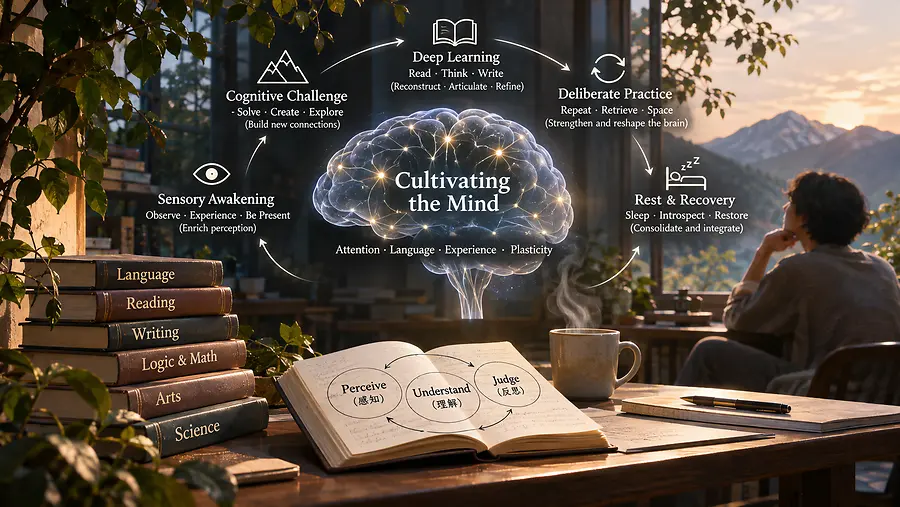
I. The Mind Is Not a Passive Container
What does it mean to develop a better mind?
We often approach intellectual development as a process of accumulation: acquiring more knowledge, reading more books, working longer hours, and solving increasingly difficult problems.
We assume that the more information we absorb, the more intellectually capable we become.
Yet the mind is not simply a container waiting to be filled.
Our intellectual capacities depend on how we encounter information, the attention we give it, the connections we establish, and the ways in which experience changes our understanding.
Two people can spend the same number of hours reading a book and emerge with profoundly different insights. One may remember its principal arguments. The other may discover an entirely new way of interpreting the world.
Likewise, two individuals may spend eight hours working on an intellectually demanding task. One becomes progressively more fatigued, repeating familiar procedures without questioning them. The other develops a deeper conceptual understanding, confronts difficult assumptions, and improves their methods.
The difference cannot be explained by duration alone.
It lies in the quality of cognitive engagement.
To understand how thinking improves, we must examine three interconnected dimensions of mental life:
- Perception: How we encounter the world.
- Cognition: How we organize and interpret what we encounter.
- Plasticity: How repeated experiences and learning alter our capacities over time.
These dimensions form the foundation of intellectual development.
II. Awakening the Senses: The Beginning of Cognition
Before we can analyze the world, we must perceive it.
Sight, sound, touch, smell, bodily movement, and awareness of our internal physical state provide information through which the brain constructs our experience of reality.
But perception is not a simple recording of external events.
The brain continuously selects, organizes, and interprets sensory information. What we notice depends partly on our expectations, previous experiences, goals, and current emotional state.
We can spend years walking along the same street without noticing the architectural details of its buildings, the changing patterns of light, or the subtle variations in its sounds.
The information may have been available to our senses all along. What was missing was deliberate attention.
This suggests that improving perception is not necessarily a matter of increasing sensory stimulation. It may instead require becoming more attentive to what is already present.
Attention as a Form of Sensory Awakening
Consider the difference between walking through a garden while scrolling through a phone and walking through the same garden while deliberately observing its surroundings.
In the second experience, we might notice the distribution of shadows, the texture of leaves, variations in temperature, or the rhythm of distant sounds.
These observations do not automatically make us more intelligent.
However, deliberate observation can change the quality of our engagement with experience.
It requires us to direct and maintain attention, discriminate between sensory features, and resist the automatic pull of unrelated thoughts.
Activities such as nature observation, drawing from life, listening closely to music, and mindful walking can provide opportunities to practice this form of attention.
A particularly interesting distinction exists between looking and seeing.
Looking is the reception of visual information. Seeing, in a richer cognitive sense, involves recognizing structure, relationships, and significance.
An artist may perceive variations in color that an untrained observer overlooks. A musician may detect relationships between sounds that a casual listener cannot distinguish.
Their sensory organs need not be fundamentally different. Their experience and training have developed more sophisticated perceptual skills.
Perception, therefore, is not entirely separate from learning.
We can learn what to attend to.
Sensory Richness and Cognitive Renewal
Modern intellectual work often occurs within narrow sensory environments: screens, artificial lighting, static postures, and continuous streams of abstract information.
This environment can be effective for certain forms of analysis. Yet it may offer limited opportunities for varied physical and perceptual experiences.
Activities such as walking outdoors, dancing, practicing a musical instrument, gardening, or sketching can introduce different combinations of movement, sensory feedback, and attention.
They may also provide relief from the demands of sustained abstract reasoning.
But we should distinguish temporary restoration from lasting cognitive change.
A walk through a natural environment may help restore attention or improve subjective well-being. Learning a musical instrument requires sustained coordination between perception, movement, memory, and feedback.
Both experiences can be valuable, but they serve different purposes.
The first may change our immediate cognitive state. The second, through repeated practice, may develop specific skills over time.
To cultivate the mind effectively, we need both renewal and challenge.
III. Language: Turning Experience Into Conscious Understanding
Sensory experience gives us contact with the world. Language allows us to interpret and examine much of that experience.
A feeling may be vivid yet poorly understood.
We may sense that something is wrong without knowing whether the underlying experience is disappointment, uncertainty, frustration, loneliness, or dissatisfaction.
Language provides distinctions that make our internal experiences more accessible to reflection.
The difference between saying "I feel unsuccessful" and saying "I have interpreted a temporary setback as evidence of a permanent limitation" is not merely stylistic.
The second statement exposes a specific pattern of reasoning.
Once articulated, that pattern can be examined.
Language thus serves as an instrument of metacognition: the capacity to make our own thoughts available for evaluation.
This is why reading and writing can be so valuable for intellectual development.
They do not merely transmit information or document existing ideas.
They create environments in which thought can become more structured.
Reading as Cognitive Reconstruction
Deep reading requires more than recognizing words or extracting information.
When encountering a difficult philosophical argument, the reader must hold multiple propositions in mind, interpret relationships between them, infer unstated assumptions, and assess whether the conclusion follows.
When reading a complex novel, the reader must track characters, reconstruct motives, interpret ambiguous behavior, and imagine circumstances beyond direct personal experience.
When studying scientific literature, the reader must distinguish observations from interpretations, understand methodological limitations, and evaluate competing explanations.
These are different forms of cognitive work.
The intellectual value of reading therefore depends partly on what the material demands of the reader.
A text that merely confirms familiar ideas may provide comfort or information. A text that challenges our existing understanding may force us to reorganize it.
The most valuable reading experiences are not necessarily those that feel effortless.
They are often those in which we encounter a difficulty that can be resolved through careful interpretation.
Deep reading is not only the consumption of another person's thoughts. It is the reconstruction of the cognitive operations through which those thoughts were created.
Writing as Cognitive Transformation
Writing creates a different kind of intellectual challenge.
In reading, we attempt to reconstruct another mind's reasoning.
In writing, we must construct and expose our own.
An idea may seem coherent until we attempt to explain it precisely.
A paragraph may reveal that two concepts we considered equivalent are actually different. An argument may expose a hidden assumption. A conclusion may prove stronger than the evidence permits.
Writing forces us to confront these difficulties.
Revision extends the process.
By refining language, reorganizing arguments, and challenging our own conclusions, we practice controlling the structure of thought.
Over time, repeated analytical writing can strengthen the particular knowledge and reasoning skills it requires.
The purpose is not to produce increasingly sophisticated sentences for their own sake.
It is to develop the ability to make increasingly sophisticated distinctions without losing clarity.
IV. Deep Focus: What Happens When Attention Remains With a Difficult Problem?
One of the most important conditions for complex intellectual work is sustained attention.
Many challenging problems cannot be understood through brief encounters.
A mathematical proof may require us to maintain relationships between several assumptions and intermediate conclusions. A philosophical question may demand that we compare multiple interpretations before reaching a judgment.
Every interruption can create a cost: we may need to reconstruct the context of our reasoning before continuing.
Deep focus reduces these disruptions.
It allows us to remain engaged with a problem long enough to develop a richer mental representation of it.
But why does deep focus matter?
Because some forms of understanding require cognitive continuity.
Imagine studying a difficult mathematical theorem.
During the first twenty minutes, the symbols may appear disconnected.
After further examination, patterns emerge. We begin to recognize why particular assumptions are necessary. We connect the theorem to earlier concepts. Eventually, we may understand not only how the proof works but why the result is meaningful.
This progression is not guaranteed by time alone. It depends on how we use that time.
A focused session becomes intellectually productive when we actively question, retrieve, manipulate, and test ideas.
The Difference Between Concentration and Mental Endurance
We should be careful not to confuse long hours of work with effective cognitive training.
An eight-hour study session may contain several hours of valuable reasoning, but it may also contain periods of fatigue, distraction, and passive repetition.
Mental effort has costs.
As cognitive fatigue increases, maintaining attention and exercising cognitive control can become more difficult.
The appropriate goal is therefore not to remain intensely focused for the longest possible time.
It is to sustain high-quality engagement for a duration appropriate to the task, followed by sufficient recovery.
A ninety-minute session of constructing and testing an argument may be more valuable than four hours of distracted reading.
Conversely, a complex research project may require several hours of work distributed across distinct phases: exploration, analysis, writing, and revision.
There is no universally optimal session length.
The essential question is whether additional time continues to improve understanding or merely increases exhaustion.
Deep work should be defined by the continuity and quality of intellectual engagement, not by the number of hours spent resisting fatigue.
V. Neuroplasticity: How Repeated Cognitive Experience Changes the Brain
The adult brain is not a fixed structure.
Learning involves changes in neural activity and, over time, can involve changes in synaptic connections, functional organization, and other features of neural systems.
This capacity for change is known as neuroplasticity.
However, the popular idea that any difficult activity automatically makes the brain stronger is an oversimplification.
Neural adaptation is influenced by the nature of the activity, prior experience, repetition, feedback, and recovery.
Repeatedly practicing a complex motor skill can improve coordination. Learning a language can change the efficiency with which familiar words and grammatical structures are processed. Sustained mathematical study can develop specialized forms of symbolic and quantitative reasoning.
These changes are often task-specific.
Becoming highly proficient at one cognitive activity does not necessarily produce a general improvement in every other intellectual ability.
A person may become excellent at memorizing vocabulary without becoming a better decision-maker. Another may develop considerable mathematical expertise while continuing to struggle with emotional interpretation or social communication.
This reveals an important limitation of cognitive training.
The brain does not develop through a single universal measure of mental difficulty.
It adapts to the demands of particular experiences.
Consequently, broad intellectual development requires a diverse but coherent collection of cognitive practices.
Language, mathematical reasoning, spatial visualization, social dialogue, creative expression, and sensory observation engage overlapping but distinct capabilities.
Their value lies not in the promise of unrestricted intelligence enhancement, but in expanding the range of intellectual operations a person can perform.
VI. The Learning Paradox: Why More Effort Is Not Always Better
An intellectually demanding activity can feel productive even when relatively little is retained.
Consider reading a textbook chapter repeatedly.
Each reading may make the material feel more familiar. Yet familiarity is not the same as the ability to reconstruct an explanation independently.
This distinction helps explain why certain learning techniques are more effective than others.
Retrieval: Learning Through Reconstruction
When we close a book and attempt to explain its argument from memory, we force ourselves to reconstruct information rather than merely recognize it.
This process can strengthen long-term retention.
A productive reading session might therefore involve reading a difficult section, closing the book, summarizing its central argument, and identifying what remains unclear.
The difficulty of recalling information is not necessarily evidence that the study session has failed.
It may be part of the learning process.
Spacing: The Value of Returning
Long-term learning also benefits from returning to material across separate sessions.
A concept studied for three hours in one sitting may feel familiar immediately afterward but become difficult to recall several days later.
Revisiting the concept over time creates repeated opportunities for retrieval and correction.
The significance of spacing is philosophical as well as practical.
It reminds us that intellectual development is not always achieved through continuous effort.
Sometimes the interval between encounters with an idea contributes to how firmly it becomes integrated into our knowledge.
Feedback: Correcting the Structure of Understanding
Repetition alone can reinforce mistakes.
If we repeatedly practice an incorrect interpretation without receiving feedback, familiarity may increase while accuracy remains poor.
High-quality learning requires opportunities to compare our understanding with reliable standards.
A mathematical solution can be checked against a proof. A scientific hypothesis can be evaluated using evidence. An essay can be challenged through critical discussion.
Feedback allows us to modify not only what we know, but how we approach a problem.
In this way, learning becomes a process of repeated reconstruction and correction.
VII. What Kind of Activities Develop Different Cognitive Capacities?
There is no single activity that develops every dimension of thinking.
Different practices create different demands.
- Close reading of philosophy encourages conceptual analysis, argument reconstruction, and the examination of assumptions.
- Reading literary fiction can invite perspective-taking, interpretation of motives, and tolerance for ambiguity.
- Writing analytical essays requires the organization of ideas, construction of arguments, and revision of conclusions.
- Mathematics and formal logic develop precision in symbolic reasoning, deduction, and the evaluation of relationships.
- Learning a foreign language requires sustained practice in vocabulary retrieval, grammatical processing, listening, and communication.
- Music and drawing involve fine-grained perceptual discrimination, memory, coordination, and feedback.
- Observation in nature can redirect attention toward sensory experience and provide opportunities for restoration.
- Meditation provides a structured way to practice awareness of attention and the recognition of distraction.
- Physical exercise supports brain health and has demonstrated benefits for several cognitive functions.
None of these activities should be treated as a magical method for increasing general intelligence.
Their value is more specific and, in many ways, more meaningful.
They allow us to cultivate different ways of attending to and understanding the world.
A rich intellectual life is therefore not characterized by the constant repetition of one supposedly optimal activity.
It is characterized by thoughtful engagement with practices that develop complementary abilities.
VIII. The Role of Rest: When We Stop Working, Learning Does Not Necessarily Stop
There is an important tendency in modern productivity culture to regard rest as the absence of achievement.
If intellectual progress is measured primarily through visible effort, hours spent sleeping, walking, or resting may appear unproductive.
Yet the biology of learning challenges this assumption.
Memory formation involves processes that continue after the initial learning experience.
Sleep plays an important role in consolidating and reorganizing memories.
A person who studies intensively but consistently sacrifices sleep may impair the very processes necessary for retaining what they have learned.
Recovery also matters during the waking day.
After sustained intellectual effort, stepping away from a task can reduce the immediate demands placed on cognitive control.
Some individuals discover new associations or insights while walking, showering, or performing simple activities.
Such experiences are familiar, although they do not establish that every break produces creative insight.
The deeper lesson is that continuous conscious effort is not the only valuable condition for learning.
The mind requires opportunities for focused engagement and for recovery.
The relationship resembles a rhythm rather than an uninterrupted upward climb:
- Attention allows us to engage.
- Effort allows us to learn.
- Feedback allows us to correct.
- Rest allows us to recover and supports the processes through which learning endures.
Intellectual development depends on the interaction of these conditions.
IX. Designing a Life That Cultivates the Mind
If the quality of our thinking is influenced by perception, cognitive practice, and the conditions of learning, then intellectual development should not be reduced to reading quotas or working hours.
We should instead design our activities around the capacities we want to develop.
A meaningful intellectual routine might begin with a period of deliberate sensory attention.
A morning walk without digital distractions could provide an opportunity to observe the physical environment and transition into more demanding work.
A focused reading session could introduce a difficult idea, followed by an attempt to reconstruct it from memory.
An analytical writing session could transform the idea into a structured argument.
A mathematical or scientific problem could provide practice in formal reasoning.
A conversation with another person could challenge the resulting interpretation.
Later, reviewing earlier material could reinforce retention, while sleep provides conditions supportive of memory consolidation.
The purpose of such a routine is not to fill every hour with cognitive labor.
It is to create a balanced sequence of meaningful intellectual demands.
Different activities should serve different purposes.
Some awaken attention.
Some develop knowledge.
Some strengthen specific skills.
Some expose errors.
Others restore the capacity to engage again.
The essential task is to recognize which activity is appropriate for the cognitive state and intellectual goal at hand.
X. The Mind We Build Through Experience
Perhaps the most significant implication of cognitive development is that our minds are shaped, in part, by the ways we repeatedly use them.
What we choose to notice, what we read, what we write, what we practice, and which questions we return to can influence our habits of attention and understanding.
A person who regularly examines competing explanations may become more practiced at recognizing uncertainty.
Someone who writes analytically may develop greater precision in articulating arguments.
An individual who practices sustained observation may become more attentive to patterns that previously escaped notice.
These changes are not automatic, universal, or unlimited.
But they reveal a powerful possibility: intellectual life can be cultivated intentionally.
We are not merely recipients of information.
We participate in the development of the cognitive instruments through which we understand information.
The ultimate purpose of this development is not to achieve uninterrupted mental performance or exceptional productivity.
Nor is it to transform every waking moment into an exercise in self-improvement.
It is to become more capable of encountering reality with precision, curiosity, sensitivity, and judgment.
A mature mind needs the ability to concentrate, but also the freedom to explore.
It requires analytical discipline, but also imagination.
It benefits from abstract language, but remains grounded in sensory experience.
It must learn to work deeply, but also recognize when continued effort has ceased to be useful.
The quality of a mind is not measured by how continuously it operates, but by how richly it perceives, how carefully it reasons, how effectively it learns, and how wisely it directs its attention.
And perhaps the most important form of intellectual growth is not simply acquiring more knowledge, but expanding our capacity to experience, interpret, and understand the world.

Debbie Shen is a risk analytics professional pursuing a Master of Engineering at Duke University with a BS in Actuarial Science and three years of risk management experience. She previously worked as a Credit Risk Analyst analyzing 200,000+ loan applications and building automated reporting systems. Her expertise spans financial mathematics, credit risk, AI systems, and quantitative analytics. As a student leader…