The Empathy Gap: Through the Lens of the Manager and the Employee.
Bridging the Gap Between Management and Staff Through Empathy and Understanding

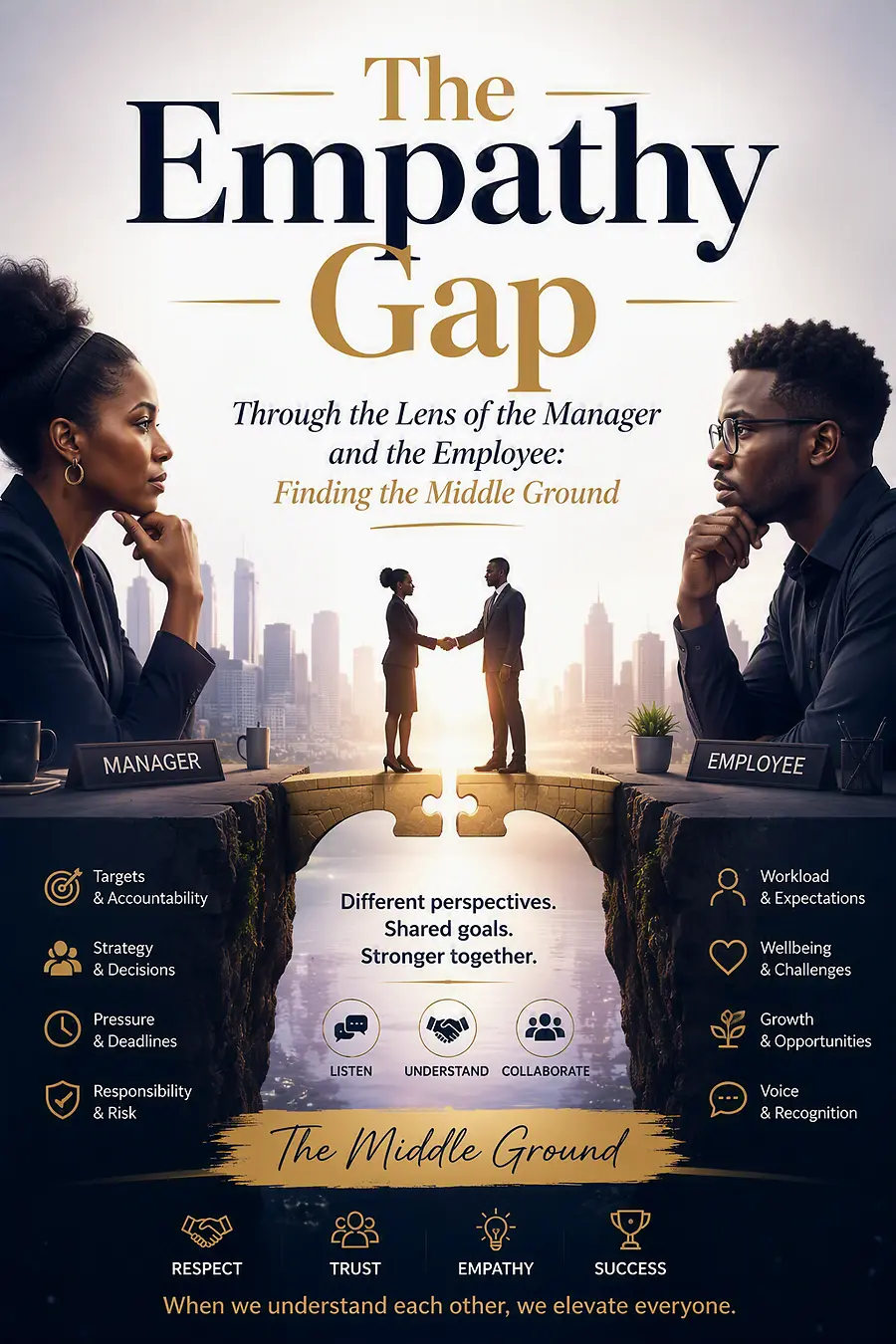
There is a phrase I have heard countless times throughout my career:
"Management doesn't understand."
Interestingly, I have also heard the opposite:
"Staff don't understand."
The more years I spend in leadership, mentoring, training, and professional practice, the more I realise something important.
Both sides are often right. And both sides are often wrong.
The reality is that many workplace frustrations are not driven by bad intentions. They are driven by different perspectives, different pressures, and incomplete understanding.
I know this because I have stood on both sides.
- I have been the employee wondering why decisions were made without consultation.
- I have been the manager carrying the burden of decisions I could not fully explain.
- I have been the new starter trying to learn, prove myself, and gain confidence.
- I have been the experienced professional expected to know the answers.
- I have trained people.
- I have supervised people.
- I have advocated for people.
And through it all, one lesson remains consistent:
We achieve more when we stop viewing each other as opponents and start seeing each other as partners.
Through the Employee's Lens
Imagine being a member of staff. You arrive every day committed to doing a good job. You are managing deadlines, family responsibilities, financial pressures, career ambitions, and the everyday realities of life.
- You want your work to matter.
- You want your voice to be heard.
- You want fair recognition for your efforts.
- You want opportunities to grow.
Yet sometimes, decisions arrive without context.
- A new process is introduced.
- A project deadline moves unexpectedly.
- A request feels unreasonable.
- A promotion opportunity is missed.
- A workload increases.
- A policy changes.
From the employee's perspective, it can feel as though management is disconnected from reality. It can feel as though leaders only see targets and dashboards while staff are carrying the emotional and practical impact.
When communication is poor, assumptions quickly fill the gap. People begin to feel undervalued, overlooked, or unheard. And perhaps most importantly, when empathy is absent, trust begins to erode.
Through the Manager's Lens
Now imagine being the manager. Every decision carries consequences. You are responsible not only for your own work but also for the performance, development, well-being, and accountability of an entire team.
You are balancing budgets, organisational objectives, regulatory requirements, performance expectations, risk management, staffing challenges, and senior leadership demands. Some days, you are expected to deliver more with fewer resources. Other days, you must make difficult decisions knowing they may not be popular.
- There are situations where a manager cannot disclose everything they know.
- There are times when information must remain confidential.
- There are occasions when a decision is not their personal preference but an organisational requirement.
From the manager's perspective, it can feel as though employees only see a small part of the puzzle. Not because they are unwilling to understand, but because they may not have visibility of the bigger picture.
Managers often carry pressures their teams never see, just as employees frequently carry burdens their managers never fully appreciate.
The Empathy Gap
The real challenge is not necessarily workload. Nor is it hierarchy. The challenge is what I call the empathy gap.
The empathy gap occurs when we become so focused on our own pressures that we lose sight of the pressures facing others.
- Employees assume managers do not care.
- Managers assume employees do not understand.
- Both sides become frustrated.
- Both sides become defensive.
- Both sides feel unheard.
And before long, workplace relationships become transactional rather than collaborative.
The tragedy is that most people entered the workplace wanting the same things:
- To do meaningful work.
- To contribute positively.
- To be respected.
- To succeed.
- To help their organisations succeed.
The Managers We Need
Let us be honest. Not every workplace challenge can be explained by misunderstanding.
- Some managers genuinely lack empathy.
- Some lead through fear instead of trust.
- Some communicate poorly.
- Some forget what it felt like to be the newest person in the room.
Leadership is not simply about authority. It is about responsibility. People may forget what a manager said. They rarely forget how that manager made them feel.
The best leaders remember that people are human before they are employees.
- They listen.
- They communicate.
- They create psychological safety.
- They hold people accountable without diminishing their dignity.
- They understand that leadership is not measured by title, but by impact.
The Employees Organisations Need
Equally, employees have responsibilities too. No organisation can thrive if accountability exists only at the leadership level.
Professional growth requires ownership. It requires curiosity. It requires resilience. It requires a willingness to learn, adapt, and contribute.
Employees who seek to understand the wider organisational context often discover that decisions are more complex than they initially appeared.
They move from asking:
"Why is management doing this to us?"
to asking:
"How can we contribute to solving this challenge?"
That shift transforms workplace culture.
Finding the Middle Ground
The middle ground is not agreement on everything. It is mutual understanding.
- It is managers recognising that behind every job title is a human being with aspirations, challenges, and responsibilities.
- It is employees recognising that leadership often involves difficult decisions, competing priorities, and pressures that may not always be visible.
- It is creating environments where questions can be asked without fear.
- Where feedback flows both ways.
- Where respect is not dependent on hierarchy.
- Where accountability and compassion coexist.
Most importantly, it is recognising that success is shared.
- When employees succeed, managers succeed.
- When managers succeed, teams succeed.
- When teams succeed, organisations succeed.
These outcomes are not competing interests. They are interconnected.
A Final Reflection
Throughout my journey as a professional, trainer, mentor, employee, and leader, I have learned that workplaces function best when we replace assumptions with conversations.
Many conflicts stem not from malice but from misunderstanding. Many frustrations can be reduced when people feel genuinely heard. And many organisational challenges become easier when we stop focusing on who is right and start focusing on what is right.
The goal should never be management versus staff. The goal should be partnership. Because at the end of the day, we are all working towards the same destination.
The question is not whether managers and employees see things differently. They do. The question is whether we are willing to understand each other's views well enough to find the middle ground.
That is where trust is built. That is where people thrive.
And that is where organisations achieve their very best.
By Bamidele Farinre, CSci, FIBMS, Hon Fellow AHCS
Agile Practitioner | Author | Mentor | STEM Advocate


