The Evolution of ABM to AI Go-to-Market Orchestration
From account-based marketing to AI orchestration: How go-to-market strategy is evolving to solve fragmentation and drive revenue alignment.

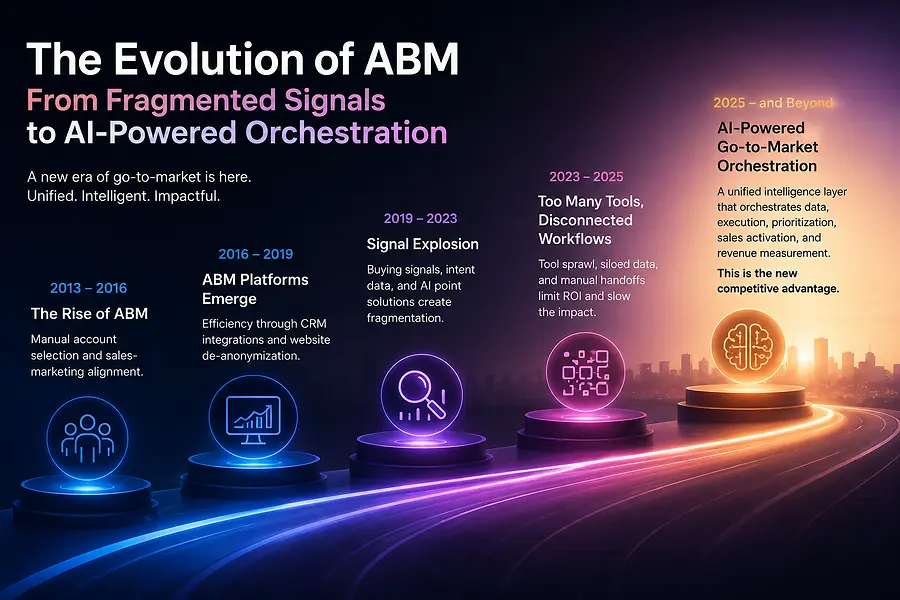
Over the past several years, I've watched go-to-market evolve tremendously. Every few years, it feels like we've solved one problem, only to create another, and I think that's exactly where we're at today.
The Rise of Account-Based Marketing
Back around 2013 through 2016, we saw the rise of Account-Based Marketing. Organizations started realizing that instead of marketing to everyone, they needed to become much more intentional about focusing on their priority accounts. Sales and marketing became much more aligned around the accounts they wanted to pursue, but a lot of this was still manual. Teams were selecting accounts themselves and making decisions based on their own understanding of where they wanted to focus their efforts.
Then, around 2016 through 2019, we started seeing dedicated ABM platforms emerge. CRM integrations became much stronger, website de-anonymization became a huge topic, and organizations finally had better visibility into which companies were engaging with them before anyone ever filled out a form. Sales teams suddenly had engagement data that they could actually activate on instead of relying purely on intuition.
The Buying Signal Explosion
That was a huge step forward. But then we entered what I think was the buying signal explosion.
From about 2019 through 2023, every company was introducing another signal. Third-party intent, buying groups, website intent, AI point solutions, review site intent. Everyone had another source of data that was supposed to tell you exactly who was ready to buy.
The problem wasn't that these signals weren't valuable. The problem was that they were fragmented.
Every platform had its own dashboard. Every platform had its own scoring model. Every platform claimed to have the answer, but none of them were really communicating with one another. Organizations were buying more tools because every new vendor promised another piece of the puzzle, but in reality, they were creating more fragmentation.
At the same time, CRM data wasn't always accurate enough to support all of these decisions. Data was refreshed periodically, people changed jobs, organizations restructured, and by the time teams were acting on some of this information, parts of it were already outdated. Everyone had more data than ever before, but not necessarily better understanding. Then we moved into where I think many organizations still are today.
Tool Sprawl and Siloed Data
From about 2023 through 2025, companies accumulated more and more technology. Marketing automation platforms, intent providers, conversation intelligence, enrichment platforms, sales engagement, AI assistants. Every tool solved one specific problem, but they weren't solving the bigger operational challenge.
Instead, organizations found themselves dealing with tool sprawl, siloed data, disconnected workflows, and manual handoffs between teams that slowed execution and made measuring true ROI much more difficult. Every platform generated another action, but very few were actually orchestrating execution across the entire go-to-market organization. That's where I believe the market is evolving today.
AI-Powered Go-to-Market Orchestration
I don't think the future is simply AI. I think it's AI-powered go-to-market orchestration.
Rather than continuing to add another point solution every time a new challenge appears, organizations are beginning to realize they need a unified intelligence layer that continuously coordinates everything that's already happening across their go-to-market motion. That includes data enrichment, campaign execution, prioritization and scoring, sales activation, and ultimately revenue measurement.
Instead of dozens of disconnected tools operating independently, I believe we're moving toward systems that orchestrate all of those functions together so every team is working from the same understanding of the customer.
The Role of Marketing Operations
To me, one of the biggest implications of this shift is the role Marketing Operations will play over the next several years. Historically, Marketing Operations has often been viewed as the team responsible for managing systems and keeping technology running. I think that role is becoming much bigger. Marketing Operations is becoming the foundation of modern go-to-market.
They're becoming responsible for owning the infrastructure that connects every part of the revenue organization together. As AI continues evolving, I believe Marketing Operations will increasingly own that unified intelligence layer that allows organizations to execute more intelligently instead of simply operating more quickly.
We're still very early in this transition, and I don't think anyone has completely solved it yet. Right now, everyone is trying to figure out what that future looks like and who will ultimately own it. The organizations that succeed won't necessarily be the ones with the most tools. I think they'll be the ones that create the most connected, trustworthy, and orchestrated go-to-market infrastructure.


