
The Kintsugi Effect™
Discover how listening and storytelling can transform our connections and help us see the beauty in each other's experiences.

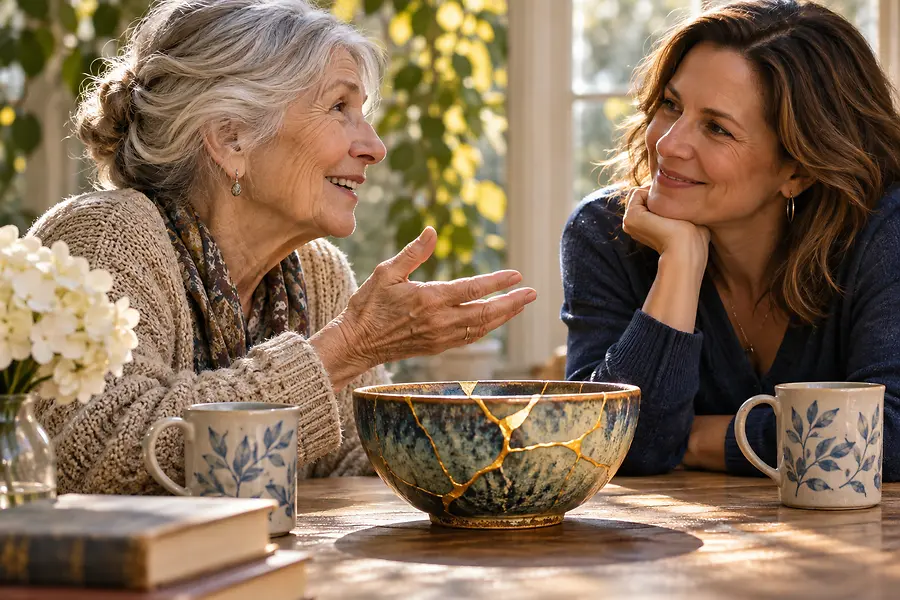
The Kintsugi Effect™
An Original Philosophy of Storytelling and Connection
By Stacey Fisher
Have you ever walked away from a conversation feeling like someone heard every word you said but didn't really listen?
Or perhaps you've experienced the opposite: someone gave you their undivided attention. They didn't interrupt, judge, or rush to offer advice. They simply listened.
And somehow, you walked away feeling a little lighter.
Something extraordinary happens when you're truly heard.
We can send messages around the world in seconds, yet a meaningful conversation can still leave us feeling more connected than a hundred messages ever could.
What makes the difference? Sometimes it's the space we give another person to tell a story—and our willingness to receive it.
That idea became the foundation of my original philosophy, The Kintsugi Effect™: everyone has a story worth telling, and everyone deserves to be heard.
The Beauty of Kintsugi
The Kintsugi Effect™ takes its inspiration from the Japanese art of kintsugi, the practice of repairing broken pottery with lacquer and powdered gold or other precious metals.
Rather than hiding the cracks, the repairs become visible features of the piece. Its history isn't erased. It becomes part of what makes the object unique.
I've always found that idea fascinating.
Because people have histories, too.
Every one of us carries experiences that have shaped who we've become. Some are joyful. Others are difficult. Some have changed us in ways we never expected.
We've celebrated accomplishments, made mistakes, experienced disappointments, formed friendships, lost relationships, and discovered strengths we didn't know we possessed.
And we carry those experiences into every conversation.
But here's something I believe is important.
We don't always need to be repaired. Sometimes we simply need to be understood.
That's where my philosophy begins.
The Kintsugi Effect™ isn't a philosophy about broken people. It's about human connection and the value of the stories that make us who we are.
The Stories We Carry
Think about the people you encounter throughout an ordinary day.
The cashier at the grocery store. The neighbor walking her dog. The coworker who always arrives early. The elderly gentleman sitting alone at a restaurant.
Every one of them has a story.
The cashier may be putting herself through college. Your neighbor may have spent years caring for someone she loves. Your coworker may have an extraordinary talent nobody knows about. The gentleman at the restaurant may have lived through experiences that would fill several books.
We rarely know.
We see people for a few minutes, sometimes only a few seconds, and form impressions based on the smallest pieces of their lives.
But what if we became a little more curious?
What if we asked more questions?
And what if, when someone answered, we actually listened?
I've discovered that people often have remarkable stories waiting just beneath the surface of an ordinary conversation.
Sometimes all it takes is someone who genuinely wants to hear them.
From Radical Listening to The Kintsugi Effect™
When I first began developing these ideas, I called them Radical Listening. That's the name I used when I first shared my work with Influential Women. I still believe in the importance of paying attention without judging, interrupting, or rushing to offer solutions.
But I began to realize the conversation had two equally important sides: the person willing to tell a story and the person willing to receive it.
The Japanese art of kintsugi offered a more complete metaphor. Just as a piece of pottery holds the visible history of its repair, we carry memories and experiences that become part of who we are. When we share them with someone who listens, we can sometimes see those experiences in a new light.
So Radical Listening evolved into my original philosophy, The Kintsugi Effect™. I prefer this concept because it embraces the whole exchange, not just the listener's role. It more fully expresses my belief in the power of storytelling and compassionate listening to bring people together.
Mending in the telling. Healing in hearing.
Mending in the Telling
Have you ever started telling a story and realized, halfway through, that you understood it differently than you did before?
Perhaps you were remembering a childhood summer, a friendship, or a decision that changed your direction. Finding the words can reveal connections we hadn't noticed.
Storytelling isn't limited to hardship. It can preserve joy, humor, family traditions, and the small details that might otherwise vanish.
A grandmother's first job, the recipe nobody thought to write down, or the story of how two people met can become a gift to someone who wasn't there.
As we tell and retell these memories, we often discover what matters most. We might recognize someone's kindness more clearly or finally understand why a particular moment stayed with us.
A story can change in meaning as we grow, even when the facts remain the same.
Not every experience is ready to be shared, and no one owes anyone their private history. We choose what to tell, when to tell it, and whom to trust.
But when we do choose to share, we give someone the chance to know us beyond the surface.
This is what I mean by mending in the telling. We aren't necessarily repairing something that is broken. Sometimes we're simply gathering the pieces of our experiences and discovering how they fit together.
Stories That Connect Generations
I think about how easily family histories can disappear.
We may know our grandparents' names without knowing what made them laugh, what frightened them as children, or what they dreamed of becoming.
Then one day, we wish we'd asked.
When someone tells us about a first home, a hard-won accomplishment, a favorite holiday, or an ordinary day that became unforgettable, the memory doesn't have to end with them.
It can become part of a family's shared understanding.
Listening across generations can also surprise us. The people we think we know best have lived whole chapters before we entered their stories.
Younger people have experiences and perspectives older relatives may never have considered. Listening allows everyone to be more than the role we've assigned them.
My philosophy invites us to make room for those exchanges while there's still time—not only to preserve the past but also to deepen relationships in the present.
We cannot go back and ask every question we wish we'd asked.
But we can begin asking them today.
Healing in Hearing
Now consider the other person in the conversation: the listener.
The most meaningful listeners I know don't treat a story as a problem to solve. They make room for it. They ask what happened next. They remember the names. They notice what matters to the person speaking.
A listener may learn something about a relative that years of ordinary conversation never revealed or discover that a friend sees the same event in an entirely different way.
Sometimes the gift flows both ways: the storyteller feels understood, and the listener leaves with a broader view of the world.
We don't always need someone to fix us. Sometimes we simply need someone to hear us.
Listening doesn't mean agreeing with everything or abandoning our own boundaries. It means making an honest effort to understand a person before deciding what to say next.
It can be a small act, but its meaning can last for years.
That's the healing in hearing that I hope The Kintsugi Effect™ will encourage.
The Gift of Being Seen
A special kind of loneliness comes from feeling invisible.
You can be surrounded by people, join conversations, and go through an entire day without feeling like anyone has truly noticed you.
And then someone asks a thoughtful question.
They remember something you told them weeks ago. They notice that you've been unusually quiet. They ask about a project that's important to you.
And they listen to the answer.
Suddenly, you feel seen.
I've felt that myself, and I've seen it in others.
While writing my memoir, Unbroken, I had the privilege of hearing stories from people whose experiences were very different from my own, even when we shared some common ground.
Those conversations reinforced something I'd been coming to understand for years.
People don't always need someone to tell them what their experiences mean.
Sometimes they need the freedom to discover that meaning for themselves, with someone willing to listen.
There's a difference between being the center of someone's attention and being the recipient of their genuine interest.
One can be fleeting.
The other can stay with you for years.
Learning to Listen to Ourselves
Another important part of my philosophy is learning to listen to ourselves.
Our memories aren't only things we pass along to others. They're also ways of discovering what matters to us.
What stories do we tell about ourselves again and again? Which details do we leave out? What delighted us as children? Which people helped us become who we are? When did we change our minds about something important?
A notebook, a quiet walk, or a few minutes of reflection can help us notice the answers.
That is part of why I created the Kintsugi Yourself journals.
With 365 guided prompts for listening and reflection, they invite readers to explore their experiences, remember meaningful moments, and preserve stories they might otherwise overlook.
The magazine includes an edition for women and a separate men's edition, each offering its own opportunities for reflection.
The prompts encourage readers to consider their relationships, memories, experiences, hopes, and the many people who have influenced their lives.
Not every reflection needs to become a revelation.
Sometimes remembering a favorite meal, a family saying, or an ordinary afternoon is enough.
Those moments belong to our stories, too.
And I believe learning to recognize the value of our own experiences can help us recognize that same value in others.
Bringing The Kintsugi Effect™ Into Everyday Life
You can practice my philosophy at a kitchen table, at work, or during a long drive with someone you love.
You don't need a special qualification. You need curiosity, patience, and a willingness to give someone room.
Ask a parent or grandparent what their neighborhood was like when they were young.
Invite a child to explain something that excites them without steering the answer.
Ask a friend what a particular memory means to them now.
When someone begins a story you've heard before, listen for a detail you may have missed.
You can also make space for stories in families where generations rarely have time to sit together.
Record a conversation, write down a recipe alongside the memory attached to it, or save a few lines from a loved one's recollection.
Ask permission before recording or sharing, and let people decide what should remain private.
The point isn't to collect stories as though they were possessions. It's to honor the people telling them.
A question asked with genuine interest can say, "Your life matters to me."
Be curious. Be patient. Be present.
A Philosophy for Everyone
The Kintsugi Effect™ grew from my experiences as a writer, interviewer, and someone who has spent years thinking about what it means to be heard.
Through Blueberry Spoon Press LLC, I've continued developing my philosophy and exploring these ideas in books, journals, and conversations that encourage reflection and connection.
But I don't think The Kintsugi Effect™ belongs only to writers, speakers, or people who have experienced extraordinary hardships.
It belongs in ordinary life.
It belongs in the conversations we have every day, with people we've known for decades and people we've only just met.
Because everyone has a history.
Everyone has experiences that have shaped them.
And everyone has something worth sharing.
We may never know which conversation will become a turning point in someone else's life.
A few thoughtful words might encourage someone to pursue a dream they've set aside. A question might bring back a cherished memory. A moment of patient listening might help someone feel less alone.
We can't always predict what our attention will mean to another person.
But we can choose to offer it.
That's what I hope my original philosophy, The Kintsugi Effect™, will encourage.
Not perfect conversations.
Not perfect people.
Simply a greater willingness to recognize the value of one another's stories.
The art of kintsugi reminds us that an object's history need not be erased for it to remain beautiful.
And our lives, with all their changes, discoveries, mistakes, joys, and unexpected turns, are worthy of the same respect.
We don't have to hide every imperfection.
We don't have to possess all the answers.
And we certainly don't have to fix everyone we encounter.
Sometimes, we can simply sit beside another person and listen.
Perhaps the next person you speak with has a story they've been waiting years to tell.
Perhaps you do, too.
Imagine what might happen if we gave one another the opportunity.
Mending in the telling. Healing in hearing.
Because being heard changes everything.

Stacey Fisher is a Tennessee-based author, speaker, and advocate who founded The Blueberry Spoon Press publishing company. She authored "Unbroken: Journeys of Acromegaly," incorporating 36 patient voices across 10 countries, and leads the Radical Listening™ initiative promoting empathy in healthcare. Committed to amplifying overlooked stories and helping others share their narratives, Stacey combines professional…





