
The Leadership I Had to Prove
From proving myself in Nepal to leading communities in America: a woman's journey through trust, resilience, and the power of representation.


When I look back at my career, I realize that I never consciously set out to prove that a woman can lead.
I simply wanted to do my work well.
But at different points in my life, I found myself having to prove that I could handle responsibility, make decisions, lead people, and have a voice at the table.
It started when I was very young.
During the final year of my bachelor's degree, I began my career as a District Program Officer with ECARDS-Nepal, working under the Multi-Stakeholder Forestry Program. I was young, and suddenly I was working with communities and managing a team of almost 20 people in both field and office settings.
It was a big responsibility for someone just beginning her career.
And it was not easy. I could sense that some people were unsure about me. Would this young woman really be able to manage the work? Would the community listen to her? Could she make the right decisions?
I understood their hesitation. So, I did not try to force anyone to accept me.
I worked. I listened to the community. I learned from the people around me. I made mistakes and learned from them. I took responsibility when things did not go as planned. Slowly, people began to trust me.
That experience taught me one of the most important lessons of my career: trust takes time, especially when people are not used to seeing someone like you in that role.
I am still grateful for those years. They gave me the opportunity to learn how to work with people, manage a team, solve problems, and, perhaps most importantly, understand what leadership looks like on the ground.
Choosing Public Service
After working in NGOs and development projects, I started thinking about what I wanted for the next stage of my career.
I wanted stability, but that was not the only reason I considered government service. I wanted to contribute through public institutions and understand how decisions and policies actually work.
So, I applied for the civil service. I was fortunate to pass and was posted as an officer in the Ministry of Forests and Environment.
That was another important chapter of my life.
It also made me more aware of something I had experienced before but had not fully understood—the way gender can affect how people perceive authority.
I remember situations where a man in a lower position would be called Sir, while I would be called sister.
I want to be clear: being called sister never offended me. It is a normal and often affectionate way of addressing someone in our culture.
What stayed with me was the difference in treatment. People would sometimes enter a room and instinctively approach the male officer first. There were occasions when I had to review files, make decisions, and sign documents, and people would look surprised when they realized I was the person responsible.
It was not one big incident. It was a series of small moments. And those small moments tell you a lot. They made me realize that sometimes people see age and gender before they see the person, the position, or the qualifications.
I could have spent my energy being frustrated by that. Instead, I decided to keep doing my work.
Starting Again in America
Eventually, my life took me to the United States. Like many immigrants, I had to start a new chapter. I continued my education, completed my higher studies, and began working as a Business Analyst and Data Analyst.
It was a very different environment from what I had known in Nepal. I continued learning, building my career, and finding my place professionally.
But after some time, I felt that something was missing. I wanted to contribute to my community.
I wanted to do something beyond my professional job. I wanted to stay connected to Nepal, to Nepali people, and to the community around me.
So, I started getting involved. I eventually was elected Secretary of NRNA NCC Colorado Chapter. That experience gave me a completely different kind of education.
Community work is not the same as a regular job. People are volunteering their time. Everyone has different expectations, personalities, and opinions. There are no simple job descriptions, and sometimes there is no clear line between personal relationships and organizational responsibilities.
But I enjoyed it. I learned a lot. I met wonderful people, worked with great teams, and had opportunities to develop myself in ways that a corporate job alone could not have offered.
Today, I serve as Secretary of NRNA NCC USA. But once again, I noticed something familiar. The word Women under the NRNA NCC USA bylaws means my position is designated Secretary (Women) for election and representation purposes.
The designation exists for the election process to ensure women's representation. It does not create a hierarchy between the Secretary (Women) and Secretary (Open) positions.
The positions have equal rights and responsibilities. Yet there are still people who interpret the word Women as though it means the position comes second.
That raises a much larger question: Why should a designation intended to ensure representation be used to diminish authority?
Women's representation should not become women's marginalization. If an organization believes women should have a place in leadership, that place must come with equal respect, equal responsibility, and equal recognition. Otherwise, representation becomes symbolic rather than meaningful.
We also need to look at ourselves.
There is another part of this conversation that we do not discuss enough.
Women also need to support women.
I have seen women-led organizations and women-led events where male guests are introduced with their professional designations and recognized prominently, while women who organized, contributed, and led the program receive much less acknowledgment.
That is something we need to reflect on. If we want young women to believe that leadership is possible, we have to demonstrate that belief through our own actions.
Recognize her work. Give her credit. Introduce her with the same respect. Recommend her for an opportunity.
Listen to her when she speaks.
And when another woman succeeds, do not see her success as taking something away from you.
Her success does not make our success smaller. Her seat does not take away our seat. Her voice does not silence ours.
A Personal Reflection
This is my personal experience.
I know things have changed, and they continue to change. I have seen many men and women genuinely support women in leadership, and I am grateful for the people who have encouraged, trusted, and supported me throughout my own journey. But some old attitudes are still present in our community—in how women are recognized, whose voices are heard, and whose contributions are acknowledged. Sometimes supporting another woman is as simple as saying, "I see your work. Keep going." Those words can mean more than we realize.
What I Want to Leave Behind
When I look back at my journey—from a young district officer in Nepal, to a government officer, to an immigrant professional in the United States, and now to an elected community leader—I realize that every chapter prepared me for the next.
The NGO and project years taught me how to build trust. Government service taught me institutional responsibility. My professional career taught me adaptability and continuous learning. Community leadership taught me service. And being a woman in leadership taught me resilience.
But perhaps the most important lesson is this: Leadership is not simply about earning a seat at the table. It is about making sure the table has room for others.
I want young women to enter leadership without first asking whether people will accept them. I want them to be judged by their work. I want them to be able to disagree without being labeled difficult.
I want them to be ambitious without being questioned for it. I want women to recognize and support the contributions of other women.
And I want men to understand that supporting women in leadership does not diminish men's leadership. It strengthens the organization we all belong to.
We need to build a culture where leadership is measured by service, accountability, competence, and contribution.
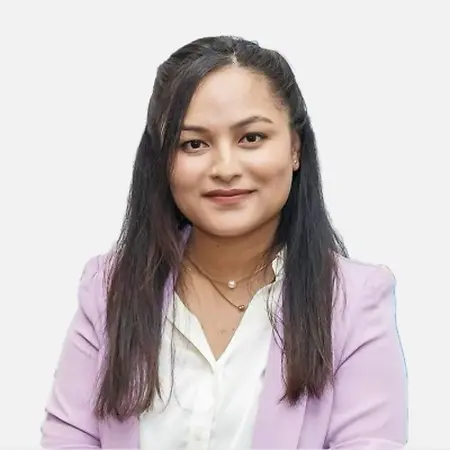
I am originally from Nepal, where I worked as a Conservation Officer with the Government of Nepal’s Ministry of Forest and Environment, leveraging my academic background in biology. Alongside my government role, I was also involved in various project-based initiatives, gaining hands-on experience in environmental programs and field-level implementation. In addition, I serve as a Secretary for the NRNA, NCC USA…





