The Macro Aggression Incident
When gatekeeping and respect collide: lessons from a community collaboration gone wrong.


Community, Creativity, and Conflict: A Reflection on Collaboration and Respect
Originally drafted June 2025 (Medium upload). Names have been altered for privacy.
In mid-April 2025, my colleague Pete reached out about supporting an engagement he was involved in—Houston Energy and Climate Week (HECW). Pete and I are both creatives, and he thought I would be a strong fit given my involvement in community work and event coordination across Houston.
It is important to note that there is also a separate event, Houston Energy and Climate Startup Week, which operates independently. Both initiatives began in 2024 and, at the time of writing, continue to host events during the same week in September 2025, though independently of one another.
Back to HECW.
Pete and I scheduled an initial meeting to discuss our roles. We were asked to co-chair the Art & Community Committee for HECW. The goal was to engage Houston’s creative communities and inform them of the event. If they chose to participate, we would support programming efforts while being transparent about a key constraint: there was no budget, so community involvement would be essential across all areas.
This detail becomes important later.
During that meeting, Pete suggested involving the graffiti community as an example. I thought it was a strong idea. I was excited about the possibility of partnering with local artists and organizing an exhibition at a brewery centered on the relationship between the city and energy. It felt meaningful and grounded in real community expression.
A few days later, the broader HECW team held its biweekly Friday Zoom meeting. This was my first meeting with the wider group and my first time meeting many of the individuals involved. Pete was absent, so I presented on our earlier discussion.
That is where I first encountered “Brans.”
As I shared updates, I mentioned the idea of engaging the graffiti community. This led to the first major point of tension.
Me: “We mentioned bringing the graffiti community in and…”
Brans: “You can’t call it that.”
Me: “I don’t think there’s anything inherently wrong with calling it graffiti.”
Brans: “They are called ‘street artists.’ I know soooo many of them who say that’s what you call them.”
Me (internally): I am just trying to give an update.
I was eventually able to continue, but being interrupted and corrected in a public forum left me feeling unsettled.
As a side note, I had recently experienced Project Row Houses: Round 58 – Free Someone, an exhibition highlighting the cultural significance and history of graffiti art. It reinforced for me how this form of expression—often dismissed publicly—has served as both a creative outlet and a gateway into the arts for many artists. It challenges traditional perspectives and opens up deeper conversations about identity, space, and cultural impact.
Graffiti would remain a recurring theme in this story.
After the meeting, an email thread continued to clarify logistics. Eventually, we agreed to host an in-person meeting with seven participants. Brans offered their office as the location. I noted that I would be unable to attend in person due to work obligations but could join virtually. The group agreed, and a hybrid setup was arranged.
The day of the meeting arrived—and this is where things escalated significantly.
The in-person portion of the meeting felt disorganized, with participants moving in and out. We began with introductions that quickly went off track. By the time the conversation reached me, one attendee had stepped out temporarily.
In their absence, I was asked about my background.
Me: “…and I help with Houston’s chapter of AIGA, the American Institute of Graphic Arts…”
At that moment, Brans re-entered mid-sentence.
Brans: “WOAH WOAH WOAH—TIME OUT. THE LAST THING WE NEED HERE IS A BUNCH OF GRAPHIC ARTISTS GIVING THEIR INPUT.”
The room went quiet. It was unclear what had prompted the reaction.
Pete clarified that I had simply been answering a question about my background. Brans then shifted the conversation back to the previous meeting, again referencing the graffiti discussion.
Brans: “This is like the last meeting where someone called it ‘graffiti art’…”
Me: “That was me.”
Brans: “Well, you can’t call it that. Graffiti is illegal.”
Me: “I don’t think that matters.”
At that point, the exchange escalated further.
Brans: “Are you an artist?”
Me: “Not by trade, no.”
Brans: “Do you have a degree in art?”
Me: “No.”
Brans: “Are you at least an appreciator of art?!”
Me: “Yes.”
What struck me most about this interaction was not just the tone, but the gatekeeping. Brans did not know my background, my experience, or my engagement with creative spaces. Yet my legitimacy in the conversation was being questioned in real time.
Creativity is not confined to formal titles or degrees. My own understanding of “creative” spans designers, directors, musicians, sculptors, painters, videographers, graffiti artists, and more. It is an ecosystem, not a hierarchy.
Following this meeting, I sent a message to the chair of HECW, who had been present throughout the exchange:
I wanted to understand a bit more what [Brans Employer]’s involvement with HECW is.
Coming out of today’s meeting, I left feeling uncomfortable after being challenged on my qualifications as an “artist.”
If clarification is needed on my background, I am happy to provide it, but I have been active in creative spaces both personally and professionally for many years.
I am also wondering whether our goal as ambassadors is to engage the full ecosystem of creatives in Houston. During the meeting, we briefly discussed infrastructure, which itself sits within design and creative disciplines.
I left the meeting unsure whether I am aligned with what the team is looking for.
Shortly after, I disengaged from the experience.
At the end of the meeting, there was also a comment about potentially involving the “hip hop community” in the future. I remember thinking—almost instinctively—how disconnected the framing felt from everything else that had been said.
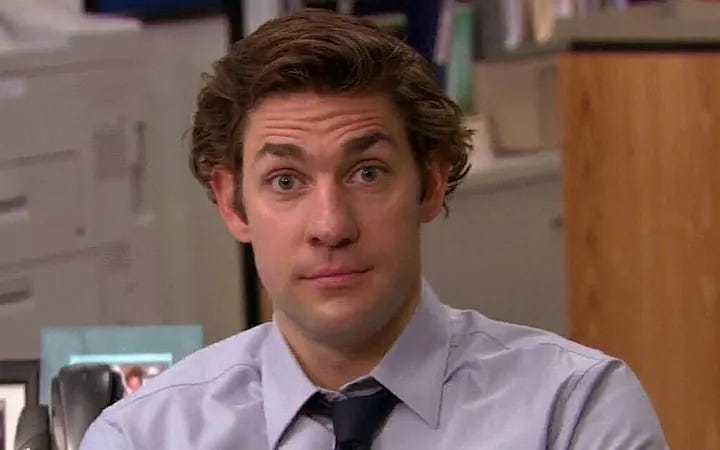
Josh Larsen • The Office and “The Look”
Why I’m Sharing This
I am sharing this reflection for three reasons.
First, for those who may find themselves in similar environments: you are not unreasonable for noticing when something feels misaligned. You are not “difficult” for questioning tone, behavior, or gatekeeping. You are allowed to expect respectful collaboration.
Second, for those in positions of influence or coordination: consider how power shows up in small moments. Interruptions, corrections, and dismissals—even when unintentional—shape who feels welcome in a space.
Finally, for those who witness these dynamics: silence often reinforces harm. Speaking up does not require confrontation, but it does require awareness.
I left these experiences reflecting not only on what was said, but on how it was said—and what it signals about inclusion in creative and community spaces.


