
The Magic of Asking Better Questions
Exploring the interconnected patterns of energy, biology, and relationship through curiosity, science, and wonder.

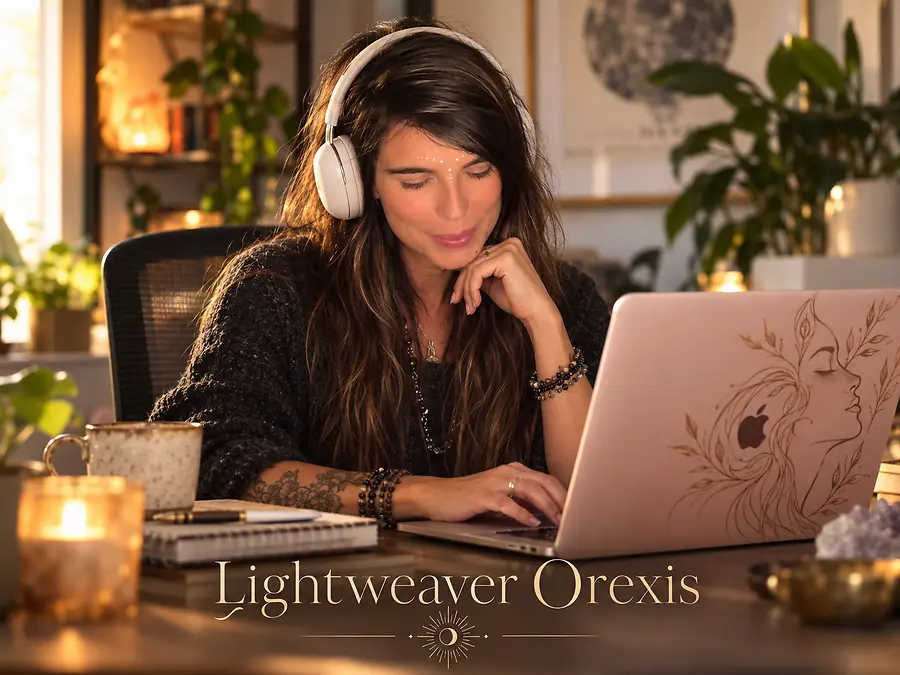
The Magic of Asking Better Questions
This is a story about a woman who never stopped asking WHY.
I've always been a curious creature. The kind who looks at the world and wonders what's happening beneath everything we can immediately see. Patterns within patterns. Systems within systems. Relationships connecting things that, at first glance, seem entirely separate.
For as long as I can remember, I've perceived the world through something I describe as "The Grid," a visual and conceptual language of interconnectedness that has accompanied me throughout my life, almost like a sublayer to my vision and thinking. But here's what's interesting: the older I get, the more I study, and the more questions I ask, the more fascinated I become with the natural world itself. Not because science has proven all the mystical things I've experienced. It hasn't. But because science continues to reveal how extraordinarily complex our existence already IS. And I find that absolutely magickal with a k.
My curiosity became deeply personal after spending 22 years living with debilitating endometriosis symptoms, navigating profound life changes, and eventually experiencing a physical collapse that left me in bed for seven weeks. When your body becomes a place of invisible suffering, you begin asking different questions. What influences pain? How does the nervous system respond to experience? What roles do movement, nourishment, stress, environment, and human connection play in our physiology? And perhaps most importantly, what happens when we begin investigating these relationships together rather than as separate things? That inquiry helped inspire The Frequency Lab, a free online community learning space where we explore science, consciousness, embodiment, and our participation in the living world.
I organize much of this exploration through the three interconnected lenses below.
The Physical World – How Energy Moves
Let's begin with something familiar: sound.
Sound travels. Light travels. Energy transfers. Matter responds.
And under certain conditions, those interactions produce astonishing, measurable effects. Sound is a mechanical wave. When something vibrates, it creates disturbances that travel through a medium such as air, water, or solid material. Frequency, measured in hertz (Hz), describes how many cycles occur per second. Amplitude relates to the magnitude of a wave's disturbance. Sound can reflect, interfere, resonate, and behave differently depending on the materials and environments through which it travels. But here's where my systems-thinking brain starts lighting up.
Have you ever seen a Chladni plate experiment? Fine sand is scattered across a metal plate, which is then vibrated at particular frequencies. As the plate resonates, the sand gathers into remarkable geometric patterns.
Different frequencies and boundary conditions produce different arrangements. Vibration becomes visible. But why?
Because physical forces interact with the material, its dimensions, and the conditions surrounding it. Suddenly, we're not just talking about sound. We're talking about relationships between energy, matter, structure, and environment. And that's only the beginning. Consider sonoluminescence. Under carefully controlled experimental conditions, sound waves moving through a liquid can cause microscopic gas bubbles to expand and collapse. During collapse, incredibly brief flashes of light are emitted. Yes. LIGHT. A documented phenomenon in which acoustic energy ultimately contributes to light emission through the extreme physical conditions generated inside collapsing bubbles.
Now, I'm not suggesting singing to your glass of water will make it illuminate.
But what an extraordinary phenomenon to investigate! What conditions allow this to happen? What influences the outcome? What does it teach us about energy transfer? Even our ability to perceive the physical world raises fascinating questions. The visible light our eyes detect represents only a small portion of the electromagnetic spectrum. Beyond it are infrared, ultraviolet, radio waves, microwaves, X-rays, and gamma rays. So, in my world, I find there's a lot we actually are unable to perceive, and that makes me interested. Sound and light are fundamentally different kinds of waves. Sound requires a physical medium, while electromagnetic radiation can travel through a vacuum. Yet both offer remarkable ways to investigate the physical world. I often wonder how much our understanding changes when we develop new instruments, new questions, and new ways of observing what was previously beyond our perception.
And that brings me to something much closer to home: our bodies.
The Living Body – How Biology Receives and Responds
Our bodies are not fixed, unresponsive machines. They're living systems, continuously receiving information, responding to their surroundings, and adapting through incredible complexity. At a cellular level, electrical differences across membranes help regulate communication and essential physiological functions. Our nervous systems communicate through electrical and chemical signals. Our hearts beat rhythmically. Our biological clocks help coordinate activity across tissues and organs. Even the expression of certain genes can be influenced by environmental conditions and lived experiences through processes involving gene regulation. So I began asking myself: If our bodies are constantly receiving information, how much of our lived experience is warped by the patterns we're participating in?
Consider something as simple as your breath. What happens when you're afraid? When you're laughing uncontrollably? When someone you love wraps their arms around you? What changes when your favorite song begins playing? Our breathing, heart rate, muscle tension, attention, and emotional experiences can all shift in response to what we're experiencing. These relationships are real, they're alive, and they're worth studying. My fascination with these processes deepened during my recovery from chronic pain and hypermobility-related challenges. After seven weeks of being in bed, I had lost strength in my legs and needed to rebuild carefully. I remember beginning by rolling onto my side and completing just six clam shells. SIX. And even that was a challenge. But rather than demanding that my body perform as it once had, I began working with its current capacity. Gradually, patiently, and with an increasing appreciation for the information my body was giving me.
Little by little. Bit by bit. Brick by brick.
That experience brought me into a deeper investigation of mechanotransduction, the process through which cells detect mechanical forces and convert them into biochemical signals. Movement, stretching, pressure, and tension can influence cellular behavior. I also learned about our connective tissues, including fascia, and how patients with hEDS have densified fascia, which became my next Weave of Investigation. How do I give my body what it needs to keep my fascia hydrated and happy? Now, this doesn't mean movement is a cure for every disease or that our minds can simply override structural conditions. Especially with hEDS, the spectrum varies, with some cases involving real, life-threatening severity. But it does mean movement is more than something we perform. Movement is information that living tissue can respond to. And I find that fascinating.
When I was stuck in bed, I was taken back to a moment I experienced during Ceremony, when I wasn't feeling well, so I was lying on my back. I had intended on being a "Lightweaver" that evening, passing my Threads of Light to everyone in the room, but the Medicine had other plans for me. The woman next to me was moving in ways I had envisioned for myself, and I remember thinking, "Man... I was going to do that! Well, I can enjoy watching, I suppose!" As I was thinking that last line, I heard another thought/voice say, "You Can." And I said, "Wait... I'm silly. You're right. I can still do this from here," and proceeded with my gridwork. This became especially useful during my collapsed state in bed this year (2025).
My investigations into endometriosis also led me toward research involving inflammation, oxidative stress, immune responses, and the nervous system. I am slowly Becoming the Scientist of my Own Body. These are complex fields, and no single mechanism explains every person's experience with chronic illness, but they do allow us to ask better questions, and better questions lead to better findings. My own improvements are meaningful to me, but they don't establish that the practices I used would produce the same results for someone else. That's why I continue studying and sharing my experience freely.
I'm equally interested in interoception, our ability to perceive internal bodily signals, and how awareness of those signals influences our experiences. I'm interested in how music, chanting, humming, breathwork, and movement can affect our physiological and psychological states. And here's an important distinction in my work.
In physics, frequency describes a measurable rate of repetition. When I speak about changing the "frequency" of my life, I'm often using the word more broadly as a metaphor for changing the patterns through which I experience and participate in the world and the signal I broadcast. How I breathe. Move. Nourish myself. Express emotion. Create. Rest. Connect. Respond. If changing some of these patterns influences our nervous system, perception, behavior, or physiological responses, isn't it worth investigating how those changes might influence our lived experiences? That question became foundational to my work.
And then I began looking beyond the individual body because we're never living in isolation.
The Relational World – How Life Interacts
Have you ever noticed how someone's laughter can become contagious? Or how sitting beside someone who feels calm can sometimes help you soften? What about the way a particular song can completely change the atmosphere of a room? I know. I keep saying everything is fascinating. What can I say? I'm a VERY fascinated creature. But these experiences invite us into established areas of scientific investigation. Psychoacoustics explores how we perceive sound. Neural entrainment investigates how neural activity can align with aspects of rhythmic stimulation. Interpersonal synchrony examines how people's movements, behaviors, and sometimes physiological processes become coordinated during social interactions. And co-regulation explores ways people influence one another's emotional and physiological states.
Think about that.
We are not merely moving through environments without responding to them. We're living organisms participating in continuous exchanges of information. When I sing, chant, hum, or move throughout my Lightweaving practices, I notice shifts in this subjective experience. Sometimes I enter deeply absorbed, trance-like states. Other times, I simply feel more present in my body. Those experiences are personally meaningful, and I'm interested in what neuroscience and physiology can help us understand about them. When I gather with others, I notice how voices, movements, and emotional expressions can begin influencing one another. Sometimes people naturally fall into a shared rhythm without consciously trying. Research into interpersonal synchrony gives us ways to investigate some of these observations without assuming that every feeling or experience has the same explanation.
Now let's expand beyond human relationships. Think about the birds singing outside your window. The bees visiting flowers. Dolphins communicating underwater. Think about the extraordinary relationships beneath our feet among fungi, plants, microorganisms, and soil. There is an entire WORLD of activity happening around us. Organisms interact through chemical signals, physical processes, sensory systems, and ecological relationships that influence their survival and behavior. In ecosystems, changes in one component can influence others through complex feedback loops.
This brings us into systems biology and ecological interdependence, fields that study how relationships between components contribute to the behavior of larger systems. And this is where my own perspective has shifted so profoundly. Rather than viewing myself as an isolated organism moving through an external world, I have become fascinated by my position within it. The more time I spend immersed in nature, the more aware I become of these relationships. The ocean. The trees. The animals. The people I encounter. I'm not simply observing life. I'm participating in it. And participation comes with responsibility. To listen. To learn. To nurture. To question. To recognize that our choices can influence the relationships and environments we're part of. This is where two of my greatest personal values meet: RELATIONSHIP & PARTICIPATION.
Relationship reminds me that I belong to something greater than myself.
Participation reminds me that I have a role in caring for it.
The Lens of Possibility – Where Science Meets Wonder
So what does all of this have to do with MAGICK?
Well… everything and nothing. ;)
I grew up experiencing things I couldn't easily explain. Experiences that shaped my understanding of consciousness, spirituality, and the possibilities of what we can actually perceive. I don't expect another person to interpret those experiences the same way I do. And I'm not interested in demanding belief.
What interests me is the space between what we can measure, what we can experience, and what remains unexplained. Consider what we've explored. Sound can produce visible geometric patterns in vibrating materials. Collapsing bubbles can emit light under particular physical conditions. Cells respond to mechanical forces. Bodies regulate themselves through electrical, chemical, and biological signaling. Human beings can synchronize aspects of their behavior and physiology during social interaction. Ecosystems function through extraordinarily complex networks of interdependence.
It's a Sea of Patterns.
None of these observations proves a supernatural explanation.
They don't need to.
The natural world is already extraordinary. And perhaps that's where my relationship with the word magick begins. Not as a rejection of science, but as my personal language for the wonder, beauty, possibility, and mystery I experience within existence itself. I want to challenge the idea that wonder must disappear when investigation begins. I also want to challenge the notion that being open-minded means accepting every extraordinary claim as fact.
We can remain curious while questioning our assumptions. We can allow Two Truths to Exist for us. We can respect personal experiences without confusing them with controlled scientific evidence. We can investigate unfamiliar possibilities while recognizing that patterns don't automatically establish causation. To me, this isn't a contradiction. It's discernment. And I believe discernment allows curiosity to become something far more meaningful: an invitation.
All last year, I began documenting my experiences and findings. Creating Maps of Understanding. Pieces of knowledge, creative practices, personal experiences, and seemingly unrelated interests that helped me navigate some extraordinarily difficult chapters in life. But looking back, I realized I hadn't simply been leaving breadcrumbs; I'd been planting seeds.
And those seeds had begun growing into an ecosystem of work devoted to a mission very close to my heart:
Heal Humanity at the Root.
That ecosystem includes my work as a somatic practitioner, my creative Lightweaving practices, my writing, and now The Frequency Lab: a community space where we can explore what it means to be living, responsive organisms within an extraordinarily interconnected world. I'm not inviting people to believe everything I believe. I'm inviting them to ask questions. To investigate. To bring their own experiences and perspectives into conversation. To study what we know, examine what we don't, and participate in the relationships that shape our lives. Because the more I learn, the less interested I become in needing to have all the answers. Instead, I find myself returning to three questions:
What can we measure?
What can we experience?
What remains unexplained?
And perhaps one more… What changes when we begin understanding life through its relationships rather than its separations? I don't know how far these questions will take us. But I know I'm going to keep asking. And you're welcome to explore alongside me.
Dream BIG. Stay Steady. Stay Curious. And never let someone else's ceiling become your sky.
Shayla Covington ||
Founder of Lightweaver & The Frequency Lab

Shayla Covington is an independent Consciousness Educator, Somatic Practitioner, writer, and Founder of Lightweaver – an evolving body of work exploring the intersections of science, consciousness, embodiment and the Human Experience. Following more than two decades of debilitating endometriosis symptoms and a deeply personal journey through chronic pain, trauma and self-discovery, Shayla began investigating the…





