The Mirror Lied
How I Learned to Stop Believing What the Mirror Told Me

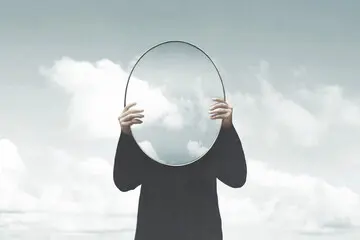
The Mirror Lied
I have struggled with body image for most of my life.
Too muscular. Too heavy. Too thin. Too flat.
Stuff your bra so I can see what you'd look like with big boobs.
Skirt too short. Not short enough.
Jeans too tight. Not tight enough.
I was dressed up to be flaunted in one relationship and kept in a potato sack in the next.
"You're pretty. You'll never be beautiful."
Yes, someone actually said that to me.
"Hairy Mary."
Kids taunted me about my very hairy arms, and the nickname stuck.
A lifetime of comments and comparisons found their way into my mind, settled into my beliefs, and eventually moved into the mirror.
The Foggy Mirror
Not long ago, I was staying in an old Airbnb while preparing for a training. The only mirror was in the bedroom. It was streaked, a little foggy, and surrounded by less-than-flattering lighting.
I looked at myself and thought, I look good. I don't look like the image in my head. Is it the mirror?
That same day, two people complimented my hair.
"Your hair is gorgeous."
"I love your curls and the color."
I have been struggling with my hair. My curls are becoming tighter, there's so much gray, and I've been feeling older.
But in that foggy old mirror, I saw beauty.
I liked how I looked.
Some mirrors show me every flaw. Others show me my beauty.
Same face.
So which reflection is true?
Maybe the question isn't whether the mirror is telling the truth.
Maybe the question is:
What do I already believe before I look into it?
Body dysmorphia is real.
Thoughts repeated long enough begin to feel like truth. They become beliefs, and those beliefs influence what we see, how we feel, and the choices we make.
But a thought can feel true without being the truth.
My perception isn't always reality.
The mirror reflects back what I already believe.
So is it showing truth?
Or is it reflecting distortion?
When the Scale Started Talking
In my early thirties, I was with someone who was very vocal about other people's bodies and very controlling about mine—what I wore, how much I showed, and how much I didn't.
There was a woman he worked with. Beautiful. Fit.
I admired her, and I said so.
His response was, "She's fat."
I was shocked.
She was beautiful.
But something clicked into place that day, and the message that had been running quietly in the background for years finally had words:
Don't gain weight. If you do, you'll be unattractive.
The fear of gaining weight became an obsession.
Around that same time, I developed a kidney infection and was bedridden for two weeks. I lost weight because I was sick, and for the first time, the number on the scale made me feel good about myself.
Then it became about keeping the weight off.
Then losing a little more.
I became terrified of being hungry.
I ate just enough to keep my head clear.
And I kept shrinking.
And I still couldn't see it.
I'd look in the mirror. I had two kids, undergone a C-section, and definitely did not have abs of steel.
All I could see was more weight I needed to lose.
People began telling me I was too thin.
I tuned them out.
I was disappearing, and the mirror was still telling me I hadn't done enough.
One night, I turned on Netflix and watched the true story of a young woman with an eating disorder. Her body eventually began shutting down, and she ended up in the emergency room fighting for her life.
I panicked.
Because her story was becoming my story.
Some moments shake you awake.
They stop you.
They force you to realize:
If I don't change, this could be me.
The next morning, I reached out for help.
I met with a nutritionist and a therapist.
I followed an eating plan and began the work of healing my relationship with food and my body.
I still struggle with those voices sometimes.
Some days, I have a firm grip on them.
Other days, I don't want to look in the mirror because I'm afraid of what I'll see.
But I never acted on those eating disorder compulsions again.
The Mirror Lies When Someone Else Holds the Scoreboard
Here is what I finally understood.
The lying mirror and the comparison trap aren't two different problems.
They're the same distortion wearing two different faces.
The mirror shows me every flaw because I'm measuring myself against a borrowed standard—someone else's body, someone else's highlight reel, someone else's life.
Comparison is sneaky.
It doesn't walk up and attack your confidence.
It quietly moves your scoreboard.
One moment you're measuring yourself against your own values, effort, growth, and progress.
The next, you're measuring yourself against someone else's appearance, social media engagement, vacation, business growth, relationships, body, home, or perceived success.
Without realizing it, you've handed someone else the power to determine whether you're doing well.
And that's a scoreboard you'll never win.
Your Scoreboard (Yours to Keep)
- Your values
- Your effort
- Your growth from where you began
- The next right choice
- Who you are becoming
- What you actually control
Comparison's Scoreboard (Borrowed and Unwinnable)
- Someone else's highlight reel
- Their likes, comments, followers, and attention
- Their body, lifestyle, vacation, or timeline
- The number on someone else's scale or social feed
- Their perceived success
- A target you cannot control and can never truly reach
Comparison causes us to forget that we're looking at a carefully selected moment in someone else's life while standing in the middle of our own messy, unedited reality.
We compare our behind-the-scenes to their highlight reel.
We compare our beginning to their chapter twenty.
We compare what we know about ourselves to what we assume about them.
Then we wonder why we feel like we're losing.
Admiration or Jealousy?
I actively work to transform comparison into admiration.
To look at someone and say,
"That's amazing. I respect what they've built and who they've become. What can I learn from them?"
Jealousy says something very different.
"I wish I had that, and I feel threatened, insecure, or less than because I don't."
The difference lies in what the feeling produces.
Admiration creates inspiration, curiosity, respect, and motivation.
Jealousy creates insecurity, resentment, suspicion, or the desire to diminish someone else.
Sometimes you can feel both at once.
You can genuinely admire someone while also recognizing that something about their life, appearance, or success has exposed an insecurity within you.
That doesn't make you a bad person.
It simply reveals an unmet desire—or a place that still needs healing.
I started asking myself:
Do I want to learn from them, or do I want what they have to be taken away?
That question exposes what comparison is producing in me.
Someone else's beauty does not diminish mine.
Someone else's success does not steal mine.
Someone else's opportunity does not mean there is no opportunity left for me.
There is room for both of us.
Keeping My Own Scoreboard
I cannot always control the first thought that enters my mind when I look into the mirror.
But I can choose which thoughts I continue rehearsing.
I can choose which beliefs I reinforce.
I can control the work I do and the person I am becoming.
I want to be healthy, so I move my body, drink water, nourish it well, and limit the things that don't serve me.
I want to be a writer, so I write every day—whether it's a journal entry, a blog post, a paragraph in my book, or a heartfelt message to someone on my mind.
I want to be a reader, so I read at least one page—a devotion, an article, a chapter, or something that helps me grow.
I want to stay connected, so I reach out to someone every day. I say hello to a stranger at the grocery store. I send the text. I make the call. I schedule the conversation. I choose authenticity.
None of those things can be measured by the number on a scale or the number on a social feed.
They are measured by alignment.
Am I living today like the person I want to become?
Am I honoring my values?
Am I doing what I said I would do?
Am I growing from where I began?
At the end of each day, I ask myself one simple question:
What did I do today that I'm proud of?
I focus on what I can control.
I celebrate the wins.
I keep my own scoreboard.
The mirror still lies to me some days.
But I've stopped letting it keep score.
— Mary Belden-McGrath
If you're struggling with your relationship with food or your body, you don't have to face it alone. The National Alliance for Eating Disorders offers a free, confidential, therapist-staffed helpline at 1-866-662-1235.


