The Most Kawaii Airport in Japan! (airport analysis #5)
Japan's Engineering Marvel: The World's Only Successful Floating Airport

Today's analysis is a special one, dearest readers! We're going over the only long-term successful floating airport in the world, Kansai International Airport; though Thailand (south of Bangkok) and South Korea (Incheon) are considering building new airports which may or may not, according to contradicting public statements, utilize reclaimed land to build airports off their main territory, and Chubu Centrair Airport, Kansai's cousin, was built with same techniques in a bay harbor, though we have yet to see if it will succeed. However, Kansai was the first, the progenitor, and Japan's engineering has, for the time-being, ensured that it is the only successfully operated floating airport in the world. Let's dive into this engineering marvel which has also been named the most Kawaii Airport in Japan.
Kansai International Airport
Kansai International Airport (Japanese: Kansai Kokusai Kuko, and IATA code: KIX, ICAO code: RJBB), commonly known to locals as Kanku is the primary international airport in the Greater Osaka Area of Japan and the closest international airport to the cities of Osaka, Kyoto, and Kobe. It is located on the artificial island of Kankujima (thus its Japanese moniker), in the middle of Osaka Bay off the Honshu shore, the main island of Japan. Kansai is more accurately centrally located within three municipalities, including Izumisano (north), Sennan (south), and Tajiri (central), in Osaka prefecture.
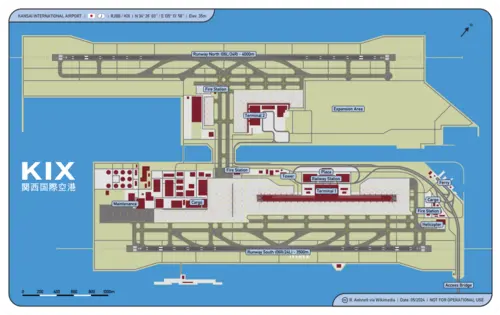
The airport consists of two artificial islands. The airport's first island covers approximately 510 hectares and the second covers approximately 545 hectares, for a total of 1,055 hectares.
Kansai consists of only two main terminals: Terminal 1 (T1) and Terminal 2 (T2). Terminal 1 is by far the longest airport terminal in the world with a length of 1.7 kilometers. The airport serves as an international hub for All Nippon Airways (ANA), Japan Airlines (JAL), and ANA-owned Nippon Cargo Airlines, and as a hub for Peach, the first international low-cost carrier in Japan. It is also the north Pacific hub for FedEx Express, which obtained fifth freedom rights under the 1998 U.S. and Japan air agreement and established the hub in 2014.
Kansai opened on the 4th of September 1994 to relieve congestion and overcrowding at the actual Osaka International Airport, also called Itami Airport, which is closer to the city of Osaka.
In 2020, Kansai was ranked the tenth-best airport in the world by Skytrax and received its awards for Best Airport Staff in Asia, World's Best Airport Staff, and World's Best Airport for Baggage Delivery. The various awards that SkyTrax gave out were suspended during the COVID pandemic and began again in 2023. Kansai picked up the awards for the World's Best Airport for Baggage Delivery again in 2023, 2024, and 2025, at this point that award is almost a foregone conclusion each year.
History and Planning
Back in the 1960s, when the Kansai region was rapidly losing trade to Tokyo, planners proposed a new airport near Kobe and Osaka. The city's original international airport, Itami Airport, located in the densely populated suburbs of Itami and Toyonaka, was surrounded by buildings, and crowded residential and commercial zones; it could not be expanded without risk of severe danger, and many of its neighbors had filed complaints because of noise pollution problems.
After the protests surrounding New Tokyo International Airport (now-Tokyo-Narita International Airport), which was built with expropriated land in a rural part of Chiba Prefecture, planners decided to build the airport offshore. Initially, the airport was planned to be built near Kobe, but the city of Kobe refused the plan, so the airport was moved to a more southerly location on Osaka Bay. There it could be open 24 hours per day, unlike its predecessor in the city-center. An artificial island, 4 km long and 2.5 km wide, was proposed and approved.
Construction
The construction of Kansai International Airport was fascinating and received an extreme amount of attention from local newspapers, particularly Osaka editions of major national newspapers, than those of Tokyo-Narita, primarily due to its construction methodology. After all, it isn't every day that a full-scale airport was built on its own island.
Engineers needed to overcome the extremely high risks of earthquakes and typhoons (with storm surges of up to 3 meters, or 10 feet). The water depth is 18 meters (59 ft) on top of 20 meters (66 ft) of soft Holocene-type clay which holds 70% water; you can think of this clay like a concrete-like porous sponge. A million sand drains were built into the clay to remove water and solidify the clay.
Construction started in 1987. The sea wall was finished in 1989 (made of rock and 48,000 tetrapods). Tetrapods are, to phrase it simply, a form of aquatic wave dissipating concrete rock. Additionally, three entire mountains were excavated for 21 million cubic meters (27 million cubic yards) of dirt, which were used in the formation of the airport's foundation. 180 million cubic meters (240 million cubic yards) was used to construct island 1.
Over three years, 10,000 workers using 80 industrial cargo ships took 10 million man-hours to complete the 30-or-40-metre (100 or 130 ft) layer of earth over the sea floor and inside the sea wall.
In 1990, a three-point-seven-five-kilometer (2.33 mi) bridge was completed to connect the island to the mainland at Rinku Town, at a cost of $1 billion. Completion of the artificial island increased the area of Osaka Prefecture just enough so that it is no longer the smallest prefecture in Japan (Kagawa Prefecture is now the smallest in Japan).
The island had been predicted to sink 5.7 m (18 ft 8 in) by the most optimistic estimate as the weight of the material used for construction compressed the seabed silts. However, by 1999, the island had sunk 8.2 m (26 ft 11 in) - almost 50% more than predicted. The project became the most expensive civil works project in modern history after twenty years of planning, three years of construction and $15 billion USD of investment capital.
Much of what was learned went into the successful artificial islands in silt deposits for New Kitakyushu Airport, Kobe Airport, and Chubu Centrair International Airport. The ongoing lessons of Kansai Airport were also applied in the construction of Hong Kong International Airport.
On 19 April 2001, the airport was one of ten structures given the "Civil Engineering Monument of the Millennium" award by the American Society of Civil Engineers (ASCE).
In 1991, the terminal construction had officially commenced. To compensate for the sinking of the island, adjustable columns were designed to support the terminal building. These are extended by inserting thick metal plates at their bases which would prove invaluable as on the 17th of January in 1995, Japan was struck by the Great Hanshin earthquake, the epicenter of which was about 20 km (or 12 mi) away from KIX airport and killed 6,434 people on Japan's main island (Honshu).
Amazingly to every geographic analyst who studied the aftermath of the Great Hanshin earthquake, Kansai's hardened earthquake mechanics, particularly the use of sliding joints, allowed the airport to emerge unscathed and handily absorb the shocks, a true marvel of state-of-the-art engineering.
Ultimately, as of 2008, the total cost of Kansai Airport was $20 billion USD, ($24.5 billion USD in 2026) including land reclamation, two runways, terminals, and facilities. Most additional costs were initially due to the island's sinking, caused by the soft soils of Osaka Bay, which was anticipated by designers. The sink rate fell from 50 cm per year during 1994 to 7 cm per year in 2008.
Operations
On Kansai's operations, the airport as stated, Opened on 4 September 1994, the airport serves as a hub for several airlines as noted. It is the international gateway for Japan's Kansai region, which contains the major cities of Kyoto, Kobe, and Osaka. Other Kansai domestic flights fly from the older but more conveniently located Osaka International Airport in Itami, or from the newer Kobe Airport.
On 17th of February 2005, Chubu Centrair International Airport opened in southern Nagoya on its own artificial island in Ise Bay, just east of Osaka. The opening of the airport was expected to increase competition between Japan's international airports. Despite this, passenger totals for Kansai were up 11% in 2005 over 2004, and international passengers increased to 3.06 million in 2006, up 10% over 2005. Adding to the competition were the opening of Kobe Airport, less than 16 miles away, in 2006 and the lengthening of the runway at Tokushima Airport in Shikoku in 2007.
Financials
In terms of financials, The airport had been deeply in debt, losing $560 million in interest every year. Airlines had been kept away by high landing fees (about $7,500 USD for a Boeing 747 and $10,000 EUR for an Airbus A380-800), the second most expensive in the world after Narita's. In the early years of the airport's operation (mid-1990s), excessive terminal rent and utility bills for on-site concessions also drove up operating costs: some estimates before opening held that a cup of coffee would have to cost a visitor or passenger $10 USD. As a result, Osaka business owners successfully pressured the city and Japanese federal government to take a greater burden of the construction cost to keep the airport attractive to both passengers and airlines.
Kansai has been often successfully marketed as an alternative to Tokyo-Narita Airport for international travelers from the Greater Tokyo Area. By flying to Kansai from Haneda Airport and connecting to international flights there, travelers can save the additional time required to get to Narita (up to one and a half hours for many residents of Kanagawa prefecture and southern Tokyo). Kansai soon faced the problem of upgrades. The airport was at its limit during peak times, owing especially to freight flights, so a portion of Phase II expansion - the second runway - was made a priority. Thus, in 2002, believing that the sinking problem was almost over, the airport operators started to construct a 4 km (2.5 miles-long) second runway and terminal.
The second runway opened to much acclaim on 2nd of August, 2007, but with the originally planned terminal portion postponed. This lowered the project cost to approximately the equivalent of $8 billion USD, saving ¥650 billion from the first given estimate. The additional runway development, which was opened in time for the IAAF World Athletics Championships in Osaka, has expanded the airport size to a total of 10.5 square kilometer's (2,600 acres). The second runway is used for landings and when there are incidents prohibiting takeoff from runway A. The new runway allowed the airport to start 24-hour operations in September of 2007. A new terminal building opened in late 2012. There are additional plans for several new aprons, a third runway (06C/24C) with a length of 2 miles, a new cargo terminal and expanding the airport size to 5 sq. mi. However, as of 2026, the Japanese government has currently postponed these plans due to ongoing funding problems, and the new prime minister's militant stance which has taken finance availability away from civilian infrastructure.
Terminal Layout
Terminal 1
The terminal layout is extremely basic yet innovative. Terminal 1 is up for an overview first. This main KIX passenger terminal, T1, is a single four-story building. T1 has a gross floor space of 296,043 square meters (3,186,580 sq ft). As of 2018, at a total length of 1.7 km (1.1 mi) from end to end, Terminal 1 is the longest airport terminal in the world. It has a sophisticated people mover system called the Wing Shuttle, which moves passengers from one end of the pier to the other. Though if passengers desire for whatever reason, they can choose to walk the terminal length.
The terminal's roof is shaped like an airfoil. This shape is used to promote air circulation through the building: giant air conditioning ducts blow air upwards at one side of the terminal, circulate the air across the curvature of the ceiling, and collect the air through intakes at the other side. Mobiles are suspended in the ticketing hall to take advantage of the flowing air.
The ticketing hall overlooks the international departures concourse, and the two are separated by a glass partition. During Kansai's early days, visitors were known to throw objects over the partition to friends in the corridor below. The partition was eventually modified to halt this practice as it was dangerous and harmful.
On 23rd of June, 2017, at the terminal's promotion space, a game experience area known as "Nintendo Check In" opened. In this game experience area, guests arriving at Terminal 1 can play Nintendo Switch games free of charge. There is a statue of Mario at the experience area, along with Super Mario Cappy caps from Super Mario Odyssey for passengers to take photos with. There are also Amiibo figurines on display there. In the northern and southern arrival routes of Terminal 1, there are decorations of Nintendo characters like Mario, Luigi, Princess Peach, and others welcoming arriving passengers to Terminal 1, Kansai Airport, and Japan as a whole.
Ever since, Kansai International Airport (and specifically Terminal 1) has been known as the most fun-oriented airport in Japan, this is known as the Airport Annual Kawaii Award. 'Kawaii' in Japanese simply means 'cute.'
Terminal 2
Terminal 2, on the other hand, is newer and reserved for low-cost carriers. Terminal 2 is not just reserved for LCCs but is a low-cost carrier (LCC) terminal designed to attract more LCCs by providing lower landing fees than Terminal 1 by purposeful design. It is exclusively occupied by Peach, Spring Airlines, and Jeju Air. Other LCCs serving Kansai, such as Jetstar, Jetstar Japan, and Cebu Pacific, use the main Terminal 1 alongside full-service carriers.
Peach requested that Terminal 2 have a simplified design in order to minimize operating costs. The terminal is a single-story building, thus eliminating the cost of elevators. Passageways to aircraft have no air conditioning unlike its neighbor, Terminal 1. The terminal also has no jet bridges, having one boarding gate for domestic departures and one boarding gate for international departures. In case of rain, passengers are lent umbrellas to use as they walk to the aircraft.
Terminal 2 is not directly connected to Terminal 1 or to Kansai Airport Station, the airport's train station for the Kansai Airport Line, and the Nankai Airport Line. Free shuttle buses run between the two terminals, and between Terminal 2 and the railway and ferry stations. It is also possible to walk between the terminals through the KIX Sora Park, a four-hectare park located adjacent to Terminal 2.
Typhoon Jebi
The airport is at the forefront of most catastrophic weather systems in Japan, rolling in from the westerly-direction. On 4th of September, 2018, the airport was hit by Typhoon Jebi, the costliest storm in Japan's history. The airport had to completely pause operations after seawater surges inundated the island; runways were hit hard, and the water reached up to the engines of some parked aircraft. The situation was further exacerbated when a large tanker crashed into the bridge that links the airport to the mainland, effectively stranding the people remaining at the airport for upwards of two days when the bridge was repaired to functionality.
All flights at the airport were canceled until September 6th, at which date then-Prime Minister Shinzo Abe announced the airport would partially resume domestic operations, though international flights would not resume until October. Train services to the airport resumed from September 18 of that year, after repair works to the Kansai Airport Line and Nankai Airport Line were completed (the former is a standard light-rail transit line to the airport, while the latter is a subterranean/subway-style light-rail to the airport), and the airport resumed regular operations on 2nd of October, 2018. In 2019, a ferry system was implemented to help alleviate traffic congestion to and from the airport. The ferry did not begin trips to and from Kansai and the mainland until 2023 due to the COVID pandemic.
We hope you enjoyed our review and analysis of the most kawaii airport in the world, and remember to book your travel itinerary through us at brookeintheairtravel.net!