The Pace of a Meaningful Life
Finding wholeness and faithfulness in the rhythms of life's changing seasons.

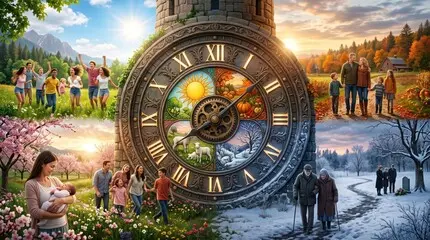
Every Season Comes With Expectations
Every season of life seems to come with an unspoken expectation. Our careers should be accelerating, our homes should be Pinterest-worthy, our outfits should coordinate with our children's, who are expected to charm everyone they meet, and our marriages should flourish with each passing year. Our Saturdays should include brunch with our girlfriends. We should be able to dedicate at least an hour to working out while our bank accounts comfortably support nourishing food. And if one area slows down, we quietly wonder whether we've fallen behind.
It's an exhausting way to live.
All of these things are good. Perhaps, for some, the expectations are a bit high, but the intention behind them reflects the ideal—the white-picket-fence, all-American dream. It's also a tremendous amount of pressure because we've come to believe that every good thing should reach its fullest expression at the same time.
I'm beginning to wonder if that's the lie.
Not long ago, I found myself apologizing for the changes in my life and feeling as though I couldn't keep up.
"I haven't been writing much."
"All I do is wash dishes."
"I'm too tired to go out tonight—sorry."
None of those statements were complaints. They were simply true. Yet somehow they always felt as though they required an explanation, as if a slower season needed a defense.
This Season of My Life
This season of my life looks very different from the one before it. My days are filled with chasing little feet, diaper changes, laundry, bedtime routines, and the thousand small moments that make up family life. Another baby is on the way, and my calendar no longer belongs entirely to me.
Honestly, I'm grateful for that and wouldn't have it any other way.
I chose this season. But choosing one thing inevitably means saying no to another. That's true for all of us.
Whether you're leading a company, building a business, caring for aging parents, raising young children, pursuing graduate school, or navigating an unexpected hardship, life eventually confronts us with competing goods.
I've come to believe life is less about choosing between good and bad and more about choosing between good and good.
The difficult question isn't, "What do I value?" It's, "What deserves my fullest attention right now?"
Good Versus Good
For a while, I assumed one of the sacrifices this season required was my intellectual life. Before motherhood, I spent hours after work reading and journaling. My time was my own, and it was flexible.
I can't say the same anymore.
Instead of waking to an alarm set according to my own schedule, my son's cries determine when it's time to hit the ground running—and it's usually long before I would have set that alarm.
It didn't take long after becoming a mother to realize the life I once knew was quickly disappearing. With it, I imagined my endless ideas piling up somewhere beyond reach, waiting patiently for a future version of me with uninterrupted afternoons and quiet mornings once again.
Nearly two years later, that future has yet to arrive. Interruption has become the rhythm of my days.
Then something shifted.
I began using artificial intelligence.
Not to become more productive or to work faster. Honestly, my output probably hasn't changed much at all.
What changed was something much harder to measure.
I no longer felt like I was losing the thread.
I could hold on to my imagination even while dishes piled up in the sink. Ideas that once would have disappeared into the chaos of an interrupted day could be picked back up days later. Questions could remain open. Conversations could continue. Curiosity no longer depended on having three uninterrupted hours and a clean desk.
The technology didn't remove the interruptions.
It simply helped me remain in conversation with my ideas until I could return to them.
A Story About Stewardship
That may sound like a small thing.
To me, it has felt like a gift.
The more I've reflected on it, the more I've realized this isn't really a story about artificial intelligence.
It's a story about stewardship.
We often think of stewardship as making the most of our time, money, or talents. I'm beginning to think it also means receiving the season we've been given with gratitude instead of constantly wishing we were living another one.
Through my transition from climbing the corporate ladder to choosing to stay home with my children, I've realized that life moves through many seasons and rhythms.
You may be graduating from college and preparing to enter the workforce. You may be buying your first home, knowing it will require countless repairs. Or perhaps you've reached the height of your career and find yourself wondering, What's next?
Regardless of our vocation, the principle remains the same.
There are seasons for building, learning, leading, and caregiving. Seasons of quiet faithfulness that no one applauds, and seasons when we're called to stand on the stage.
For me, even with the newfound ability to preserve ideas that once felt fleeting, I realized it wasn't really about the ideas themselves.
It was about what they represented.
As they accumulated, they became evidence that I was still me.
Motherhood hadn't replaced the woman who loved philosophy, writing, and long conversations. It had simply reordered my days.
Those parts of me hadn't disappeared.
They had simply grown quieter for a season.
Perhaps that's true for many of us.
Carrying the Same Self
We often speak about seasons as though they require us to become someone new.
But I wonder if maturity is less about reinventing ourselves than faithfully carrying the same self through changing responsibilities.
The person I was before motherhood isn't gone.
She's simply becoming a mother.
And when this season changes again, I won't have to rediscover myself.
I'll still be here.
I'll simply be better prepared to continue building my story in a new season.
As it turns out, a meaningful life isn't one in which every part of us grows at the same pace.
It's one in which our priorities are ordered well enough that we can give ourselves fully to what matters most today without believing we've lost ourselves—or what will matter tomorrow.
Perhaps that's why I've become so interested in the relationship between people and technology.
I didn't build my career in AI because I believe technology can help us do everything. I'm the first to admit it cannot.
For starters, it cannot eliminate the sacrifices every meaningful life requires.
Yet every meaningful life still requires choosing.
What technology can do, when we use it wisely, is help us make different sacrifices.
In my case, it has preserved the thread until I had the capacity to pick it up again.
I don't see AI—or any technology—as an escape from the limits of being human. Rather, I see it as a support that allows us to inhabit those limits more faithfully.
Whatever Your Season
Whatever your season, I hope you know this:
Not everything meaningful has to be growing at the same rate to be considered successful.
Some parts of our lives lead for a season while others wait patiently in the background.
That isn't failure.
It's rhythm.
Perhaps wisdom is less about trying to become everything all at once and more about learning to recognize what this season is asking of us, then trusting that what is planted deeply today will still be there when tomorrow asks something different.
Maybe that's what we're really hoping for.
Not lives where every dream unfolds at once, but lives that remain whole through every season.
Where ambition gives way to caregiving without resentment, and caregiving gives way to leadership without regret.
Where learning never ends, even when it slows.
Where the thread of who we are is never broken, only woven into something richer with time.
In the end, I don't think the goal is to have it all.
I think it's to become someone integrated and whole—someone who can faithfully carry what matters most through every season they're given.


