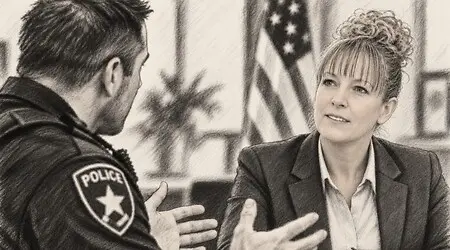
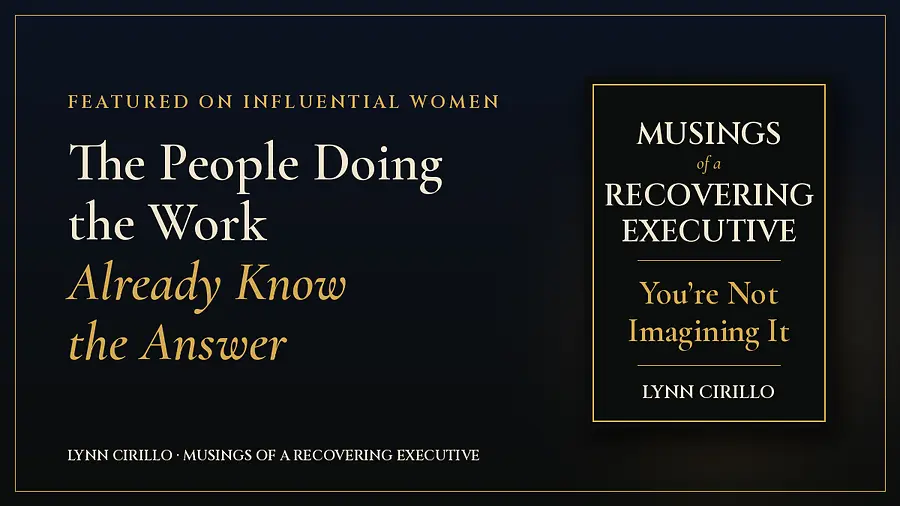
The People Doing the Work Already Know the Answer
How leaving frontline workers out of decisions creates costly cycles of rework, eroded trust, and wasted potential.

So many workplace problems could be avoided if decisions were simply made with the people who do the actual work. Here's why leaving them out keeps teams spinning their wheels, and what to do instead.
By Lynn Cirillo
You've probably seen it happen. A new process gets announced on a Monday. By Wednesday, the people expected to use it have found three reasons it won't work. By Friday, they've built a workaround. A month later, leadership is frustrated that "adoption is low," schedules another meeting, and rolls out a fix. The fix creates two new problems. And around it goes.
Nobody in that story is lazy. Nobody is trying to fail. The problem started long before the rollout, in a room where the decision was made without the people who do the actual work.
I've watched this cycle play out across corporate America more times than I can count. It's one of the most common, most expensive, and most avoidable problems I know of. And it rarely gets named for what it is.
The Cycle Nobody Means to Create
Here is how the spinning usually works.
A decision is made at a distance. The people deciding are smart and well-intentioned, but they're working from reports, dashboards, and assumptions, not from the daily reality of the job.
The people closest to the work see the gaps immediately. They know which step will break, which customer will be confused, and which system doesn't talk to the other one. Nobody asked them.
The gaps show up as "resistance." When those people raise concerns after the fact, it can sound like complaining. So it gets treated as a change-management problem instead of what it really is: information that arrived too late.
Rework begins. Time, money, and goodwill go into fixing something that could have been designed right the first time.
Trust erodes. And the next time a decision comes down, people are a little more tired, a little more skeptical, and a little less willing to speak up.
That's the endless loop. Lots of motion. Very little forward movement.
Why It Keeps Happening
I don't believe most leaders exclude people on purpose. More often, it comes from pressures that feel perfectly reasonable in the moment.
Speed. Asking feels slow. Deciding feels efficient. Until the rework starts, and the "fast" decision turns out to be the slowest path of all.
Distance. The higher a decision travels, the farther it gets from the details. What looks simple on a slide can be anything but on the ground.
Habit. In many organizations, decisions have always been made in a certain room, by a certain group. No one questions it, so no one changes it.
Discomfort. Inviting input means hearing things you may not want to hear. It means admitting you don't have every answer. For some leaders, that feels like a risk to their credibility. In reality, it's one of the strongest ways to build it.
What It Does to People
The cost isn't only operational. It's personal.
In You're Not Imagining It, the sixth book in my series, I describe the small things that wear people down over time, including "A conversation you weren't included in. A decision that seemed to have been made long before anyone asked for your input." None of those moments seems big enough to challenge on its own. Together, they send a clear message: your experience doesn't count here.
When people learn that message, they adapt. As I wrote in the book, instead of asking, "What is the best decision?" they begin asking, "What decision is least likely to get me in trouble?" The people with the most practical knowledge stop offering it. Not because they don't care, but because they've learned it doesn't change anything.
That's the quiet tragedy of the cycle. The expertise is right there, in the building, on the team, at the desk down the hall. It just never makes it into the room where it's needed.
A Simple Framework for Leaders: The Work-First Loop
Including people doesn't mean every decision becomes a committee vote. It means the people who do the work help shape the decisions that change their work. Here's a simple approach I call The Work-First Loop.
1. Ask before you decide. Before a decision is final, go to the people who will live with it. Ask: What will this make harder? What are we missing? What would you do? Ask early enough that their answers can still change the outcome.
2. Listen to understand, not to defend. When someone raises a concern, resist the urge to explain why it won't be a problem. Get curious. The objection you're tempted to dismiss may be the one that saves you months.
3. Decide out loud. Not every suggestion will be used, and that's okay. What matters is that people understand how the decision was made, what input shaped it, and why. Transparency turns "they decided" into "we decided."
4. Close the loop. Go back to the people you asked. Tell them what you heard and what changed because of it. Then check in after the decision is in motion. This is the step most often skipped, and it's the one that builds the trust that makes the next conversation easier.
Questions for Leaders to Sit With
- Who will be most affected by the last decision I made? Did I talk to them before it was final?
- When people raise concerns after a rollout, do I treat it as resistance or as information?
- Is there someone on my team who used to offer ideas and has gone quiet? When did that start?
- How many times have we "fixed" the same problem this year?
If You're the One Who Keeps Getting Left Out
If decisions about your work keep landing on your desk fully formed, I want you to hear this: you are not imagining it, and you are not being difficult for noticing.
Feeling unheard is exhausting. It can make you question whether your perspective matters, or whether you're just not "strategic" enough to be in the room. Please don't let a broken process convince you that your knowledge isn't valuable. The fact that you can see what's going to go wrong is a skill, not a flaw.
A few things that may help:
Write down what you see. When a decision is coming, note the specific risks and your suggestions, plainly and calmly. It helps you get clear, and it gives you something concrete to share.
Offer input before it's requested. Sometimes the door opens because someone knocked. A short note like "Before this is finalized, here's what I'm seeing from the front line" can be hard to ignore.
Frame it around the outcome. Leaders tend to listen when concerns are tied to what they care about: time, cost, customers, and results.
Find your allies. You're rarely the only one who sees the problem. A shared perspective carries more weight than a lone voice.
Notice the pattern, and protect your energy. If you've spoken up again and again and nothing changes, that tells you something about the environment, not about your worth. You get to decide how much more of yourself you put into a system that won't listen.
Moving Forward Instead of Around
The good news is that this is one of the most fixable problems in the workplace. It doesn't take a reorganization or a new software platform. It takes a willingness to ask, to listen, and to bring the people who do the work into the decisions about that work.
When that happens, something shifts. Fewer workarounds. Less rework. More ownership. People who feel heard tend to bring their best thinking forward, and teams finally stop spinning their wheels and start moving.
You're Not Imagining It is the sixth book in my Musings of a Recovering Executive series. It's about toxic workplaces, gaslighting, and reclaiming confidence: noticing what's happening, understanding the pattern, and finding your way back to yourself. You can learn more at https://MusingsOfaRecoveringExecutive.com/books/youre-not-imagining-it/.
About the Author
Lynn Cirillo is an author and the founder of Grounded Leadership LLC. I help people trust themselves again at work and in life, and stop measuring their worth by how much they can carry. I'm over 55, I still live with imposter syndrome, and I write about both because pretending otherwise helps no one. Learn more at https://MusingsOfaRecoveringExecutive.com/.

Lynn Cirillo is an author, leadership mentor, and Founder and Principal of Grounded Leadership, LLC in Cheyenne, Wyoming. She brings nearly 40 years of professional experience across commercial real estate, corporate operations, research, and technology. Her six-book nonfiction series, Musings of a Recovering Executive, explores the journey from burnout and reinvention to boundaries, identity, neurodiversity, and…