The Question That Changed My Career: What If the Problem Was Never Disability?
From Deficit to Dignity: Reimagining Disability Justice in Higher Education and Healthcare

"No one builds their lives on remediated weaknesses. No one." — Kristie K. Patten (2022)
For decades, disability has been viewed through a deficit-based lens. Whether in healthcare, education, or the workplace, the first question has often been: What needs to be fixed?
This question has shaped professional practice, educational policy, and institutional culture for generations. Although often asked with good intentions, it reflects a deeper assumption—that disability is primarily an individual problem rather than a reflection of systems designed around narrow definitions of normalcy.
As healthcare professionals, many of us were trained to identify impairments, limitations, and functional deficits. Our role was to restore function, improve independence, and reduce disability-related challenges. These goals remain important. However, they are no longer sufficient. The growing scholarship on disability justice and neurodiversity invites us to ask a different question:
What if the greatest barriers people experience are not their diagnoses, but the environments designed without them in mind?
The Deficit Model Is No Longer Enough!
Traditional healthcare has achieved remarkable advances in rehabilitation and clinical care. Yet disability is more than a medical experience.
It is also an educational experience.
A social experience.
A cultural experience.
A political experience.
When disability is viewed only through the lens of impairments, institutions often overlook the environments that create exclusion. Students struggle not because they are incapable, but because educational systems frequently reward one way of learning, one pace of working, and one definition of success.
Quigley et al. (2024) argue that, despite growing commitments to equity and inclusion, there remains "a gap between rhetoric and reality concerning neurodiversity." Universities increasingly embrace the language of strengths and diversity, yet many continue operating according to neurotypical assumptions that unintentionally disadvantage neurodivergent students (Quigley et al., 2024).
Changing the language without changing the system is not transformation. It is rebranding.
The Invisible Cost of Ableism
Perhaps the greatest consequence of ableism is not only exclusion—it is internalization. When students repeatedly encounter environments that question their competence, require them to justify accommodations, or measure success using rigid definitions of productivity, those messages gradually become personal beliefs.
Over time, external stereotypes become internal narratives.
Many students begin asking themselves:
"Maybe I don't belong here."
Disability justice reminds us that this question should never belong to the student.
It belongs to the institution.
Accommodation Is Not the Finish Line
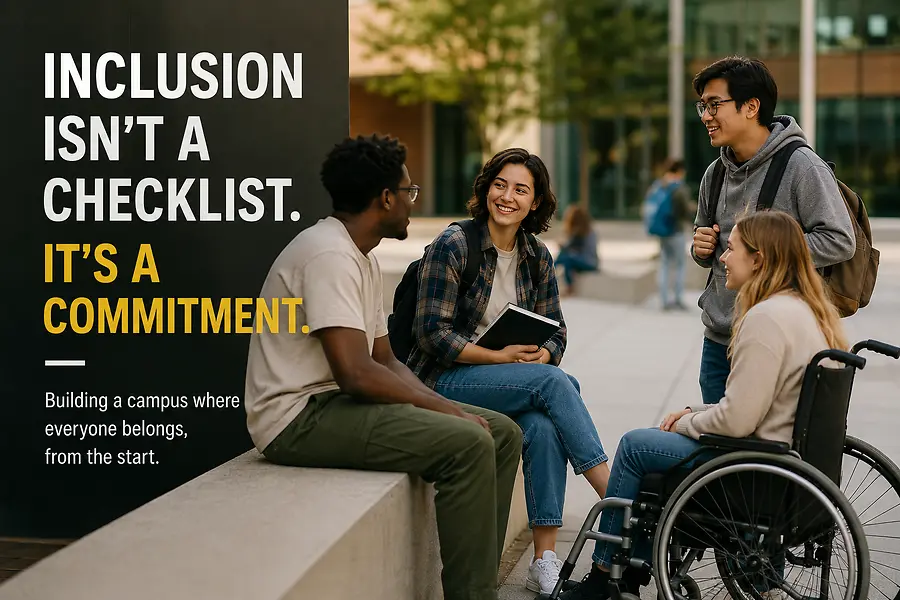
For many universities, disability inclusion is measured by accommodation processes. But accommodation is only one step. Accommodation asks, How can we help this student succeed within our existing system? Disability justice asks a far more transformative question: Why was the system designed to exclude people in the first place?
Otis (2025) challenges higher education to move toward collective access, where accessibility is embedded into educational design from the beginning rather than added after barriers appear. Similarly, disability justice shifts our attention from compliance toward belonging—from individual adjustments to institutional transformation.
Belonging should never depend on disclosure. It should never depend on documentation. And it should never depend on how closely someone approximates society's definition of "normal."
Disability Justice Is a Leadership Framework
One of the most powerful lessons emerging from disability scholarship is that disability justice extends far beyond disability itself. Ramirez-Stapleton, Porter, and Kennedy (2025) describe disability justice as "a way of life," emphasizing that justice cannot be separated from race, culture, identity, or community. They also remind us that "both communities have fought to be seen as human in this world," highlighting the deep connections between disability justice and broader struggles for equity. This perspective fundamentally changes how institutions should think about inclusion. Rather than asking disabled students to adapt to higher education, disability justice asks higher education to become more responsive to human diversity.
What This Means for Healthcare Professionals
This conversation is especially important for those of us working in rehabilitation, physical therapy, occupational therapy, speech-language pathology, psychology, and medicine. Clinical expertise will always matter. But perhaps our future contribution extends beyond helping people function within existing systems.
Perhaps our responsibility is also to help redesign those systems.
Healthcare professionals understand adaptation.
Higher education needs that same mindset.
Instead of asking, "How can students adapt?" perhaps we should begin asking, "How can institutions evolve?"
"Difference is a natural and indeed important aspect of life." (Quigley et al., 2024)
That sentence represents far more than a philosophical statement.
It represents a new educational paradigm.
One where diversity is expected rather than accommodated.
One where disability is recognized as expertise rather than deficiency.
One where belonging is designed into institutions rather than earned by individuals.
Perhaps the future of higher education is not about helping students become more "normal." Perhaps it is about building institutions that recognize human diversity as the foundation of learning rather than the exception.
Because when we stop asking people to fit our systems, we finally begin creating systems worthy of the people they are meant to serve.


