The Rise of Agentic Commerce and Autonomous Customer Journeys
How AI-powered autonomous systems are transforming enterprise customer engagement through intelligent orchestration and responsible governance.

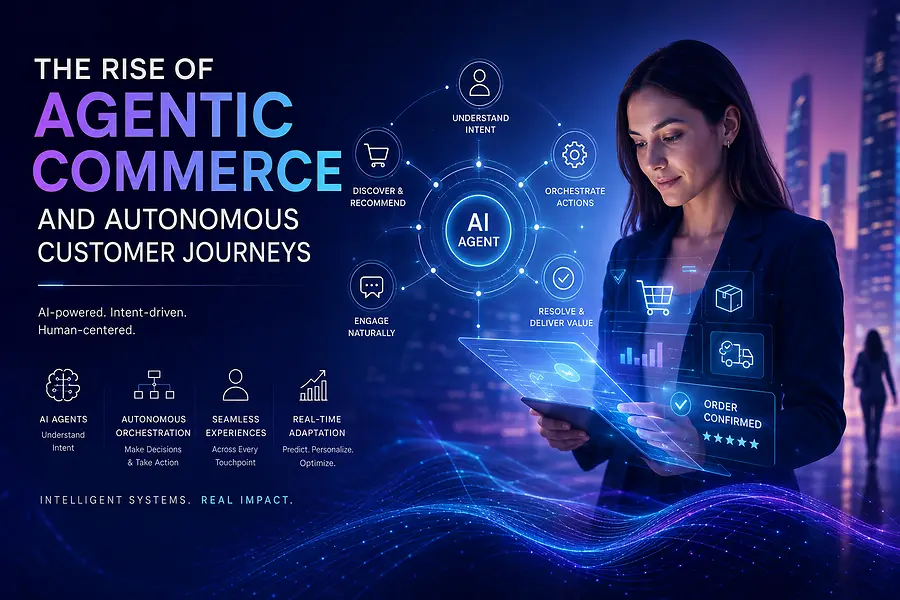
The Future of Customer Engagement: The Rise of Agentic Commerce
For more than a decade, digital transformation has focused on improving customer-facing experiences—modern websites, mobile applications, omnichannel engagement, personalization engines, and real-time marketing. Organizations have invested heavily in making interactions faster, more intuitive, and more connected.
Today, however, enterprise customer engagement is entering a fundamentally different phase.
Artificial intelligence is evolving from a reactive support capability into an autonomous decision-making layer embedded directly into the customer journey itself. The next evolution of digital commerce is not simply smarter automation—it is agentic commerce, a model where intelligent systems can independently interpret customer intent, orchestrate business processes, initiate actions, and continuously optimize experiences in real time.
This shift represents one of the most significant transformations in customer experience strategy since the rise of digital commerce itself.
According to McKinsey & Company, organizations are rapidly expanding AI adoption across customer operations, marketing, service delivery, and business decision-making as AI capabilities become increasingly integrated into enterprise workflows. At the same time, Gartner predicts that AI agents and autonomous systems will play a growing role in enterprise operational execution over the next several years.
From Personalization to Autonomous Orchestration
The first generation of AI-driven customer engagement focused primarily on personalization:
- Product recommendations
- Predictive targeting
- Dynamic content
- Chatbots
- Marketing optimization
While these capabilities improved customer interactions, they still required customers to actively navigate processes themselves.
Agentic commerce changes that model entirely.
In autonomous customer journeys, AI systems do not merely respond to requests—they proactively coordinate experiences across interconnected enterprise systems.
A future customer interaction may look like this:
- An AI system identifies a billing anomaly before the customer notices it
- A personalized resolution workflow is automatically initiated
- Communication preferences are dynamically selected
- Service agents receive contextual intelligence in real time
- Predictive recommendations are continuously updated based on behavioral signals
- Resolution paths adapt automatically based on customer sentiment and intent
The customer is no longer navigating disconnected systems. Instead, the ecosystem intelligently orchestrates around the customer.
This emerging model is being accelerated by advances in:
- Generative AI
- Large language models (LLMs)
- Real-time customer data platforms (CDPs)
- Event-driven architectures
- Intelligent workflow orchestration
- Agent-based automation frameworks
- API-first, composable commerce ecosystems
Industry analysts increasingly describe this transition as the movement from “systems of record” to “systems of intelligence,” where AI continuously interprets operational and customer data to optimize enterprise decision-making in real time.
Why Agentic Commerce Matters
The rise of agentic commerce is not just about improving convenience. It directly impacts:
- Customer loyalty
- Operational efficiency
- Revenue growth
- Brand trust
- Enterprise scalability
Modern customers expect:
- Frictionless experiences
- Immediate responsiveness
- Hyper-personalization
- Context-aware engagement
- Proactive service resolution
Traditional enterprise architectures struggle to deliver these expectations consistently because customer data, operational workflows, and communication systems often remain fragmented across disconnected platforms.
Autonomous customer journeys help close that gap by enabling intelligent coordination between systems that historically operated independently.
For enterprises, the potential benefits are substantial:
- Reduced operational overhead
- Faster issue resolution
- Improved customer retention
- Increased conversion rates
- Better workforce productivity
- More scalable engagement models
According to the IBM Institute for Business Value, organizations implementing AI-enhanced customer service and intelligent automation are already reporting measurable improvements in efficiency, responsiveness, and operational scalability.
The Governance Challenge
Despite the excitement surrounding AI-driven automation, the most important challenge facing enterprises today is not technological capability.
It is trust.
As AI systems become increasingly autonomous, organizations must determine:
- When AI should act independently
- When human oversight is required
- How decisions are validated
- How bias is mitigated
- How customer transparency is maintained
- How governance frameworks are enforced across distributed systems
This is especially critical in highly regulated industries such as:
- Healthcare
- Energy
- Financial services
- Insurance
- Public sector organizations
In these environments, customer engagement systems are deeply interconnected with operational platforms, compliance requirements, and sensitive data ecosystems.
Without strong governance, autonomous systems can introduce:
- Security vulnerabilities
- Regulatory exposure
- Customer distrust
- Inconsistent decision-making
- Operational risk
The future of agentic commerce therefore depends not only on AI innovation, but on responsible AI leadership.


According to the World Economic Forum and the NIST AI Risk Management Framework, organizations adopting AI at scale increasingly require governance models focused on transparency, resilience, accountability, and human oversight.
The Rise of Human-Centered Autonomous Experiences
One of the biggest misconceptions about autonomous customer journeys is that they eliminate the need for human interaction.
In reality, the opposite is true.
As AI handles more operational complexity, human engagement becomes even more valuable in moments that require:
- Empathy
- Judgment
- Relationship-building
- Exception handling
- Strategic guidance
The most successful organizations will not replace human interaction with AI. They will use AI to enhance human experiences by removing friction, simplifying complexity, and enabling employees to focus on higher-value customer engagement.
This is where enterprise leadership becomes essential.
Technology alone cannot create trusted customer experiences. Organizations must intentionally design systems that balance:
- Automation with accountability
- Intelligence with transparency
- Efficiency with empathy
- Scale with personalization
- Innovation with resilience
The enterprises that succeed in this next phase of digital transformation will be those that treat AI not simply as a technology initiative, but as an enterprise-wide operating model transformation.
Preparing for the Future of Commerce
The future of customer engagement will be increasingly autonomous, predictive, and intelligent.
AI agents will continue evolving from isolated assistants into interconnected orchestration layers capable of coordinating customer experiences across:
- Commerce platforms
- Service systems
- Marketing ecosystems
- ERP environments
- Contact centers
- IoT ecosystems
- Enterprise operations
Organizations that modernize now by investing in:
- Real-time data architectures
- Composable platforms
- AI governance
- Secure APIs
- Event-driven ecosystems
- Responsible automation frameworks
will be significantly better positioned to adapt as autonomous experiences become mainstream.
The rise of agentic commerce is not merely a technology trend.
It represents a broader transformation in how enterprises build relationships with customers, operate digital ecosystems, and create long-term business value.
And while AI may increasingly power the infrastructure of customer engagement, trust will remain the defining currency of the customer experience economy.


